BWSSB Expansion: Bengaluru Urban District Comes Under Water Board Limits
Synopsis
Karnataka has expanded BWSSB limits to cover the entire Bengaluru Urban district. The board will oversee drinking water, drainage and sewage infrastructure, while newly added areas will continue to depend on groundwater for now.
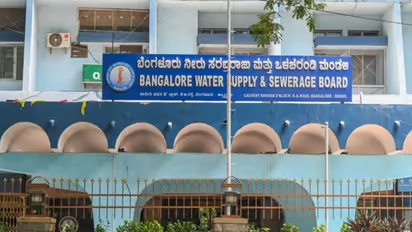
The Karnataka government has expanded the limits of the Bangalore Water Supply and Sewerage Board (BWSSB) to cover the entire Bengaluru Urban district. The state government issued a notification on Thursday, bringing the expanded areas under the water board's jurisdiction. The move is expected to significantly expand the city's drinking water supply and underground drainage network as the BWSSB takes responsibility for areas beyond its earlier limits.
The BWSSB previously managed an area of around 800 sq km, covering seven City Municipal Councils (CMCs), one Town Municipal Council (TMC) and 110 villages. Under the new notification, the entire Bengaluru Urban district will now fall within the BWSSB limits.
BWSSB To Take Charge Of Water And Drainage
The BWSSB will now be responsible for planning, implementing and maintaining drinking water supply systems across the expanded area. The board will also oversee underground drainage facilities and sewage treatment plants for the safe disposal and treatment of wastewater.
The entire areas of Bengaluru North, Bengaluru East, Bengaluru South, Yelahanka and Anekal taluks, along with the district boundaries, will now come under the BWSSB's jurisdiction.
The new rules came into effect on Thursday. The government has directed the concerned departments to prepare a long-term plan for drinking water supply and drainage infrastructure across Bengaluru Urban district.
The state government initiated the expansion to provide essential urban infrastructure, including drinking water and drainage facilities, in areas experiencing rapid urbanisation.
Joint Plan For Areas Outside GBA Limits
Officials from the BWSSB, Bengaluru Metropolitan Region Development Authority (BMRDA) and Minor Irrigation Department recently held a meeting to discuss ways to provide city-like infrastructure to areas outside the Greater Bengaluru Area (GBA) limits.
The government has directed the BWSSB to assess drinking water requirements for the period beyond 2030. The exercise will cover not only water demand but also the infrastructure required to meet future needs.
The board will prepare plans for water storage facilities, treatment plants and distribution networks. The project will also include underground drainage systems and wastewater treatment plants, which will be developed in phases.
Officials will jointly prepare a master plan for the entire Bengaluru Urban district located outside the GBA limits.
No Cauvery Water For Now
The newly added villages will not receive Cauvery drinking water immediately. For the time being, these areas will continue to depend on groundwater sources.
Officials plan to recharge groundwater and improve water levels in lakes around the GBA by using treated wastewater. The government has already instructed the Minor Irrigation Department to initiate these measures.
The expansion is aimed at creating a long-term water and sanitation framework for Bengaluru Urban district, while immediate water requirements in the newly added areas will continue to be met through existing groundwater sources.
Stay updated with the Breaking News Today and Latest News from across India and around the world. Get real-time updates, in-depth analysis, and comprehensive coverage of India News, World News, Indian Defence News, Kerala News, and Karnataka News. From politics to current affairs, follow every major story as it unfolds. Download the Asianet News Official App from the Android Play Store and iPhone App Store for accurate and timely news updates anytime, anywhere.