NASA's Webb Spots Life’s Chemical Ingredients Frozen in a Neighboring Galaxy
Synopsis
NASA’s Webb found complex organic molecules, including acetic acid, frozen around a young star in the Large Magellanic Cloud, showing that life’s chemical ingredients can form in harsh, metal-poor environments similar to those in the early universe.
Astronomers using the James Webb Space Telescope (JWST) have detected complex organic molecules — including acetic acid, the key ingredient in vinegar — frozen around a young star in the Large Magellanic Cloud, a small galaxy near the Milky Way. It’s the first time acetic acid has ever been observed beyond our galaxy.
Detecting Life’s Ingredients in Cosmic Ice
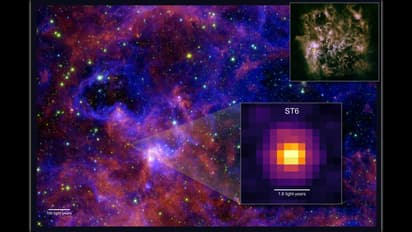
Led by Dr. Marta Sewiło of the University of Maryland and NASA, the team used JWST’s Mid-Infrared Instrument (MIRI) to study a forming star known as ST6. They found five carbon-based compounds — methanol, ethanol, methyl formate, acetaldehyde, and acetic acid — trapped in icy layers around the protostar.
Before Webb, methanol was the only complex organic molecule ever confirmed in ice around young stars, even within our Milky Way. The telescope’s incredible sensitivity allowed scientists to detect these faint signatures with unprecedented clarity.
A Harsh Galaxy, a Surprising Chemistry
The discovery’s location makes it even more remarkable. The Large Magellanic Cloud (LMC) has far fewer heavy elements and harsher radiation than the Milky Way — conditions similar to the early universe. Despite that, Webb’s data show life’s chemical precursors can still form and survive there.
“This tells us complex organic chemistry thrives even in primitive environments,” Sewiło said. “It means the seeds of life could have formed much earlier and under more extreme conditions than we imagined.”
Rewriting the Timeline of Life’s Origins
Co-author Will Rocha of Leiden University added that these compounds likely formed in icy layers coating dust grains, later released into gas — a key process for planetary and prebiotic chemistry.
Finding such molecules in a low-metallicity galaxy suggests that life’s building blocks are cosmic and ancient, possibly arising in the universe’s earliest galaxies.
Sewiło’s team plans to observe more protostars in both the Large and Small Magellanic Clouds to see how common these life-linked molecules are. The research, published in The Astrophysical Journal Letters, opens a new era in understanding how and where the chemistry of life begins.