New Gamma-Ray Halo Signal May Be the First-Ever Direct Evidence of Dark Matter
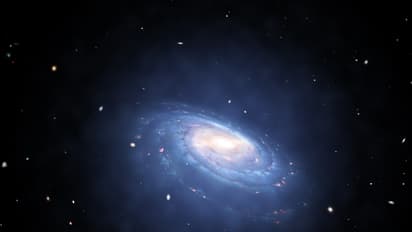
Synopsis
A newly detected gamma-ray halo around the Milky Way may be the first direct hint of dark matter. NASA’s Fermi telescope spotted an intense glow matching predictions for colliding dark-matter particles, igniting major scientific debate.
Scientists may have captured humanity’s first direct glimpse of dark matter — the invisible substance believed to make up nearly 25% of the universe. Using 15 years of data from NASA’s Fermi Gamma-ray Space Telescope, Professor Tomonori Totani from the University of Tokyo has identified an intense, halo-like glow of high-energy gamma rays surrounding the Milky Way.
This eerie emission matches predictions for what should happen when two WIMPs — weakly interacting massive particles — collide and annihilate. For decades, dark matter has only been detected indirectly through its gravitational effects. But Totani believes this newly mapped halo could be the first time we are actually “seeing” dark matter’s radiation.
Why This Halo Is Different
Researchers have long studied a faint gamma-ray glow at the galaxy’s heart, known as the Galactic Centre (GC) excess. But Totani’s halo signature stands out:
- It is far more spread out than the GC excess
- It is 10× more powerful
- No known stars, black holes, or astrophysical processes can easily explain such intense energy
Independent experts say the signal fits neatly with theoretical predictions for dark-matter particles colliding and releasing gamma-ray photons. Dr. Moorts Muru notes that “none of the known stellar objects” could create such extreme energy levels.
Debate Within the Scientific Community
Despite the excitement, not everyone agrees the signal confirms dark matter. Some physicists argue the energy could have been produced by ancient explosions from the Milky Way’s central black hole, which formed the massive Fermi bubbles. These violent shockwaves can accelerate charged particles, possibly creating a similar gamma-ray glow.
Professor Joe Silk cautions that if Totani’s interpretation is correct, similar signatures should also appear in dark-matter-rich dwarf galaxies — something not yet observed.
Totani acknowledges the need for more evidence but remains confident that future observations will either support or sharpen his theory. For now, the discovery has ignited one of the most thrilling debates in modern astrophysics.