Mysterious Giant Structures Hidden Deep Inside Earth May Reveal How Life Began
Synopsis
What lies 3,000 km beneath us? A new study reveals how a leaking core may have formed mysterious deep-Earth structures, influencing the origins of life on our planet.
For many years, scientists have been fascinated by two massive, mysterious structures that lie deep within our planet. These unusual formations are located so far beneath the surface and behave in such a different way compared to the rest of Earth’s interior that the usual theories about how the planet formed have never fully explained them.
Now, a new study published in Nature Geoscience may finally offer an answer. Led by Yoshinori Miyazaki, a geodynamicist at Rutgers University, the research team proposes a new explanation for where these features originated and what they can tell us about how Earth became a planet capable of supporting life.
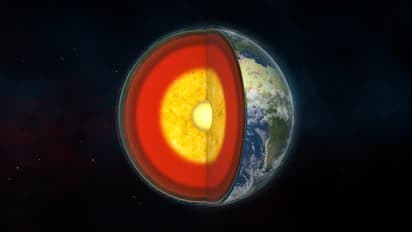
These deep structures are known as large low-shear-velocity provinces and ultra-low-velocity zones. Both are located at the boundary between Earth’s mantle and its core, nearly 3,000 kilometres underground. The large low-shear-velocity provinces are huge masses of unusually hot, dense rock, one beneath Africa and one beneath the Pacific Ocean. The ultra-low-velocity zones, in contrast, are thin, partly molten regions sitting directly on top of the core, almost like puddles.
What connects them is how they affect seismic waves. When earthquakes send vibrations through the Earth, these two types of structures significantly slow down the waves, suggesting they are made of material unlike anything else in the surrounding areas.
Clues from Earth’s Molten Beginnings
Scientists widely agree that in its very early history, Earth was covered by a vast ocean of molten rock, known as a magma ocean. As this ocean cooled and solidified, many expected the mantle to settle into neat chemical layers. But this tidy pattern is not what we see today.
Instead, seismic studies show the lower mantle is lumpy and irregular, with the two giant structures forming strange piles at the bottom. This inconsistency has been a long-standing puzzle.
Leaking Material from the Core
The team suggests that the “missing piece” is the core itself. According to their model, over billions of years, the core has slowly leaked tiny amounts of elements, such as silicon and magnesium, into the mantle. This gentle but continuous mixing would have blurred any clean chemical layers that formed early on.
More importantly, this leaking could explain the unusual composition of the large low-shear-velocity provinces and ultra-low-velocity zones. The researchers believe these two structures may be the cooled remains of a long-lost “basal magma ocean” that once sat at the very bottom of the mantle and became chemically altered by materials rising from the core.
Why This Matters for Life on Earth
This theory has implications far beyond rock chemistry. The exchange of material between the core and mantle likely influenced how Earth cooled over time, how volcanoes formed, and how gases were released into the atmosphere. These deep processes may have helped shape the conditions that eventually made life possible.
A New Way of Seeing Earth’s Interior
By using seismic data, mineral physics, and computer simulations, the researchers have reframed these deep-Earth features not as odd leftovers, but as key evidence of how the planet formed.
Their work also suggests these structures could play a role in powering volcanic hotspots like Hawaii and Iceland, linking the deepest layer of the mantle to activity on the surface. Although many questions remain, each new insight helps scientists reconstruct the planet’s earliest history.