Mysterious Glow in Milky Way Could Be First Evidence of Dark Matter
Synopsis
Scientists may have spotted dark matter for the first time as a mysterious gamma-ray glow at the center of the Milky Way could reveal where the elusive substance hides, offering new insights into the universe.
For decades, dark matter has remained one of the universe’s greatest mysteries. Though it accounts for roughly 25% of the cosmos, this elusive substance has never been directly observed—until now, researchers suggest.
Gamma-Ray Glow Offers a Clue
A new study from Johns Hopkins University and the Leibniz Institute for Astrophysics points to a strange glow of gamma rays coming from the center of the Milky Way as a potential signature of dark matter.
Unlike ordinary matter, dark matter doesn’t emit light or energy. However, when dark matter particles collide, they produce bursts of gamma rays. “Gamma rays, and specifically the excess light we’re observing at the center of our galaxy, could be our first clue,” said Professor Joseph Silk, co-author of the study. He added, “Dark matter dominates the universe and holds galaxies together. It’s extremely consequential, and we’re constantly thinking of ways to detect it.”
Hunting Dark Matter with Fermi
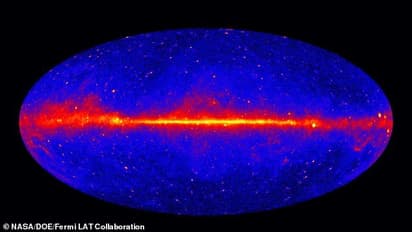
Since 2008, NASA’s Fermi Gamma-ray Space Telescope has been mapping the Milky Way in unprecedented detail. Scientists noticed an unusual diffuse glow of gamma rays at the galactic center—light that didn’t appear to come from any known source.
Initially, researchers proposed two possible explanations: the radiation could either originate from spinning cores of dying stars, called millisecond pulsars, or from colliding dark matter particles. Figuring out which was correct has been a challenge.
Simulating the Milky Way
The new study, published in Physical Review Letters, used supercomputer simulations to map where dark matter should exist in the galaxy, taking into account the Milky Way’s formation history. Professor Silk explained: “Our galaxy formed from a vast cloud of dark matter. Ordinary matter cooled and fell into the central regions, dragging along some dark matter for the ride. Over billions of years, this process increased the number of dark matter collisions in the galactic core.”
By comparing these simulations to Fermi’s gamma-ray data, researchers found a striking match. Lead author Dr. Moorits Muru of the Leibniz Institute for Astrophysics told the Daily Mail: “One challenge for the dark matter explanation was that previous models assumed it was perfectly spherical around the Galactic Center. In reality, our simulations show it’s flattened.”
A Step Closer to Proof
Although these findings are not yet definitive proof, they provide strong evidence that dark matter could be responsible for the gamma-ray glow. Dr. Muru noted: “This is not concrete proof, but it’s a step closer to understanding dark matter. Our results also make it less likely that the radiation is coming from millisecond pulsars.”
Looking forward, Professor Silk hopes the upcoming Cerenkov Telescope Array in Chile will help resolve the debate. “Detecting the same gamma-ray signal in nearby dwarf galaxies would strongly support the dark matter hypothesis,” he said. The new telescope, poised to be the world’s most powerful gamma-ray observatory, could finally confirm one of astronomy’s greatest mysteries.