This Odd Forest "Mushroom" Is Actually One of Nature’s Weirdest Plants
Synopsis
In the forests of Asia grows Balanophora, an organism that looks like a mushroom but is actually a parasitic plant. Learn how this ancient survivor lives without sunlight and defies the rules of evolution.
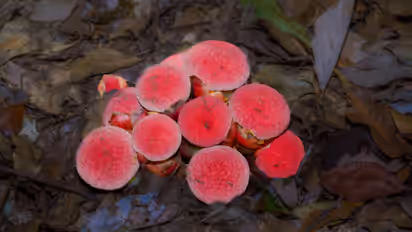
In the dark and damp forests of Taiwan, mainland Japan, and the islands of Okinawa, something unusual grows beneath the trees. At first, it appears similar to a mushroom rising from the forest floor. However, this strange-looking organism is not a fungus at all. It is a plant known as Balanophora, which defies almost every rule we typically associate with plants.
Unlike most plants, Balanophora does not have green leaves, stems, or the ability to produce its own food. It lacks chlorophyll, which means it cannot use sunlight to generate energy through photosynthesis. In fact, it barely resembles a typical plant. The findings were published in New Phytologist.
Parasitic Plant
Instead of growing roots in the soil, Balanophora survives by attaching directly to the roots of nearby trees. From there, it absorbs all the water and nutrients it needs. This makes it a fully parasitic plant, entirely dependent on its host for survival.
Despite its simple appearance, Balanophora produces some of the smallest flowers and seeds found in the plant world. Some species even have the ability to create seeds without being fertilized, a rare trait among plants.
A Plant That Confused Scientists
Balanophora has puzzled scientists for centuries. Its name comes from Greek words meaning "acorn-bearing," referring to its rounded, knobbly shape. Because it only grows in very specific and hard-to-reach habitats, scientists have struggled to study it in detail. Many of these habitats are also at risk due to deforestation and human activity.
Now, a team of researchers from the Okinawa Institute of Science and Technology, Kobe University, and the University of Taipei has conducted the most comprehensive study of Balanophora to date.
The researchers found that Balanophora evolved from ordinary leafy plants millions of years ago. Over time, it lost many of the features that define modern plants while retaining just enough to function as a parasite.
Life Without Sunlight
Most plants rely on structures called chloroplasts to convert sunlight into energy. These structures are part of a group of cell components known as plastids. In parasitic plants, plastids often shrink or disappear as the plant becomes more dependent on its host.
Surprisingly, Balanophora has not completely lost its plastids. Instead, they have been reduced to a very basic form. While normal plants use around 200 genes to maintain their plastids, Balanophora uses only about 20. Even so, these tiny plastids are still active and receive hundreds of proteins from the rest of the cell.
This suggests that the plastids still perform important functions unrelated to photosynthesis, such as producing crucial chemicals needed for survival.
An Ancient Survivor
By comparing different populations, the researchers discovered that Balanophora belongs to one of the oldest known families of parasitic plants. This group began to diversify around 100 million years ago, during the age of the dinosaurs. This makes Balanophora one of the earliest land plants to completely abandon photosynthesis.
Balanophora’s method of reproduction is just as unusual as its lifestyle. Some species reproduce in the usual way, through fertilization. Others can reproduce both with and without fertilization. A few do not reproduce sexually at all and instead clone themselves through seed production.
This strategy, known as agamospermy, is uncommon in plants because it reduces genetic diversity and increases the risk of extinction. However, it may provide Balanophora with an advantage on islands. A single plant can create a new population, helping it spread into dark forest environments where few other plants can survive.
A Fragile Future
Despite its clever survival strategies, Balanophora is highly vulnerable. Each population depends on just a few specific tree species. If those trees disappear, the parasite cannot survive.
Although many of its habitats in Okinawa are protected, illegal collection and logging continue to pose serious threats. Scientists hope that by studying Balanophora now, they can better understand its biology before it disappears.
Balanophora is a powerful reminder that evolution does not follow simple rules. Even something that barely looks like a plant can be a highly specialized survivor, shaped by millions of years of adaptation in the shadows of the forest.