Can Xabi Alonso finally break Real Madrid's Spanish manager curse?

Synopsis
Xabi Alonso aims to break the long-standing curse of Spanish coaches at Real Madrid, where none have succeeded since Vicente del Bosque's departure in 2003.
Xabi Alonso's tenure as Real Madrid manager begins with no easy task: a match-up against a superior Barcelona side. But beyond the immediate challenge lies something far more daunting: a two-decade pattern of failure for Spanish managers at the Santiago Bernabeu.
Since Vicente del Bosque’s exit in 2003, no homegrown coach has managed to replicate the stability, let alone the silverware, that defined his reign. Now, Alonso carries the hopes of ending a dry spell that has come to feel more like a curse.
Del Bosque: The Last Great Spaniard
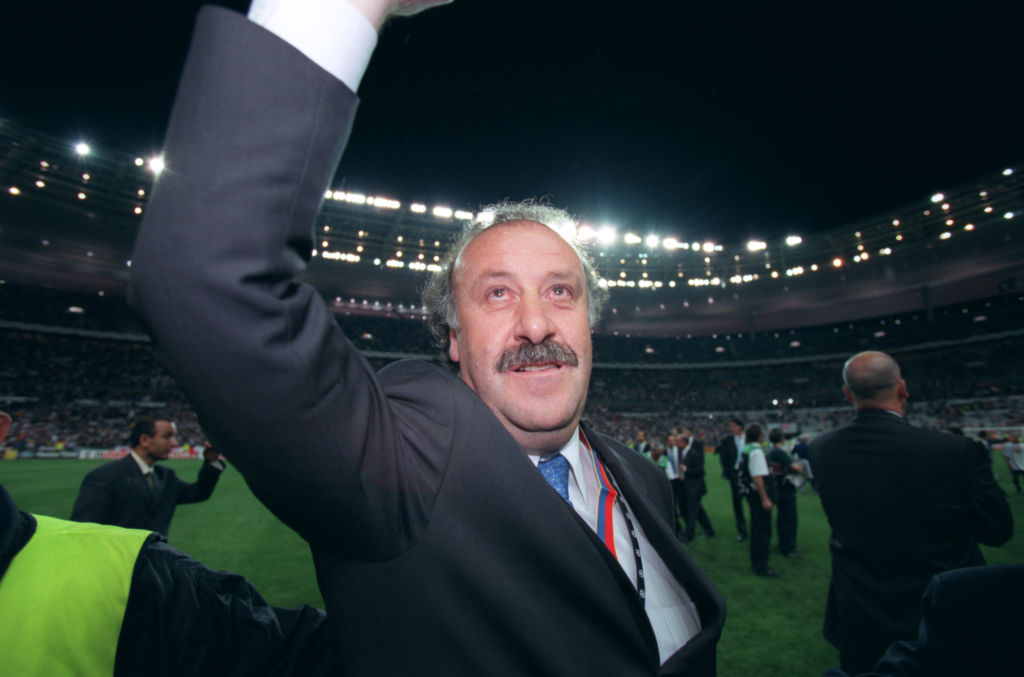
Vicente del Bosque remains a reference point—perhaps the final word—on what Spanish success at Real Madrid can look like. Over 1,314 days, he captured seven titles between 1999 and 2003, ushering in an era of calm amid the Galactico frenzy. Yet even he wasn't spared by the brutal demands of the club’s hierarchy.
His exit in 2003, orchestrated by then newly elected president Florentino Perez, was anything but celebratory. Del Bosque once described it as a "cold farewell dinner.” Perez justified the decision by pointing to “signs of exhaustion,” adding that the club needed “a different type of person, someone more technically advanced from a strategic and tactical perspective.”
Del Bosque, alongside Miguel Munoz and Luis Molowny, remains one of the most decorated Spanish coaches in Real Madrid history. Since his departure, however, the club has repeatedly failed to find another Spaniard who could measure up.
Six In, None Victorious
Real Madrid has tried six times since 2003 to find the next Spanish leader. Each experiment ended prematurely—and trophy-less.
- Jose Antonio Camacho (May 2004 – Sept 2004): 117 days
- Mariano Garcia Remon (Sept 2004 – Dec 2004): 101 days
- Juan Ramon Lopez Caro (Dec 2005 – June 2006): 207 days
- Juande Ramos (Dec 2008 – June 2009): 174 days
- Rafa Benitez (June 2015 – Jan 2016): 215 days
- Julen Lopetegui (June 2018 – Oct 2018): 137 days
All were deemed long-term projects at the time of their appointments. All left with reputations bruised and empty trophy cabinets.
Benitez and Lopetegui: Two Big Bets That Failed
Rafa Benitez, who had been wildly successful at Liverpool, lasted just 25 games. His tenure was marked by locker room disconnects and philosophical clashes with star players.
“I only told Modric that 'on a three-meter shot, you hit it with the inside so that the ball reaches your teammate cleanly, without effect.' It was just a comment that they made the most of,” he once defended himself.
Years later, he added: “Cristiano, knowing what he was like, you had to guide him. The problem is when you have to guide seven players, some of them don't play, they're not happy. And they go to the media to leak information.”
Julen Lopetegui, meanwhile, inherited a depleted side after Cristiano Ronaldo and Mateo Kovacic's departures. Despite some promising football, a 5-1 loss to Barcelona sealed his fate after just 137 days. Real Madrid’s statement at the time was telling: “We believe there is a huge disproportion between the quality of the squad, which has eight players nominated for the next Ballon d'Or, something unprecedented in the club's history, and the results obtained to date."
Camacho’s Frustration: Galacticos Don’t Like Advice
Of all the short-lived tenures, Jose Antonio Camacho’s second spell was arguably the most truncated, overseeing just six games. He later reflected on the player-manager disconnect.
“It's possible they felt I was annoying them when I coached them. I don't bother anyone if we win, but we have to win games,” he said. “The least I have to give my players when there's a game is that they know something about the opponent. No matter how much of a Galactico they are, I'll have to tell them how the other team plays."
“I had three or four players who were Ballon d'Or winners, not that they were going to be that year, and that's important,” he added.

Foreign Coaches Still Dominate
With 62 titles won by foreign managers compared to 53 by Spanish ones, the numbers highlight a historical preference and better success rate for non-Spanish tacticians.
Carlo Ancelotti (15 titles), Zinedine Zidane (11 titles, Leo Beenhakker (6 titles), and Jose Mourinho (3 titles) are among those who have delivered silverware while their Spanish counterparts faltered.
Why Might Xabi Be Different?
Xabi Alonso enters with a distinct pedigree. A Real Madrid alumnus and a student of multiple schools—Guardiola’s positional play, Ancelotti’s pragmatism, and Benitez’s tactical detail—Alonso offers a fusion that could prove effective at the Bernabeu.
He also seems to understand the unique pressures that come with managing Real Madrid: the media scrutiny, the locker room egos, the boardroom expectations. Perhaps more crucially, he knows that micromanagement doesn't thrive at Concha Espina.
Alonso’s successful spell at Bayer Leverkusen demonstrated his ability to implement a winning identity. But Madrid is a different beast. Managing stars is as important as managing systems. Alonso’s biggest test might not be tactics, but temperament—and timing.
Is Real Madrid simply a graveyard for Spanish coaches? Or has it just been a run of poor fits at unfortunate times? As Xabi Alonso takes the helm, the question lingers: will he be the one to finally rewrite the narrative?
If he succeeds, he won't just bring trophies—he’ll exorcise a ghost that’s haunted Spanish managers at the Bernabeu for 20 years.