Once Ferguson's fortress, now a farce: Manchester United's Europa League final horror show exposes deep rot
Synopsis
Manchester United delivered a historically abject performance in the Europa League final, embarrassing themselves, their fans, and their legacy in a night Spurs finally shed their 'Spursy' tag.
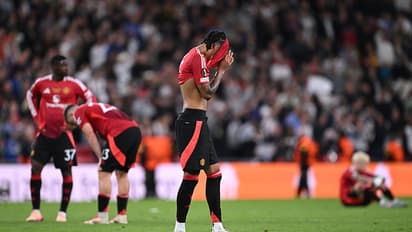
In the cathedral of San Mames, where greatness is often carved into memory and mediocrity banished to the shadows, Manchester United delivered a performance so dismal it felt like a requiem. Not just for a season, but perhaps for a bygone identity. In losing 1-0 to Tottenham Hotspur in the Europa League final, they didn’t just hand their opponents their first trophy in 17 years—they handed themselves over to ridicule, shame, and painful introspection.
This wasn’t just a defeat. This was a full-blown embarrassment.
An embarrassment to their fans, who travelled with hope but left with heads bowed. An embarrassment to Sir Alex Ferguson, watching from the stands in Bilbao, who must have winced as his legacy was dragged deeper into the mire. And above all, an embarrassment to the institution of English football, which once proudly flaunted United as its global emblem.
A Final That Felt Like a Funeral
From the first whistle, United looked like a team plagued not by nerves, but by an identity crisis. Shapeless, spiritless, and riddled with ineptitude, they stumbled across the pitch like a side awaiting mercy. But none came. Tottenham were not good—far from it—but they didn’t need to be. All they had to do was watch United collapse under the weight of their own dysfunction.
The goal, when it came just before half-time, was an accidental piece of ugliness, befitting the occasion. Brennan Johnson got a touch on Pape Sarr’s cross before it deflected off Luke Shaw and wrong-footed Andre Onana. Johnson made sure, poking it over the line for a lead Spurs barely deserved but United certainly did.
It was the kind of goal United used to defend against with contempt. Now they concede them and shrug.
This Was United’s Escape Hatch. They Slammed It Shut.
What made this loss so galling was its significance. It wasn’t just about lifting silverware—it was about salvaging a season on life support. With Champions League qualification at stake, with a much-needed financial boost of 100 million pounds up for grabs, and with the pride of a once-great institution on the line, United played like a pub side.
They couldn’t string passes together. They couldn’t manage basic tactical discipline. And most damningly, they couldn’t summon any fight. Garnacho's late spark, Fernandes’ missed sitter, and Zirkzee’s brief influence were nothing more than fleeting flickers in a long, dark night.
At times, it looked as though Amad Diallo and Bruno Fernandes were more interested in writhing on the turf than getting on the ball. Rasmus Hojlund, the 72 million-pound striker, barely touched it. When he did, it often ended in panic. His eventual substitution for Joshua Zirkzee felt like a mercy.
Postecoglou Laughs Last
While Tottenham celebrated a landmark win under Ange Postecoglou—a manager mocked as a “clown” only days before—it was United who left the pitch in a state of existential crisis. Spurs were missing key creative players like James Maddison and Dejan Kulusevski. They started without Son Heung-min. And they still won.
Postecoglou, overseeing his 100th game in charge, may or may not survive into a third season. But he has something that few at United can boast—tangible success. In a night of low-quality football, his side found a way to win. United, by contrast, found a way to humiliate themselves.
A Frankenstein's Monster of a Team
This team, stitched together with reckless spending and little coherence, bears no resemblance to the United of old. Ruben Amorim has inherited a mess—a Frankenstein's monster of mismatched parts, expensive flops, and broken egos.
The task of revival is now steeper than ever. With Champions League football gone, the lure of Old Trafford to elite players will diminish further. Financial constraints will tighten. Sir Jim Ratcliffe’s rebuild now begins from even further behind the likes of Manchester City, Liverpool, and even Aston Villa.
There will be no fairy-tale ending for this season. No magic redemption arc. No Ferguson-era miracle.
From Powerhouse to Punchline
The final whistle in San Mames confirmed more than just a result—it confirmed a shift. Once, it was Tottenham who were the punchline. “Lads, it’s Tottenham,” United players famously used to say, as if the outcome was inevitable. Now, that line reads like tragic irony.
The joke is over. Spurs are laughing last.
And Manchester United? They’ve become the punchline. They’ve become the problem. Not just for themselves, but for the legacy they continue to tarnish with every abject outing.
From theatre of dreams to theatre of farce, United are no longer a giant slumbering. They are something worse—an empire crumbling, and seemingly unaware of how far they’ve already fallen.