Inter Milan accused of 300 million euros financial fraud, mafia links: Will a Serie A ban follow?
Synopsis
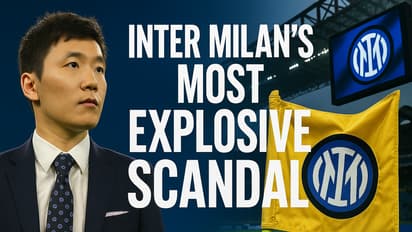
Inter Milan Scandal: A leaked report exposes alleged financial fraud, fictitious sponsorships, and institutional cover-up at Inter Milan, marking a potential scandal on par with Calciopoli.
Inter Milan Scandal: In what could be Italian football’s most explosive revelation in nearly two decades, a confidential investigative report has exposed systemic financial fraud, institutional complicity, and possible mafia influence at the heart of Inter Milan — one of Serie A’s most iconic clubs. The report, prepared by a London-based financial advisory firm hired by a group considering acquiring the club, paints a damning picture of alleged financial engineering under Chinese ownership, offshore opacity, and regulatory blind eyes.
Released mere days after Inter’s humiliating Champions League final defeat at the hands of Paris Saint-Germain (PSG) and the high-profile departure of head coach Simone Inzagh to Saudi club Al-Hilal, the timing could not have been worse — or more revealing.
Inter Milan Scandal: 300 Million Euros in “Fictitious” Revenue
Between 2016 and 2019, Inter Milan reported a staggering 300 million euros in commercial income from Asian sponsorships — nearly 46% of its total revenue for that period. According to the dossier, much of this revenue was either unverifiable, grossly inflated, or entirely fabricated.
The sponsorships in question stem primarily from Suning Holdings Group, the Chinese conglomerate that acquired Inter in 2016. Several listed sponsors — such as FullShare Holding (Tourism), King Down Investment (Online Travel), and iMedia (Sports Marketing) — either lacked a meaningful operational footprint, failed to publish financial statements, or were virtually unknown in their claimed sectors.
One unnamed Southeast Asian entity is flagged for paying an entry fee of 10 million euros and 25 million euros annually to promote Inter’s brand — without any verifiable marketing activity.
The report contends that these entities were potentially shell companies used to pump “phantom revenue” into Inter’s books to simulate financial health and circumvent UEFA’s Financial Fair Play (FFP) regulations.
Inter was under a 2015 UEFA settlement after breaching FFP. The dossier claims that the Suning-era financial architecture was meticulously designed to appear compliant while hiding unsustainable operating costs:
- Wage Bill: Rose from 124 million euros to 192 million euros
- Operating Expenses: Surged from 211 million euros to 310 million euros
- True Revenue Without Fictitious Sponsorships: Insufficient to meet even basic financial obligations
Without these “sponsor” funds, Inter would have faced negative equity, triggering either relegation, exclusion from European competitions, or under Italian law, liquidation.
Inter Milan Scandal: FIGC and COVISOC – Complicit or Careless?
Arguably more damning than the financial sleight-of-hand is the report’s charge of institutional complicity. The FIGC (Italian Football Federation) and COVISOC (Supervisory Commission on Professional Football Clubs) are accused of enabling — and in some cases, protecting — Inter.
Specific allegations include:
- FIGC’s creation of ad hoc financial rules to allow Inter breathing room
- COVISOC’s deliberate soft-pedaling of oversight, allegedly under external pressure
- A former COVISOC official quoted as admitting to inaction due to “orders from above”
Had Inter Milan been held to the same standard as other Italian clubs, the report argues, they would have been sanctioned, forced into administration, or expelled from Serie A.
This raises a seismic question: Was Inter too big to fail — or too politically connected to touch?
Inter Milan Scandal: Offshore Web and Cayman Islands Ties
Ownership transparency is another major red flag.
While Suning was the public face of Inter’s ownership, the report outlines a maze of offshore holding structures, including significant activity through the Cayman Islands — a jurisdiction blacklisted by EU authorities for opacity.
The structure makes it difficult to identify ultimate beneficiaries, a red flag for potential money laundering, tax evasion, and regulatory evasion.
Even after Oaktree Capital Management acquired the club in May 2024 for a reports $455 million, many of these opaque financial relationships remain in place.
Inter Milan Scandal: Marotta and the Mafia Link
The club’s Chairman and CEO, Giuseppe Marotta, is portrayed as a key crisis negotiator who mediated between management and Inter’s notorious ultras — several of whom are under investigation for mafia involvement.
The report does not directly implicate Marotta in criminal activity but highlights:
- His “appeasement meetings” with ultras during moments of internal crisis
- Parallels with his past tenure at Juventus, where he reportedly met figures linked to organised crime
- Phrases in internal correspondence like: “Marotta gives in to pressure” and “resolution thanks to Marotta”
The same ultras group allegedly ran ticketing rackets, unauthorised merchandising stalls, and are currently linked to a violent power struggle that includes multiple homicides.
Inter figures including Vice President Javier Zanetti, Hakan Calhanoglu, and Simone Inzaghi have all been fined or banned for their contact with this group.
While financial investigators were quietly compiling this damning report, Inter Milan was being paraded as a civic darling.
- In late 2023, the club received the Ambrogino d’Oro, Milan’s highest honour, from Mayor Giuseppe Sala
- Politicians like Ignazio La Russa and journalists like Fabrizio Biasin appeared at public events celebrating the club
These civic celebrations, just weeks after reports of mafia connections and financial irregularities surfaced, reveal a troubling disconnect between image management and institutional accountability.
Inter Milan Scandal: Where Is Steven Zhang?
Amid all this chaos, Inter Milan's president Steven Zhang has been notably absent. Officially, travel issues related to passport renewals and Chinese legal scrutiny are cited. But with Zhang effectively missing from club operations, questions abound over:
- Who authorised the club’s financial decisions?
- What oversight existed from the top?
- Is Zhang evading potential legal exposure?
Zhang’s silence and disappearance have only deepened public suspicion.
Italy’s Sports Minister Andrea Abodi broke his silence this week, calling for ‘total transparency, like glass’.
His remarks reflect growing political unease that the FIGC may once again be sitting atop a volcano of scandal — one eerily reminiscent of the 2006 Calciopoli refereeing scandal that saw Juventus relegated to Serie B and stripped of titles.
Will Inter Milan Be Banned?
That question now looms over Serie A.
The club may not lose titles from the period in question — as they didn’t win any during 2016-2019 — but their seven trophies since, including two Serie A titles and two Coppa Italias, could be at risk pending further investigation.
Potential punishments include:
- Points deductions
- Stripping of trophies
- Bans from UEFA competitions
- Relegation to Serie B
- Criminal proceedings against club executives and regulators
Just as Manchester City faces similar allegations in the Premier League, Inter Milan now finds itself on the precipice of disaster.
Inter may have clawed their way back to a projected 24 million euros profit in 2024-25, but that might be too little, too late.
This is not just a club scandal. It is an indictment of Italian football’s regulatory system — where political interference, financial gamesmanship, and silence have replaced integrity.
If even half of what’s in this report is proven, it won’t just be Inter Milan in the dock — it will be Italian football itself.