Zero-Error Aerostructures: The Robotic Cell Building Tejas Wings
Synopsis
HAL is overcoming a major production bottleneck for the Tejas fighter by replacing slow, manual wing drilling with a fully automated robotic cell. This new system, a first for its Aircraft Division, can drill and inspect each of the 16,000 holes in a wing set in under 60 seconds.
Picture a technician at HAL's Bengaluru Aircraft Division coaxing a hand-held drill through a fighter wing — twenty-five to thirty-five minutes per hole. Multiply that patience by sixteen thousand, the count for a Tejas wing pair including every attachment and temporary-fastener hole, and you see why one wing set swallowed weeks. The fault was never the hands. It was the arithmetic.
Why is it so hard? A Tejas compound-delta wing is not one material but a sandwich. Its outer skins are carbon-fibre composite of some 1,600 MPa ultimate strength, while the bones beneath — front and rear spars, root ribs, pylon and wing-fuselage brackets — are aluminium-copper alloy and titanium. Per wing hand, about 3,200 holes of 5, 6, 8, 10 and 12 mm must pass through that stack, plus roughly 2,700 anchor-nut rivet holes of 2.5 mm in the composite skins and metal spars. Each must land within ±0.30 mm of its programmed position, hold H8/H9 size — a tight fit — and be countersunk so the rivet sits flush.
Errors are unforgiving. Carbon fibre cannot be flooded with coolant, so the heat must be managed dry. Press too hard and the layers peel apart — delamination — or burrs rise on the metal side. One bad hole can seed a fuel leak or weaken an aircraft flying at the edge of its envelope.
The stake is national. The Indian Air Force has ordered 83 Tejas Mk1A fighters, with 97 more contracted, at a time when squadron strength matters. Every wing set finished sooner is an Indian-designed fighter on the flight line sooner.
HAL's answer is a first for its Aircraft Division: a fully automated, turnkey robotic cell that clamps, normalises, drills, countersinks, measures then passes or rejects every hole in one unbroken cycle. The requirement is blunt — under 60 seconds per hole including countersink, five days at most per wing side on two eight-hour shifts, and 20 wing sets — 40 left- and right-hand modules — a year, expandable if output rises. It sits within a wider automation drive under Chairman and Managing Director Ravi Kota, long associated with Tejas.
Leading the work is ADD Engineering Components (India), the Bengaluru arm of Germany's ADD Engineering GmbH and an HAL-registered MSME under Girish Linganna, through a three-nation consortium. Britain's True Position Robotics brings automated drilling and inspection systems already proven on Boeing and BAE programmes, with lightweight drill heads and optical guidance that keeps its aim true. Germany's Robot-Technology GmbH supplies the cell, its mobile seventh axis, controls and integration. Indian tooling and fixtures come with Ripple Technologies, and German specialists Norbert Kreller and Dr Werner Gryksa bring NASA and fighter-programme experience.
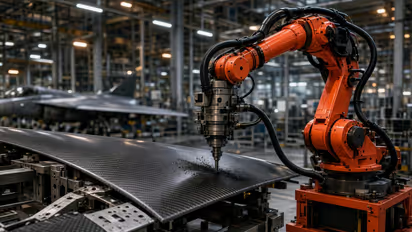
On the shop floor sits a six-axis articulated robot — an arm with the reach of a human shoulder, elbow and wrist — with secondary encoders for aerospace-grade accuracy, on a mobile platform. Rather than move the wing, the robot walks around it, guided remotely on air bearings for fine positioning, then locks to floor references and works as though bolted down. A 30-station tool changer, cameras, probes and a test-coupon station travel with it. A fixture holds both wings at the aircraft's ICY points, the master features used to build the airframe.
The end effector carries a water-cooled spindle turning from just over 200 rpm for titanium to 20,000 for softer stacks, at least 10 Nm continuous torque, nose-piece dust extraction targeting 95 per cent, and chilled air at the tip. A camera finds the programmed coordinate from the digital model, reading reference points and holes. A pressure foot with normality sensors clamps the stack square, so the drill enters perpendicular and the layers stay bonded. One dry pass cuts hole and countersink. A probe then measures diameter to ±0.005 mm, countersink depth to ±0.05 mm and trueness at top, middle and bottom, filed under a unique identity. Any hole out of tolerance halts the cell. Cutter wear is watched live; tools change themselves.
Programming is done offline from the design model, with collision avoidance and escape paths, and HAL's engineers can edit it themselves. The software is specified to take Tejas Mk2 and AMCA data, with perpetual licences and twenty years of spares and service.
HAL has hedged nothing. Design reviews come within two months, then coupon trials, inspection at the builder's works and acceptance on a wing set in Bengaluru. Two years of warranty give way to five of full maintenance, a specialist on site every working day, a 90 per cent uptime target. The cell must last twenty years in Indian heat and humidity, and is due eighteen months after the order — by end-2027.
What changes is not only speed. Quality stops depending on how tired a pair of hands is at shift's end and becomes a property of the machine. The skill moves upward, into programming and judgement. More wings, more Tejas, sooner.
(Girish Linganna is an award-winning science communicator and a Defence, Aerospace & Geopolitical Analyst. He is the Managing Director of ADD Engineering Components India Pvt. Ltd., a subsidiary of ADD Engineering GmbH, Germany.)
Stay updated with the Breaking News Today and Latest News from across India and around the world. Get real-time updates, in-depth analysis, and comprehensive coverage of India News, World News, Indian Defence News, Kerala News, and Karnataka News. From politics to current affairs, follow every major story as it unfolds. IMD cities weather forecastsRain Cyclone Asianet News Official App