India-US Trade Deal: Why the Trade Pact Matters
Synopsis
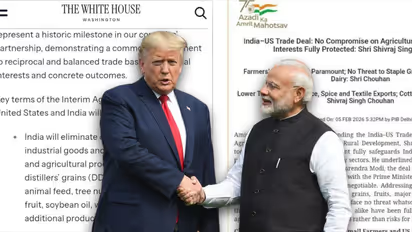
A new India-US interim trade agreement is a strategic geopolitical pact more than an economic deal. The US capped tariffs on Indian exports at 18%, while India committed to $500 billion in US purchases.
The new India US interim trade agreement is being sold as an economic détente, but that framing understates its true significance. This deal is less about tariffs and purchase commitments and more about power, positioning, and the recalibration of global influence at a moment when economic statecraft has replaced diplomacy as the primary tool of geopolitics.
At one level, the agreement is plainly transactional. The United States stepped back from the brink of punitive reciprocal tariffs that could have reached a whopping 50 percent on Indian exports, settling instead at an 18 percent ceiling. India, in return, pledged a staggering 500 billion dollars in purchases of American energy, aircraft, technology, and industrial inputs over five years. That arithmetic matters. But the politics and the undercurrents behind it matter more.
This is a pact born of mutual anxiety. Washington is grappling with supply chain fragility, domestic political pressure to protect manufacturing jobs, and the strategic imperative of reducing dependence on China. New Delhi, meanwhile, faces slowing export momentum, intense competition from Southeast Asia, and the constant risk of being squeezed between protectionist Western policies and an assertive Beijing. The deal offers both sides predictability in a volatile world.
The beneficiaries, unsurprisingly, sit at the intersection of economics and strategy. Indian MSMEs in textiles, leather, gems, and light manufacturing gain breathing room to remain competitive against Bangladesh and Vietnam. Zero tariff access for pharmaceuticals and aircraft parts strengthens India’s ambition to move up the value chain, not just assemble it. For the United States, long term commitments on LNG, aircraft, and advanced equipment translate into industrial jobs, export certainty, and political wins in energy producing and manufacturing states.
But to read this merely as a jobs for tariffs exchange is to miss the point. The real ballast of the agreement lies in its emphasis on economic security, especially around GPUs, data centers, and AI critical infrastructure. In effect, Washington is signaling that India is no longer just a large market but a trusted node in the technological architecture of the future. Trade policy here doubles as technology policy, and by extension, national security policy.
This is where the China Plus One strategy stops being rhetoric and becomes operational. By aligning on rules of origin and supply chain standards, the deal explicitly shuts the door on third country transshipment. It tells Beijing that India will not serve as a convenient backdoor into the US market. More importantly, it tells global capital that the world’s two largest democracies are prepared to coordinate, not perfectly but deliberately, to de risk from Chinese manufacturing dominance without triggering an outright rupture.
Critics are right to note that an 18 percent tariff hardly qualifies as free trade. Yet perfection was never the objective. Stability was. In an era defined by sanctions, tariff shocks, and weaponized interdependence, this agreement functions as a geopolitical insurance policy. It locks India and the US into a shared economic trajectory at a time when neutrality is becoming harder to sustain.
This deal is not the end of India US trade negotiations. It is the beginning of something more consequential, a recognition that in today’s world, trade agreements are no longer about lowering barriers alone. They are about choosing sides, shaping supply chains, and quietly deciding who gets to write the rules of the next global order.
Stay updated with the Breaking News Today and Latest News from across India and around the world. Get real-time updates, in-depth analysis, and comprehensive coverage of India News, World News, Indian Defence News, Kerala News, and Karnataka News. From politics to current affairs, follow every major story as it unfolds. IMD cities weather forecastsRain Cyclone Asianet News Official App