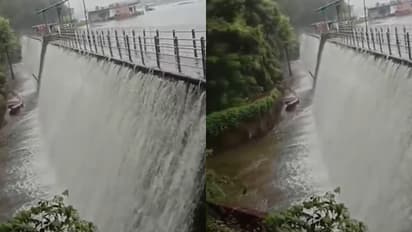
Mumbai Rains: Powai Lake Overflows After Heavy Showers Lash City, Video Goes Viral (WATCH)
Synopsis
Powai Lake in Mumbai began overflowing around 5.30 am amid heavy showers, even as the city’s overall water stock remains low at 7.18 per cent. Despite localised overflow, BMC data shows reservoir levels are still below normal across Mumbai.
Mumbai’s Powai Lake, one of the key artificial lakes under the Brihanmumbai Municipal Corporation (BMC), began overflowing around 5.30 am on Wednesday, even as the city’s overall water reserves continue to remain below normal levels. The lake, which has a storage capacity of 545 crore litres, is used exclusively for industrial purposes. Despite the overflow at Powai, data from the BMC shows that Mumbai’s total lake storage remains significantly low, highlighting uneven monsoon progress across catchment areas.
बृहन्मुंबई महानगरपालिका क्षेत्रातील कृत्रिम तलावांपैकी महत्त्वाचा असणारा पवई तलाव आज पहाटे ५:३० वाजेच्या सुमारास पूर्ण भरुन वाहू लागला आहे. ५४५ कोटी लीटर एवढी जलधारण क्षमता असणाऱ्या या तलावाचे पाणी फक्त औद्योगिक कारणांसाठी वापरले जाते.
💧Powai lake, one of the most important… pic.twitter.com/PMrAEz8fsb— माझी Mumbai, आपली BMC (@mybmc) July 1, 2026
Mumbai Lake Levels At 7.18 Per Cent Useful Storage
According to the BMC’s daily water stock report released at 6 am on Wednesday, July 1, the combined useful live storage across Mumbai’s seven key lakes stood at 7.18 per cent.
The total water stock currently stands at 1,03,871 million litres (ML) against a full capacity of 14,47,363 ML. Although this marks a slight improvement compared to last year’s 5.46 per cent, it is still far below the 41.17 per cent recorded on the same date in 2025.
Officials noted that while there has been a year-on-year improvement, overall reservoir levels remain under pressure as the monsoon has not yet fully stabilised.
Finally, Good news, Mumbai! 😍
Due to yesterday's heavy-very heavy rain, Water levels in Mumbai's catchment areas have now risen from 6.75% to 7.18% ⬆️
More heavy rains are coming this week! #MumbaiRains pic.twitter.com/1Hb3e750rE— Mumbai Rains (@rushikesh_agre_) July 1, 2026
Key Lakes Supplying Mumbai
Mumbai’s drinking water supply depends on seven major reservoirs: Bhatsa, Upper Vaitarna, Middle Vaitarna, Tansa, Modak Sagar, Vihar and Tulsi.
Among them, Upper Vaitarna has dropped to 594.73 metres, which is below its lowest drawdown level (LDL) of 595.44 metres, leaving it with no usable storage.
Middle Vaitarna currently stands at 241.10 metres, with 11.71 per cent storage. Controlled water releases from this reservoir have been ongoing since November 30, 2025, while the WSCPO gate was opened on January 7, 2026.
Tansa Lake is at 119.39 metres, with only 2.21 per cent capacity remaining.
Collectively, Upper Vaitarna, Middle Vaitarna and Tansa account for just 7.54 per cent of total usable live storage, further indicating the stressed water situation in Mumbai.
Social Media Reactions
The development triggered reactions on social media, with users sharing mixed opinions about the situation.
One user commented: "All MUMBAIKARS have been waiting for see this."
All MUMBAIKARS have been waiting for see this
— Raviranjan Mehta (@rrworld185) July 1, 2026
Second user commented: "Any plans to increase its capacity ? Mumbai hardly received 400 MM of rains so far and it's already full."
Any plans to increase its capacity ? Mumbai hardly received 400 MM of rains so far and it's already full
— Vivek Nair (@vmnair126) July 1, 2026
Rainfall Deficit Despite Local Overflow
Officials pointed out that while Powai Lake has started overflowing due to localised rainfall, it does not significantly impact Mumbai’s potable water supply. The city’s main reservoirs still depend on sustained monsoon activity in their catchment areas across the Western Ghats.
Despite early signs of overflow in some areas, experts say a steady and widespread monsoon is required to bring Mumbai’s water stock back to comfortable levels in the coming weeks.
Stay updated with the Breaking News Today and Latest News from across India and around the world. Get real-time updates, in-depth analysis, and comprehensive coverage of India News, World News, Indian Defence News, Kerala News, and Karnataka News. From politics to current affairs, follow every major story as it unfolds. IMD cities weather forecastsRain Cyclone Asianet News Official App