Vijay-Ajith's Maturity vs. DMK-AIADMK 'Betrayal': A Tamil Nadu Tale
Synopsis
The warm interaction between TN CM Vijay and actor Ajith is seen as maturity, while a potential DMK-AIADMK alliance is called betrayal. The article analyzes why personal respect is accepted while political cooperation is scrutinized for accountability.
A Tale of Two Rivalries: Cinema vs. Politics
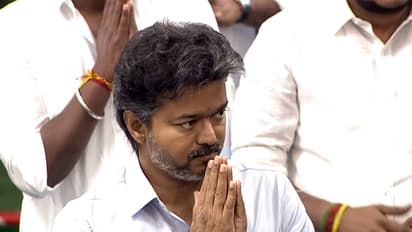
The warm interaction between Tamil Nadu Chief Minister C Joseph Vijay and actor Ajith Kumar at Silverstone has produced an unusual contrast in the state's public life: a rivalry once fiercely defended by millions of fans can now be celebrated as mutual respect, while even the possibility of cooperation between two major political rivals, the DMK and AIADMK, can trigger accusations of betrayal.
The contrast raises a fundamental question: Why is reconciliation between two individuals accepted as maturity, while political cooperation between two parties is often perceived as betrayal of their supporters? Vijay and Ajith spent more than three decades being portrayed as competing stars of Tamil cinema. Their fan bases frequently engaged in comparisons and, at times, bitter online and public confrontations. Yet the actors themselves have repeatedly demonstrated that professional competition need not mean personal hostility.
Reconciliation Without Political Stakes
The distinction was particularly visible this week at Silverstone. Vijay, now Chief Minister, was invited as a special guest to the Michelin Le Mans Cup, where Ajith was competing. Ajith publicly thanked Vijay for taking time from his official responsibilities to attend the event and expressed happiness over his former colleague's political journey. The moment was readily embraced by fans because it carried no direct political threat. There was no question of sharing power, changing an election result or transferring political authority. Two individuals were simply acknowledging each other's success.
The High Stakes of a Political Alliance
The reported possibility of a DMK-AIADMK understanding during the post-election government-formation uncertainty in May generated immediate controversy because the two parties have spent decades defining themselves, in large part, through their opposition to each other. Some reports cited sources claiming back-channel discussions between the parties, while other political observers described the proposed arrangement as speculation and said there had been no confirmed discussions. DMK chief MK Stalin subsequently rejected rumours that his party was negotiating with the AIADMK to form the government.
That distinction is crucial. A reconciliation between Vijay and Ajith changes nothing about the constitutional distribution of power. A political alliance can change who governs the state. For decades, DMK and AIADMK have represented competing political traditions, leaderships and electoral coalitions. Their supporters therefore do not view them simply as two organisations competing for market share. For many, their political identities are deeply connected to ideology, social movements, leaders and decades of electoral conflict. Consequently, a sudden political understanding can be interpreted not as maturity but as abandonment of the principles or positions on which voters believed they were casting their ballots.
Beyond Handshakes: Politics Demands Accountability
The reaction also exposes a broader problem in political culture: the tendency to understand politics through the language of cinema. A film rivalry can end with a handshake. A political rivalry cannot be evaluated merely through friendship or hostility. Political parties are not actors competing for box-office collections. Their decisions affect government formation, budgets, public policy and the mandate received from voters.
At the same time, the acceptance of Vijay-Ajith friendship offers an important lesson. Fans have demonstrated that it is possible to admire one person without treating another as an enemy. The same principle should apply to politics but with one crucial difference: political reconciliation must be examined through transparency, ideology, policy and democratic mandate. The 2026 election itself demonstrated how rapidly Tamil Nadu's political landscape can change. Vijay's TVK emerged as the largest single party with 108 seats, while subsequent political manoeuvring eventually produced a government that secured a majority in the Assembly.
The lesson for voters is therefore not to oppose alliances automatically, nor to accept them blindly. Instead, voters must ask: Why is this alliance being formed? Was it declared before the election? Does it respect the voters' mandate? What policies will the partners follow? Who benefits, and who is accountable? Politics, however, demands something more demanding than reconciliation: accountability. The real test for Tamil Nadu's voters is to stop treating political parties like rival fan clubs. A fan can forgive a star for changing direction. A citizen has the right to demand an explanation from a political party when it changes course. That is the line between entertainment and democracy, and understanding that line may be more important than any political rivalry itself. (ANI)
Stay updated with the Breaking News Today and Latest News from across India and around the world. Get real-time updates, in-depth analysis, and comprehensive coverage of India News, World News, Indian Defence News, Kerala News, and Karnataka News. From politics to current affairs, follow every major story as it unfolds. IMD cities weather forecastsRain Cyclone Asianet News Official App