MK Stalin's 'Dravidian Model 2.0' Dream Ends With Shocking Kolathur Defeat
Synopsis
MK Stalin's dream of leading DMK to a second straight term has suffered a major blow after his shock defeat in Kolathur. TVK's VS Babu won by 8,795 votes, ending Stalin’s long winning streak. Result reflects wider political shift with Vijay's TVK emerging as strong force. Outcome signals changing voter mood and could reshape Tamil Nadu's politics.
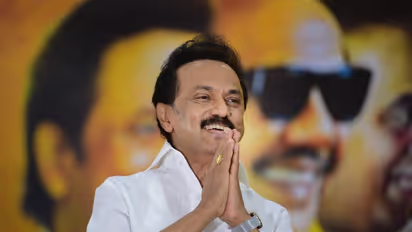
Tamil Nadu has witnessed a dramatic political moment. Chief Minister M. K. Stalin has lost the Kolathur Assembly seat, ending his long winning streak. The defeat comes at a time when he was aiming to lead his party into a second straight term with what he called the “Dravidian model government 2.0”.
Instead of moving towards another victory, the results have brought a major setback. The loss is not just personal but also political, as it signals a shift in voter mood across the state.
Kolathur defeat: a major turning point
Kolathur had been one of Stalin’s strongest seats for years. Since the constituency was formed in 2008 after delimitation, it had always been represented by him.
This time, however, things changed.
TVK candidate V. S. Babu defeated Stalin by a margin of 8,795 votes. According to data from the Election Commission of India, Babu secured 82,997 votes, while Stalin received 74,202 after 22 rounds of counting.
The result marks the first time Stalin will not represent Kolathur in the Assembly. It is also his first major electoral defeat in decades.
A confident campaign that fell short
Before the election, Stalin appeared confident. He hoped to achieve something his father, M. Karunanidhi, could not—leading the Dravida Munnetra Kazhagam to consecutive victories.
The idea of “Dravidian model 2.0” was central to his campaign. It aimed to build on welfare schemes, social justice, and inclusive governance.
However, the results show that this message did not fully connect with voters this time.
The rise of TVK changes the game
The biggest factor behind this shift has been the rise of Tamilaga Vettri Kazhagam. The party, led by actor-turned-politician Vijay, has made a powerful debut.
By evening trends, TVK had won 14 seats and was leading in 94 others. In comparison, the DMK was far behind, with only a few wins and limited leads.
This strong performance by a new party has disrupted the traditional political balance in Tamil Nadu.
A long political journey
Stalin’s defeat becomes more significant when seen against his long career.
Born in 1953, he entered politics at a young age. During the Emergency, he was detained under the Maintenance of Internal Security Act (MISA). Over the years, he built his position step by step within the DMK.
He first became an MLA in 1989 from Thousand Lights in Chennai. He went on to win multiple elections from the same seat in 1996, 2001 and 2006.
Later, he became Mayor of Chennai from 1996 to 2002. This role helped him gain administrative experience and public visibility.
From party leader to chief minister
After years of groundwork, Stalin took over the leadership of the DMK following the death of his father in 2018.
He then led the party to victory in the 2021 Assembly elections. That win brought the DMK back to power after 10 years.
Stalin was sworn in as Chief Minister on May 7, 2021. His government introduced several welfare schemes, including financial support for women, free bus travel for women, and education-focused initiatives like the breakfast scheme.
These policies formed the backbone of his governance model.
What went wrong this time
Despite his record, several factors appear to have worked against Stalin and the DMK:
1. Anti-incumbency
After five years in power, some voter fatigue may have set in.
2. Strong challenger
TVK emerged as a fresh option, especially for young voters looking for change.
3. Urban shift
TVK performed strongly in cities, including Chennai, where the DMK has traditionally been strong.
4. Changing voter mood
The election reflects a growing openness among voters to try new leadership.
A symbolic loss beyond numbers
Stalin’s defeat is not just about losing one seat. It carries deeper meaning.
Kolathur was closely linked to his political identity. Losing it sends a clear signal that even strong leaders are not immune to changing public opinion.
It also raises questions about the future direction of the DMK.
Actor power meets political reality
The rise of Vijay has added a new dimension to Tamil Nadu politics.
Like past leaders such as M. G. Ramachandran and J. Jayalalithaa, Vijay has turned film popularity into political strength.
His party’s success shows that emotional connection with people can translate into votes.
End of an era in sight?
For decades, Tamil Nadu politics has been dominated by the DMK and All India Anna Dravida Munnetra Kazhagam. If current trends hold, this election could break that pattern.
It may lead to the first government outside these two major parties in nearly 50 years.
The final results are still being confirmed, but the message is already clear. Stalin’s plan for “Dravidian model 2.0” has faced a serious setback. At the same time, TVK’s rise signals the arrival of a new political force.
For the DMK, this is a moment to rethink strategy and reconnect with voters.
For Tamil Nadu, it may mark the beginning of a new political chapter.
(With inputs from agencies)
Stay updated with the Breaking News Today and Latest News from across India and around the world. Get real-time updates, in-depth analysis, and comprehensive coverage of India News, World News, Indian Defence News, Kerala News, and Karnataka News. From politics to current affairs, follow every major story as it unfolds. IMD cities weather forecastsRain Cyclone Asianet News Official App