Punjab Farmers Struggle as Stubble-Burning Spikes and Air Quality Plummets
Synopsis
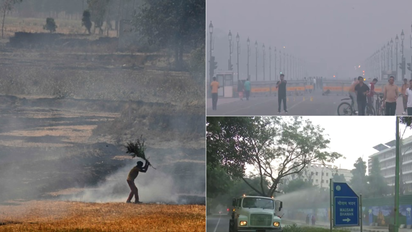
Punjab has seen a sudden jump in stubble-burning incidents with 122 fresh cases reported on Sunday, taking the total to 743. Tarn Taran recorded 224 incidents, and Amritsar recorded 154. Over the past six days, there were 328 incidents in the state
In Punjab, stubble-burning has surged with 122 new cases in one day, bringing the season's total to 743. The worst hit is Tarn Taran district (224 incidents), then Amritsar (154). Cities are choking, AQI reached 439 in Jalandhar, 321 in Bathinda. Authorities have filed 266 FIRs and made 296 red-entries in land records, with Rs 16.8 lakh in penalties impose, says a report by India Today.
Officials say the number may go higher as paddy-harvest accelerates and wheat sowing time window shortens.
The air quality takes a hit
With so many fires, air quality across the state has worsened significantly. For example:
- Jalandhar’s AQI reached 439.
- Bathinda hit 321, Ludhiana 260.
- Amritsar, Patiala and Mandi Gobindgarh also saw AQI levels of 257, 195 and 153 respectively.
These high levels of pollution pose health risks, especially for children, elderly and people with lung or heart conditions.
Why the spike now?
Several factors are at play:
Harvesting of paddy is speeding up, leaving farmers with limited time to clear fields for wheat sowing. Officials note that delayed harvesting has pushed the cycle.
Many fields are being cleared quickly by burning because it's faster and cheaper.
Although overall cases for the season are lower than in previous years, the recent uptick is sharp. For instance, earlier the total was 621 by Oct 26.
Legal action and penalties
To curb the burning, authorities have stepped up enforcement:
266 FIRs have been registered under Section 223 of the Bharatiya Nyaya Sanhita (BNS) for disobedience of public-servant orders, says India Today report.
296 red‐entries have been made in land records, preventing farmers from getting loans or selling land.
Environmental compensation amounting to Rs 16.8 lakh has been imposed across the state. Rs 12 lakh has been recovered so far.
Districts like Tarn Taran and Amritsar feature heavily in the FIR and red‐entry numbers.
The challenge continues
Despite enforcement, the challenge remains big:
Paddy harvesting is incomplete in many high-yield districts (especially in the Malwa region) which raises the risk of more burning ahead.
Earlier in the season, overall numbers were much lower, giving a chance that conditions could improve but the sharp rise suggests the issue is still serious.
Weather conditions (low wind speed, cooler air) may trap pollutants close to the ground, making air-quality worse. Hindustan Times
The pollution beyond Punjab
The smoke from stubble burning not only affects Punjab but also the neighbouring regions including the national capital zone. Farm fire emissions can contribute significantly to the background pollution levels in places like Delhi-NCR. Poor air quality has direct health consequences: people can suffer from breathing difficulties, cough, throat irritation and worsening of asthma or heart problems.
The environmental cost is heavy too! Fertile residue clear-up by burning loses potential for soil enrichment and harms local biodiversity.
Air quality in Delhi worsens to 'very poor' category
The Air Quality Index (AQI) in Delhi dropped to the ‘very poor’ category on Sunday morning, according to the Central Pollution Control Board (CPCB). On Saturday, the AQI was in the ‘poor’ category, but it worsened within a day even as Stage II of the Graded Response Action Plan (GRAP) remains in force across Delhi-NCR.
CPCB data showed AQI readings of 287 at Lodhi Road, 325 near India Gate, and high levels in Ashram and Maharani Bagh - all within the 'very poor' range. Truck-mounted water sprinklers were deployed along Lodhi Road to help settle dust and reduce particulate matter. Despite these steps, pollution remained intense in most central and south Delhi areas.
Cloud seeding plan to combat pollution
Chief Minister Rekha Gupta announced that Delhi will conduct cloud seeding as an experimental solution to combat persistent smog. She called it a 'necessity' and the “first experiment of its kind” for the national capital. Cloud seeding trials are planned between October 28 and 30, with the government ready for physical tests and permissions on October 29.
Health experts raise concerns
Former AIIMS Director Dr Randeep Guleria warned of serious health risks from rising pollution. He said poor air quality causes chest discomfort, breathing problems, coughing, and worsens conditions like asthma and COPD. Children, elderly people, and those with heart or lung diseases are most vulnerable. Even healthy residents have reported nasal irritation and throat pain.
Government urges caution
Environment Minister Manjinder Singh Sirsa confirmed that GRAP Stage II restrictions will stay in effect. Residents have been urged to limit outdoor activity, use masks, and avoid crackers, as pollution levels are expected to remain high through the coming week.
(With ANI inputs)
Stay updated with the Breaking News Today and Latest News from across India and around the world. Get real-time updates, in-depth analysis, and comprehensive coverage of India News, World News, Indian Defence News, Kerala News, and Karnataka News. From politics to current affairs, follow every major story as it unfolds. IMD cities weather forecastsRain Cyclone Asianet News Official App