SC raps police over curbs, detentions; orders removal of notices
Synopsis
The Supreme Court ordered the removal of prohibitory notices under Section 163 around its complex, calling them 'excessive'. It ruled that local curbs cannot justify detentions in far-off areas and sought a report on illegal detentions.
SC Orders Removal of 'Excessive' Prohibitory Notices
In a strong intervention on Sunday, the Supreme Court of India ordered the removal of prohibitory notices imposed under Section 163 of the BNSS around its own complex, calling them "excessive measures" that hinder access to justice.
Hearing petitions and a contempt plea over the police crackdown on protesters on October 10, a bench of Justices Joymalya Bagchi and V.Mohana ruled that the right to peaceful movement must be protected. The Court clarified that localised restrictions cannot be stretched to justify detentions in far-off areas like Gurugram or elsewhere outside the designated operational zone.
Court Clarifies Scope of Restrictions
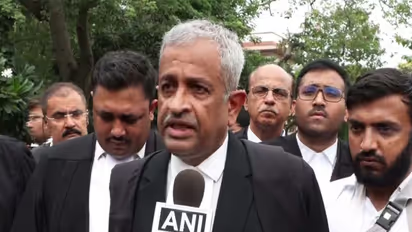
"The Court has sought justifications from the authorities. It has clarified, in a sense, that it understands the need for restrictions and detentions within the area where Section 163 has been imposed. However, the authorities cannot rely on those restrictions to justify detaining someone in Gurugram or elsewhere outside that area," said Advocate Sanjay Hegde to ANI. "The Court has sought responses and will examine them. Their work is not confined to courtrooms. Lawyers also act as sentinels at police stations during detentions, ensuring adherence to the law and the Constitution."
Briefing reporters on the proceedings, Advocate T Bala added, "The Supreme Court also took cognisance of the illegal detentions that allegedly took place. The Court examined whether its earlier order, which directed that essential services such as metro and rail services should not be restricted, had been complied with or violated. The Court took note of these issues today and sought a report from the government..."
Key Directives Issued
The Supreme Court directed authorities to take down Section 163 restriction notices and barricades in and around the Supreme Court premises to guarantee that ingress and egress to courts are not restricted.
The bench mandated that there shall be no illegal detentions of peaceful, unarmed assemblages outside the designated zones where Section 163 is active, demanding formal reports and justifications from the government.
The bench examined compliance with its previous order stipulating that public transport and metro networks must not face complete arbitrary shutdowns, ensuring normalised movement for citizens. The court took note of reports regarding lawyers being stopped from discharging their professional duties and emphasised that professionals and legal representatives must have unhindered physical access to courts.
Stay updated with the Breaking News Today and Latest News from across India and around the world. Get real-time updates, in-depth analysis, and comprehensive coverage of India News, World News, Indian Defence News, Kerala News, and Karnataka News. From politics to current affairs, follow every major story as it unfolds. IMD cities weather forecastsRain Cyclone Asianet News Official App