SC hears ED's plea against Mamata govt over I-PAC search obstruction
Synopsis
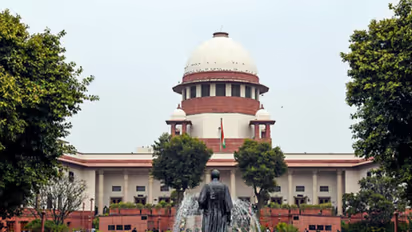
The Supreme Court has started hearing the ED's plea against the Mamata Banerjee govt for obstructing a search at I-PAC. The court rejected the state's adjournment request, prompting West Bengal to question the ED's legal right to file the plea.
SC Hears ED Plea Against WB Govt
The Supreme Court has commenced hearing on the ED's (Enforcement Directorate) plea against West Bengal Chief Minister Mamata Banerjee and state government officials for allegedly obstructing its search operation at the offices of the All India Trinamool Congress-linked political consultancy firm I-PAC.
Court Denies Adjournment Request
Counsel appearing on behalf of the West Bengal government sought time to respond to the ED's rejoinder affidavit, submitting that it contains lengthy averments that go beyond the scope of the issue. "We require some time to respond. It's not a rejoinder in the conventional sense," Senior Advocate Shyam Divan said. The Solicitor General of India, Tushar Mehta, appearing for the ED, opposed the request, submitting that if the State seeks to delay proceedings, it must provide valid reasons. A bench of Justices Prashant Kumar Mishra and K. V. Vishwanathan refused to adjourn the hearing and asked the West Bengal government to begin its submissions.
West Bengal Seeks Reference to Constitution Bench
The West Bengal government then sought reference to a five-judge Bench, contending that the case raises substantial questions involving the interpretation of the Constitution, particularly on the maintainability of the ED's plea under Article 32 and the constitutional framework governing disputes between a Central agency and a State.
State's Counsel Questions ED's Legal Standing
Senior Advocate Shyam Divan advanced three key arguments: First, the ED, as the primary petitioner, lacks corporate existence and is not a juristic entity; therefore, it has no right to sue and cannot maintain the petition. Second, under Part III of the Constitution, a petition under Article 32 requires a breach of fundamental rights. The ED, not being a legal person, cannot claim violation of fundamental rights. Third, the dispute concerns constitutional interpretation and must be resolved within the constitutional framework meant for Centre-State disputes, warranting consideration by a Constitution Bench.
Divan also referred to Article 145 (Rules of Court), reiterating that a government department, which is not a body corporate, cannot sue by itself. He argued that while both Central and State governments function through departments, such entities must possess legal personhood to invoke constitutional remedies. In this case, the Union is effectively invoking Part III against a State, even though the State's role is to guarantee fundamental rights to citizens--highlighting a structural inconsistency in the ED's plea. (ANI)
Stay updated with the Breaking News Today and Latest News from across India and around the world. Get real-time updates, in-depth analysis, and comprehensive coverage of India News, World News, Indian Defence News, Kerala News, and Karnataka News. From politics to current affairs, follow every major story as it unfolds. IMD cities weather forecastsRain Cyclone Asianet News Official App