Russia Offers Su-57 Co-Production, Rolls-Royce Backs AMCA Engine As India Weighs Fighter Future
Synopsis
Russia has offered India co-production of the Su-57 stealth fighter, while Rolls-Royce has proposed jointly developing the AMCA engine. The competing proposals could significantly influence India's future air combat capabilities and defence strategy.
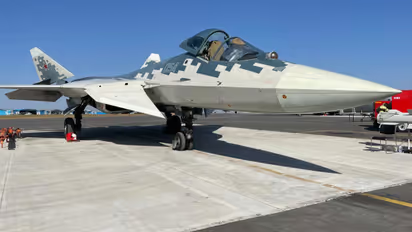
New Delhi: Russia has formally offered New Delhi a joint-production arrangement for the Su-57 stealth fighter, while Rolls-Royce has proposed a collaborative engine development programme for India’s homegrown Advanced Medium Combat Aircraft, or AMCA.
The offers, arriving within days of each other, have placed Indian defence planners at a strategic crossroads – one that will shape the country’s airpower calculus for decades.
The Russian president, Vladimir Putin, is understood to have extended the Su-57 offer through diplomatic channels. The proposal includes co-manufacturing provisions, technology transfer, local assembly, and the integration of Indian weapons systems into the airframe.
Moscow’s central argument is that the Su-57 is already in active service with the Russian Aerospace Forces, and could deliver operational stealth capability to the Indian Air Force faster than building an entirely new aircraft from scratch.
Russia revives memories of the Fifth Generation Fighter Aircraft programme, a joint venture between India and Russia that collapsed in 2018 after years of disputes over costs, technology access, and performance benchmarks.
The Rolls-Royce proposition
Rolls-Royce, the British company, has proposed jointly developing an engine for the AMCA, with shared intellectual property and significant manufacturing activity conducted within India.
The proposed powerplant is expected to produce around 110 kilonewtons of thrust, with a designed growth path to between 120 and 130 kilonewtons – the performance band considered necessary to enable supercruise, internal weapons carriage, and the aerodynamic demands of a stealth configuration.
Rolls-Royce has indicated willingness to carry out design, development, testing, and production inside India, directly addressing the government’s Atmanirbhar Bharat requirements for the programme.
The Kaveri Engine Story
Engine development is widely recognized as the AMCA’s most daunting technical challenge. India’s earlier attempt at an indigenous powerplant – the Kaveri engine, developed for the Tejas light combat aircraft by the Gas Turbine Research Establishment – failed to meet required thrust levels after more than two decades of effort. That experience has left policymakers and the defence research establishment acutely wary of repeating the exercise for a far more demanding aircraft.
Rolls-Royce, which produces the EJ200 engine for the Eurofighter Typhoon and has a long track record in military propulsion, would provide a degree of technical assurance the AMCA programme currently lacks.
Rolls-Royce is not the only bidder. GE Aerospace of the United States and Safran of France have also signalled interest in the AMCA engine requirement.
The AMCA programme is at an early but critical stage. The Cabinet Committee on Security approved the full development phase in March 2024, and the Aeronautical Development Agency has been working on the aircraft’s detailed design.
The first prototype is not expected to fly before the end of this decade, meaning any engine partner must commit to a programme lasting at least a decade with no guaranteed export market beyond India. That commercial reality complicates the proposition for any foreign collaborator, even as the strategic case for engagement with India remains strong.
Stay updated with the Breaking News Today and Latest News from across India and around the world. Get real-time updates, in-depth analysis, and comprehensive coverage of India News, World News, Indian Defence News, Kerala News, and Karnataka News. From politics to current affairs, follow every major story as it unfolds. IMD cities weather forecastsRain Cyclone Asianet News Official App