Republic Day 2026: Murmu to preside, EU leaders to be Chief Guests
Synopsis
India is set for its 77th Republic Day on Jan 26, 2026. President Droupadi Murmu will preside over the celebrations at Kartavya Path. European Council President Antonio Costa and Commission President Ursula von der Leyen will be the Chief Guests.
India is set to celebrate the 77th Republic Day on January 26, 2026. President Droupadi Murmu will preside over the grand celebrations at Kartavya Path, New Delhi. The President of the European Council, Antonio Costa, and the President of the European Commission, Ursula von der Leyen, will attend as the Chief Guests on this momentous occasion.
This year, Kartavya Path, stretching from Rashtrapati Bhawan to the National War Memorial, has been elaborately decorated to showcase India's remarkable journey. The celebrations will feature an extraordinary blend of the 150-year legacy of the national song Vande Mataram, the country's unprecedented developmental progress, robust military strength, vibrant cultural diversity, and active participation from citizens across all walks of life, according to the release from the Ministry of Defence.
Commencement of the Ceremony
The ceremony will commence at 10:30 hrs and run for a duration of approx. 90 minutes. It will start with the visit of Prime Minister Narendra Modi to the National War Memorial, where he will lead the nation in paying solemn tributes to the fallen heroes by laying a wreath. Thereafter, the Prime Minister and other dignitaries will head to the saluting dais at Kartavya Path to witness the parade.
The arrival of the President of India, the President of the European Council and the President of the European Commission in the 'Traditional Buggy' will be escorted by the President's Bodyguard, which is the senior-most regiment of the Indian Army.
As per tradition, the National Flag will be unfurled, which will be followed by the National Anthem with a thunderous 21-gun salute using 105 mm Light Field Guns, an indigenously developed artillery weapon system. The 21-gun Salute will be presented by the 1721 Ceremonial Battery of the 172 Field Regiment.
The Grand Parade Begins
100 cultural artists will be heralding the parade, on the theme 'Vividata Mein Ekta - Unity in Diversity', which is set to be a grand presentation of musical instruments, demonstrating the nation's unity and rich cultural diversity.
Showering of flower petals will be carried out by four Mi-17 1V helicopters of the 129 Helicopter Unit in the Dhwaj Formation. Trooping the National Flag, this formation of helicopters will be led by Group Captain Alok Ahlawat.
The parade will then begin with the President taking the salute. The parade will be commanded by Parade Commander Lieutenant General Bhavnish Kumar, General Officer Commanding, Delhi Area, a second-generation officer. Maj Gen Navraj Dhillon, Chief of Staff, HQ Delhi Area, a third-generation Army officer, will be the Parade Second-in-Command.
Gallantry Award Honourees
The proud winners of the highest gallantry awards will follow. They include Param Vir Chakra winners - Subedar Major (Honorary Captain) Yogendra Singh Yadav (Retd) & Subedar Major Sanjay Kumar - and Ashok Chakra winners - Major General CA Pithawalia (Retd) & Colonel D Sreeram Kumar. The Param Vir Chakra is awarded for the most conspicuous act of bravery, valour and self-sacrifice in the face of the enemy, displayed by members of the Defence Forces, while the Ashok Chakra is awarded for similar acts of gallantry, courage and self-sacrifice, performed other than in the face of the enemy.
European Union Contingent
The European Union (EU) contingent will comprise four Flag Bearers on three gypsies. They will be seen carrying four flags - the flag of the EU, the most recognisable symbol of the European Union; the flag of the European Union Military Staff; the flag of EU Naval Force Atalanta; and the flag of EU Naval Force Aspides.
Indian Army's 'Aatmanirbhar' Prowess
Phased Battle Array and Combat Elements
For the first time, the parade will showcase a phased Battle Array Format of the Indian Army, including the aerial component. The Recce element would consist of the 61 Cavalry in active combatised uniform. It will be followed by High Mobility Reconnaissance Vehicle, India's first indigenously designed Armoured Light Specialist Vehicle. Providing aerial support would be the indigenous DHRUV Advanced Light Helicopter and its armed version RUDRA in Prahar formation, demonstrating battlefield shaping.
The Combat Elements will then follow with T-90 BHISHMA and Main Battle Tank Arjun rolling past the saluting dais with aerial support from Apache AH-64E and PRACHAND Light Combat Helicopter. Other Mechanised Columns include BMP-II Infantry Combat Vehicle, along with Nag Missile System (Tracked) Mk-2.
Advanced Unmanned and Robotic Systems
A detachment of Special Forces will follow, comprising Ajayketu All-Terrain Vehicle, Randhwaj Rugged Terrain Tactical Transport System and Dhawansak Light Strike Vehicles. Following them would be Robotic Dogs, Unmanned Ground Vehicles and four Autonomous Unmanned Ground Vehicles (NIGRAHA, BHAIRAV, BHUVIRAKSHA & KRISHNA) mounted on vehicles.
Combat Support and Indigenous Arsenal
The Combat Support Element would consist of India's new generation unmanned warhead arsenal showcased through SHAKTIBAAN and DIVYASTRA, mounted on specialised High Mobility Vehicles (HMV 6x6). Equipped with cutting-edge niche technologies, together they demonstrate advanced surveillance through swarm drones, tethered drone systems, and indigenously developed tactical hybrid UAV ZOLT, employed for direction of artillery fire. Their targeting capability is reinforced by a wide spectrum of aerial loitering munitions - HAROP, Mini HARPY, Peacekeeper, ATS (Extended Range), ATS (Medium Range), and SKY STRIKER-enabling precise engagement across the depth of the battlefield. These systems are capable of launching swarm drones, long range drones exceeding 1,000 kilometres for see and strike missions, and loitering munitions for precision strikes on critical targets.
Artillery and Missile Systems
The Dhanush Gun System and Amogh Advanced Towed Artillery Gun System (ATAGS) will follow, reflecting the spirit of Aatmanirbhar Bharat and technological self-reliance in defence manufacturing. A powerful combination of long-range precision and overwhelming firepower will be showcased through the alongside the supersonic BrahMos Weapon System alongside indigenous SURYASTRA Universal Rocket Launcher System, together showcasing deep strike dominance. The Akash Weapon System and ABHRA Medium Range Surface-to-Air Missile (MRSAM) System - the two strong pillars of India's air defence - will also roll past the saluting dais. The Drone Shakti Lorry, developed by Corps of Electronics and Mechanical Engineers to enhance the operational capabilities of the Indian Army in forward areas, will follow.
Operation Sindoor and Him Yodhas
A glass-cased Integrated Operational Centre, depicting the conduct of Operation Sindoor in brief, will also roll down Kartavya Path. A masterful blend of 'VIRASAT, VIVIDHTA AUR VIKAS' acted as the magic potion during the operation. While the BRAHMOS missile struck deadly blows to the enemy, the Akash missile systems and S-400 provided a protective shield, which reflects the Sudarshan Chakra vision of Prime Minister Narendra Modi.
The Him Yodhas of the Indian Defence Forces will follow, comprising the Animal Contingent featuring brave soldiers alongside Bactrian Camels, Zanskar Ponies, Black Kites (Raptors) - Ingenious and Vigilant Birds; and Indian breed dogs (Mudhol Hound, Rampur Hound, Chippiparai, Kombai, and Rajapalayam) equipped with bullet-resistant jackets, cameras, GPS, radios, and advanced surveillance systems. A Glacier ATV mounted on a vehicle is also part of the Him Yodhas.
Marching Regiments
Marching down Kartavya Path would be the Mixed Scouts Contingent; Rajput Regiment; Assam Regiment; Jammu & Kashmir Light Infantry; Regiment of Artillery; 4 BHAIRAV Battalion - Sikh Light Infantry Regiment; and Combined Military Bands.
Showcase from the Seas and Skies
Indian Navy: 'JAI' - Jointness, Aatmanirbharta, Innovation
The Indian Navy contingent will consist of 144 young personnel, led by Lt Karan Nagyal as Contingent Commander, and Lt Pawan Kumar Gandi, Lt Priti Kumari & Lt Varun Dreveriya as Platoon Commanders. It will be followed by the Naval Tableau, presenting a vivid depiction of the theme of a Strong Navy for a Strong Nation. The tableau depicts a stitched ship from the 5th century CE, now christened as INSV Kaundinya, Gurab class ships of the Maratha Navy, and frontline indigenous platforms including the aircraft carrier INS Vikrant, Project 17A Nilgiri-class stealth frigates INS Himgiri and INS Udayagiri, a Kalvari-class submarine, and the GSAT-7R (Project Rohini) communication satellite. The tableau also features a depiction of the circumnavigation route followed by INSV Tarini as part of the Navika Sagar Parikrama-II expedition. In addition to naval personnel, young cadets from the Sea Cadets Corps, a non-governmental organisation that imparts basic nautical skills to youth in Mumbai, will march alongside the tableau. The tableau reflects the Indian Navy's march towards Jointness, Aatmanirbharta, and Victory through Innovation 'JAI'.
Indian Air Force: 'Spearhead' Formation
The Indian Air Force contingent comprises four officers (One Contingent Commander and three supernumerary officers) and 144 airmen. The Contingent Commander would be Sqn Ldr Jagdesh Kumar with Sqn Ldr Nikita Choudhery, Flt Lt Prakhar Chandrakar and Flt Lt Dinesh as supernumerary officers. Syncing with the marching contingent would be a thrilling fly-past by 02 Rafale, 02 MiG-29, 02 Su-30 and 01 Jaguar in 'Spearhead' Formation, symbolising the Sindoor Formation.
Tribute Through Tableaux: Veterans and Tri-Services
The Veterans' Tableau of the Tri-Services, with the theme 'Sangram se Rashtranirman Tak', will showcase the journey of veterans from the war to nation-building. The front portion, symbolising Sangram, will feature a striking three-dimensional circular wall depicting iconic war machines that shaped India's decisive moments in conflict. Crowning the wall would be the symbolic Amar Jawan Jyoti, a solemn tribute to the fallen heroes whose supreme sacrifice secured the nation's freedom and integrity. The trailer portion, representing Rashtranirman, highlights the veterans' continued service towards nation-building.
The Tri-services tableau would depict 'Operation Sindoor: Victory Through Jointness', representing the collective strength, unity, and integration of the Indian Army, Indian Navy, and Indian Air Force in safeguarding national sovereignty. The tableau represents India's resolve to respond decisively through synchronised planning, joint execution, and seamless coordination across all domains of warfare. The visual narrative highlights precision air strikes by the Indian Air Force, swift naval manoeuvres ensuring maritime dominance, and coordinated ground offensives by the Indian Army, reflecting a decisive joint military campaign.
Strength of Paramilitary, Police, and Youth Wings
Indian Coast Guard
The all-women Indian Coast Guard (ICG) contingent will be led by Assistant Commandant Nishi Sharma, assisted by Assistant Commandant Apurva Gautam Hore, Assistant Commandant Lakshita and Assistant Commandant Hardik. Guided by their motto 'Vayam Rakshamah - We Protect', the contingent would depict India's maritime strength and commitment to safety and security, representing the ICG's commitment to protecting the nation's 11,098-km coastline.
DRDO's Technological Leap: The LR-AShM Missile
The DRDO will showcase LR-AShM with launcher during the parade. This weapon system is designed to meet the coastal battery requirements of the Indian Navy. The LR-AShM is a Hypersonic Glide Missile capable of engaging static and moving targets and is designed to carry various payloads. The missile is a first-of-its-kind with indigenous avionics systems and high accuracy sensor packages. This hypersonic missile follows a quasi-ballistic trajectory with hypersonic speeds starting at Mach 10 and maintaining average Mach 5.0 with multiple skips. Indigenously developed sensors are provided for engaging the moving targets in the terminal phase. As this missile flies in low altitude with high speed and manoeuvrability, enemy ground and ship-based radars cannot detect this missile during most of its trajectory. The LR-AShM is configured with two stage solid propulsion rocket motor system. These propulsion systems boost the missile to the required hypersonic velocities. Stage-1 of the vehicle is separated after it is spent. After Stage-II burnout, the vehicle performs an unpowered glide with required manoeuvres in the atmosphere before engaging the target.
Further Marching Contingents
Among the contingents marching down the Kartavya Path will be the Central Industrial Security Force Contingent, led by Sub Inspector Karan Singh; Central Reserve Police Force Contingent, headed by Assistant Commandant Simran Bala and Assistant Commandant Surabhi Ravi; Indo-Tibetan Border Police Contingent, led by Band Master-ASI Devindra Singh; and Delhi Police Contingent headed by Assistant Commissioner of Police Anant Dhanraj Singh. The Camel contingent of Border Security Force will be under the command of Deputy Commandant Mahendra Pal Singh Rathore.
SW (Girls) Contingent Commander Senior Under Officer Mansi Vishwakarma of Uttarakhand Directorate will lead the NCC Girls Contingent consisting of 148 Girl Cadets drawn from all Directorates. SD (Boys) Contingent Commander Senior Under Officer Tawheed Altaf of Jammu Kashmir and Ladakh Directorate will head the 148 Boy Cadets contingent. The MY BHARAT National Service Scheme marching contingent of 200 volunteers will be led by Ms Charu Singh from Jaipur, Rajasthan.
Vibrant Tableaux: A Glimpse of India's Diversity and Progress
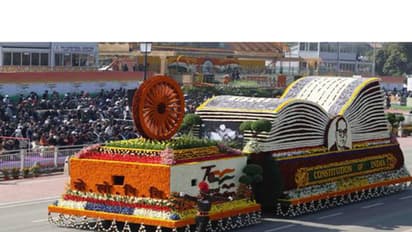
A total of 30 tableaux - 17 of States/Union Territories and 13 of Ministries/Departments/Services - will roll down with a broad theme of 'Swatantrata ka Mantra: Vande Mataram' and 'Samriddhi ka Mantra: Aatmanirbhar Bharat'. The tableaux will showcase a unique mix of 150 years of national song Vande Mataram and the nation's rapid progress on the back of the growing self-reliance across sectors, dipped in its rich and vibrant cultural diversity. (ANI)
(Except for the headline, this story has not been edited by Asianet Newsable English staff and is published from a syndicated feed.)Stay updated with the Breaking News Today and Latest News from across India and around the world. Get real-time updates, in-depth analysis, and comprehensive coverage of India News, World News, Indian Defence News, Kerala News, and Karnataka News. From politics to current affairs, follow every major story as it unfolds. IMD cities weather forecastsRain Cyclone Asianet News Official App