Railway Minister on board tests India’s anti-collision system ‘Kavach’ for trains
Synopsis
The two trains at top speed hurtled towards each other at full speed, one with the Railway Minister on board and the other with the Chairman of the Railway Board.
Marking the occasion of World Safety Day, Indian Railways' South Central Railway (SCR) zone on Friday carried out the testing of the indigenous Automatic Train Protection (ATP) System known as ‘Kavach’. Kavach, which literally means armour, is being promoted by the Railways as the world’s cheapest automatic train collision protection system.
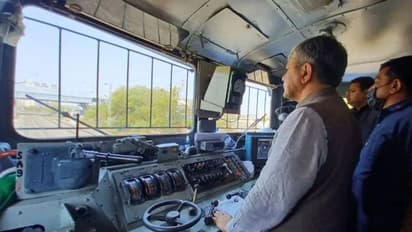
Railway minister Ashwini Vaishnaw in Secunderabad conducted a live testing of Kavach, an indigenously developed, automatic protection technology for trains. The Railways Minister was at the helm along with the driver of the train and other officials who were part of the trial.
The one-and-a-half minute video begins with officials in the driving room and the train running on a set of deserted tracks. A few seconds later, the minister says to the driver, “Now the red signal will come and the train will automatically stop.”
The two trains at top speed hurtled towards each other at full speed, one with the Railway Minister on board and the other with the Chairman of the Railway Board.
Kavach is built to help the Railways achieve the goal of “zero accidents”. It is designed to bring a train to a halt automatically when it notices another train on the same line within a prescribed distance.
All you need to know about Kavach:
· A signal is passed at danger (SPAD) when a train passes a stop-signal when not allowed to do so. Also, once the system is activated, all trains within a 5-km range will halt to provide protection for trains on adjacent tracks.
· The system works in three situations — head-on collisions, rear-end collisions, and signal is passed at danger (Spads).
· Trains will also stop on their own when the digital system notices any manual error like “jumping” of the red signal or any other malfunction, senior officials said.
· Once implemented, it will cost Rs 50 lakh per kilometre to operate compared to about Rs 2 crore worldwide, they said.
· Future plan is to roll it out very rapidly and export it to other countries also. This year we will roll it out at 2,000 Kms and in coming years 4,000-5,000 Kms every year, said the Railway Minister Ashwini Vaishnaw.
· It works on the principle of continuous update of movement by using high frequency radio communication.
· It also conforms to SIL-4 (Safety Integrity Level – 4) which is the highest level of safety certification.
· The ‘On Board Display of Signal Aspect’ (OBDSA) is to help loco pilots check signals on board consoles even when the visibility is low,” an official said.
· Also, once the system is activated, all trains within a 5-km range will halt to provide protection for trains on adjacent tracks.
· Currently, loco-pilots or assistant loco-pilots usually crane their necks out of the window to look out for caution signs and signals, said officials.
· It also includes stationary equipment to gather signaling inputs and loco inputs and relay them to a central system for seamless communication with the train crew and stations.
Stay updated with the Breaking News Today and Latest News from across India and around the world. Get real-time updates, in-depth analysis, and comprehensive coverage of India News, World News, Indian Defence News, Kerala News, and Karnataka News. From politics to current affairs, follow every major story as it unfolds. IMD cities weather forecastsRain Cyclone Asianet News Official App