India–Russia 2030 Roadmap: Can 'Unprecedented Trust' Survive a Tariffed World?
Synopsis
India and Russia aim to reboot their decades-old partnership with the Strategic Economic Roadmap 2030, focusing on trade, MSMEs, energy, labour mobility, and strategic balance amid global pressures.
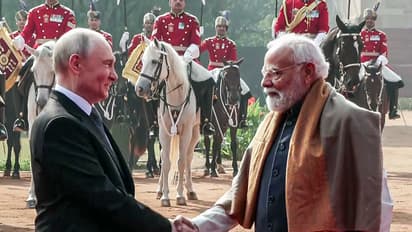
By Dr Aparaajita Pandey and Anshumaan Mishra: The arrival of the Russian President, Vladimir Putin should be seen as indicative of the balancing act that India will need to maintain in the coming future. As the world oscillates between deciding if India and Russia will maintain their close relations or drift away, the two nations get ready to sign the Strategic Economic Roadmap 2030, gesturing that the decades-old India–Russia relationship may be entering a new phase. This should be seen as revamping and rebooting a partnership that has proverbially stood the test of time but needs an addition of new energy to it.
From Cold War Reliance to Post-2022 Realities
India’s relationship with the erstwhile Soviet Union and, later, with the Russian Federation was forged in the crucible of Cold War geopolitical dynamics. It was the Soviet assistance that helped India establish its heavy industries, space and nuclear programmes, and long-term defence infrastructure. Over time, this bond grew stronger and important in context of balancing the Cold war dynamics. Later under successive Indian and Russian administrations, becoming the Special and Privileged Strategic Partnership. There were also underlying commonalities in terms of affinity towards socialist approach to politics and economics that brought India and Soviet Union and later Russia a little closer to each other.
However, quite counterintuitive to popular assumption despite all the political and defence bonhomie, economic ties between India and Russia have remained surprisingly thin. Private-sector engagement, diversified trade, and deep structural economic integration were disappointingly limited. Over the past two decades, much of what defined the partnership were defence deals, energy agreements, and occasional high-level diplomacy, there has been negligible focus on people-to-people ties or balanced trade. It has been limited to highly specialised and exceedingly large corporate and industrial sectors, and smaller medium enterprises have not had their time in the sun.
This began to change during and after the Russia – Ukraine conflict. Moscow saw a pivot to Asia as the western sanctions began to smother Russian trade with Europe. Heavy discounts on crude oil and fertilisers resulted in the India–Russia trade, reaching US$ 68.7 billion in 2024–25 from just USD 10.1 billion in the pre-Covid era. However, this increase in the magnitude of trade has not meant the diversification of trade, the focus still is defence and energy and there is almost no space for small and medium enterprises. This kind of trade is also indicative of a highly unequal trade, where there is a risk of India creating a dependency on Russia in critical sectors if India is not careful with diversification.
The 2030 Roadmap: A Bid for Diversified Partnership
The 2025 summit with Putin’s visit marks a bold attempt to reset that imbalance. According to Indian and Russian officials, both sides plan to sign a comprehensive development programme of strategic areas of economic cooperation by 2030. The publicly shared ambition to reach US$ 100 billion in bilateral trade by 2030.
What is the most important facet of this and is also a diversification from the norm, is that the roadmap is trying to focus on sectors that go beyond energy and oil.
MSMEs, manufacturing and trade have found place in the roadmap and there’s a push towards Indian small and medium enterprises to export agricultural, pharmaceutical, machinery and consumer goods to Russia. Russian interest in importing Indian goods is reportedly growing.
Labour mobility is also being discussed. There is a realisation that the lack of labour in Russia and a labour surplus in India can be a synergy for both the nations. There is special focus on blue-collar and semi-skilled Indian workers, potentially offering jobs in Russia at a time when Moscow is seeking labour from abroad.
Maritime corridors, shipping routes, and logistics cooperation to bypass traditional Western-dominated supply routes. Both India and Russia realise that there is a need for multiple and multi – modal corridors to facilitate greater connectivity despite the high feasibility costs.
There is also talk of rekindling some elements of Soviet-era cooperation under a modern paradigm, clean energy, space, high-tech manufacturing, and innovation specially in the Civil- Nuclear sector.
Balancing Act
This transition is nevertheless taking place under a daunting global lens. The US and its allies remain deeply suspicious of India’s engagement with Russia especially over energy which has been made apparent by them repeatedly. As this summit unfolds, New Delhi faces a real balancing act, deepen ties with Russia without jeopardizing relations with Western powers.
The reality is unforgiving, discounted Russian oil helped India under pressure; however, now Western tariffs and sanctions threaten to undercut the very advantage that drew New Delhi toward Moscow at the time of the conflict. For India, the calculus is shifting energy security remains vital, but trade diversification and diplomatic manoeuvring have become equally critical. The strategic autonomy that India has practised now needs to be balanced with the pressures from the US.
The Strategic Comparison: Russia, China — and India’s Tightrope
Of course, no conversation about India–Russia partnership today is complete without referencing Russia’s increasing closeness to People's Republic of China. Since 2022, Moscow has deepened its ties with Beijing a connection that understandably causes unease in New Delhi. One shouldn’t forget that India is not the only country Russia has been close with. historically, Russia and China also have deep historical ties that were bolstered by their mirrored approaches towards statecraft specially during the cold war. The Russian pivot to Asia comes with an undeniable tilt to China, and that is more than mildly concerning to India in the long run.
The greater people to people contact that India and Russia want to encourage, is already a reality between Russia and China. These fears are not unfounded as the Indian Ocean Region becomes more and more contested India the trepidations about Russian support become larger.
For India, the 2030 roadmap is as much about deepening ties as it is about hedging sustaining a strategic link with Russia, while also strengthening global engagement with the West, via BRICS, G20, and other multilateral platforms. The goal, ideally, is a balanced, multipolar partnership architecture keeping Russia close but not captive, engaging China but not aligning, maintaining autonomy in a polarized world.
This 2025 summit may be the most consequential meeting between India and Russia in decades. The ambition is no longer just strategic solidarity, but structural partnership built on trade, infrastructure, mobility, and human connection. It is apparent that just trust even when deep and time-tested is not a substitute for economic balance, institutional frameworks, and people-centric policies.
It has been suggested by Russians that stability of relationships between US, India, China, and Russia, bilaterally and tri-laterally are essential for stability of geopolitics around the world. Shifting alliances and long – term visions need to be cared for as India and Russia try to build on a solid foundation of the past for a future.
(Dr Aparaajita Pandey is an energy strategist, policy consultant, and Professor at Amity Institute of Defence and Strategic Studies, Amity University.)
(Anshumaan Mishra is a lawyer and a strategy consultant working on the intersection of law, politics, and public policy.)
Disclaimer: The opinions expressed are solely those of the author and do not reflect the views or stance of the organization. The organization assumes no responsibility for the content shared.
Stay updated with the Breaking News Today and Latest News from across India and around the world. Get real-time updates, in-depth analysis, and comprehensive coverage of India News, World News, Indian Defence News, Kerala News, and Karnataka News. From politics to current affairs, follow every major story as it unfolds. IMD cities weather forecastsRain Cyclone Asianet News Official App