Public institutions must be open to questioning: Justice Vikram Nath
Synopsis
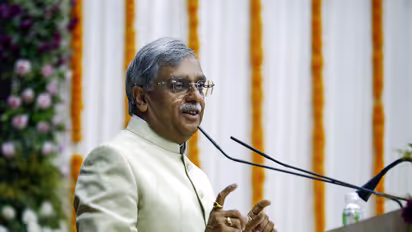
Supreme Court judge Justice Vikram Nath said public institutions must remain open to questioning and be accountable. He said this is a sign of strength, not a threat, and justice must be a lived experience for all citizens.
Supreme Court judge Justice Vikram Nath on Thursday said public institutions must remain open to questioning, noting that people today are more aware of their rights and the institutions that govern them. He said that if institutions expect citizens to respect them, then they also must equally be willing to be accountable for the power entrusted to them.
Justice Nath said questioning institutions should be viewed as a sign of their strength rather than a threat, while emphasising that justice, fairness and transparency must be experienced by citizens and should not remain confined to judgments, speeches or statutes. "We are living through unprecedented times. People today are far more aware of their rights and of the institutions which govern them... Institutions must be open to questioning. That is part of their strength, not a threat to it. If citizens are expected to respect institutions, then institutions must be equally willing to account for the power entrusted to them. Justice, fairness and transparency cannot remain confined to the language of judgments, speeches or statutes; they must be felt in the lived experience of those who approach the system," the judge said.
Justice Nath was speaking at a lecture on "The Future of Justice Delivery: Innovation, Inclusion and Integrity" organised by the Supreme Court Advocates-on-Record Association (SCAORA), which welcomed Justice Abha Nayar Patel of the Supreme Court of Zambia, a person of Indian origin. Justice Patel earlier in the day attended proceedings of the Supreme Court in the courtroom presided over by Chief Justice of India (CJI) Surya Kant. The event was also addressed by CJI Surya Kant and Supreme Court judge Justice V Mohana.
Role of Courts and Stakeholders
Speaking on the role of courts in a constitutional democracy, Justice Nath said courts are often described as guardians of rights, but that responsibility acquires real meaning only when individuals approach the justice system seeking protection of their liberty and equality. He said preserving constitutional values cannot mean preserving outdated methods and emphasised that the responsibility of delivering justice does not rest on judges alone but extends to lawyers, court staff and every stakeholder in the justice delivery system.
Stressing that change is inevitable, he said institutions must evolve while remaining anchored in their constitutional values.
Technology as an Enabler
CJI Surya Kant in his address highlighted the judiciary's technological transformation and said that technology is an instrument to enable courts to discharge their constitutional responsibilities more effectively. Recalling the days when lawyers had to physically check cause lists outside courtrooms, he said today litigants can track cases on their phones. This, the CJI said, reflects the evolution of an integrated digital justice ecosystem.
AI: Augmenting, Not Replacing
On artificial intelligence, the CJI reiterated that AI may augment judicial intelligence but can never replace judicial conscience. Referring to the Supreme Court's draft AI Regulations, he said they are designed to ensure AI only assists judges while safeguarding privacy, data protection and judicial independence. He also highlighted initiatives such as SUVAS for translation of judgments into regional languages, SU-SAHAY for assisting litigants through a conversational interface, and the One Case One Data project to create a standardised digital record for every case across the judicial hierarchy.
Justice Delivery for All
Justice V. Mohana in her speech underscored that justice cannot be truly inclusive if it remains inaccessible to those unable to travel to courts, engage lawyers or navigate complex legal procedures. She said mechanisms such as Lok Adalats, mediation, online dispute resolution and digital mediation have brought justice closer to people. While welcoming the use of AI-assisted transcription and the proposed AI framework for courts, she stressed that AI may assist justice but cannot replace human judgment. She said technological innovation must always be guided by judicial independence, transparency, accountability, fairness, explainability and protection of personal data.
The future of justice delivery lies in building a system that reaches every citizen, listens to every citizen and earns the trust of every citizen, the judge added. (ANI)
(Except for the headline, this story has not been edited by Asianetnews Editorial staff and is published from a syndicated feed.)Stay updated with the Breaking News Today and Latest News from across India and around the world. Get real-time updates, in-depth analysis, and comprehensive coverage of India News, World News, Indian Defence News, Kerala News, and Karnataka News. From politics to current affairs, follow every major story as it unfolds. IMD cities weather forecastsRain Cyclone Asianet News Official App