Post-Diwali, Delhi turns unbreathable
Synopsis
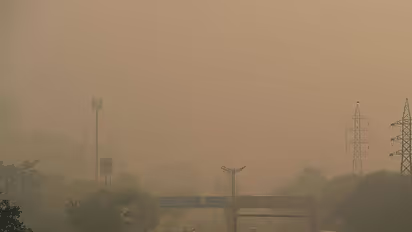
There was near-zero visibility in many parts of the city. Prolonged exposure beyond safe limits can harm the respiratory system.
Delhi woke up to the season's worst air quality as smoke from Diwali fireworks, coupled with moisture and nearly stagnant wind movement, shrouded the city in a thick cover of smog with respirable pollutants reaching perilous levels.
The volume of ultrafine respirable pollutants -- PM 2.5 and PM 10 -- shot up to alarming highs in the wee hours today, in line with the prediction of the Centre's Pune-based SAFAR (System of Air Quality and Weather Forecasting and Research).
Around 2 AM, the level of PM 10 had breached the 1,000 micrograms mark (in real time) in many parts of the city including the densely populated RK Puram and Anand Vihar. The safe limit of PM 10 is 100 micrograms per cubic metre.
Though the Safdarjung observatory recorded visibility at 200 metres officially, there was near-zero visibility in many parts of the city during the early morning hours, with smoke seen hanging heavy even in underground metro stations.
The level of PM 2.5, which ideally should be within the safe limit of 60 micrograms, shot up to 883 micrograms per cubic metre at Anand Vihar at 2 AM, while the same was 748 at RK Puram, as per the readings of the Delhi Pollution Control Committee (DPCC).
Even areas like Shanti Path, which record moderate levels of air quality even on the worst of days, had hazardous air, with the US Embassy's pollution monitor recording extremely high levels of PM 2.5, even way beyond the severe category.
"The highest levels of PM 10 and PM 2.5 are expected between 11 AM to 3 AM on the night of October 30-31. Air quality will be the worst on October 31 and start to improve from November 1," Project Director of SAFAR Gufran Beig had said.
Prolonged exposure to PM 2.5 and PM 10 beyond safe limits can harm the respiratory system as the ultra fine particulates can embed deep into the lungs and also enter the bloodstream.
Nearly all the monitoring stations of Central Pollution Control Board (CPCB), another agency that monitors the city's air, had 'severe' AQI (air quality index).
Agencies like SAFAR and CPCB advise people not to go outdoors when air quality turns 'severe' as it has adverse effect especially on children, elders and those having heart or lung diseases.
Pollution peaks in the national capital during Diwali as a hazardous mix of noxious gases and respirable pollutants hang very close to the surface due to low temperature and near-stagnant wind movement.
Smoke emanating from farm fires raging across agricultural fields of neighbouring Punjab and Haryana only worsens the situation.
Stay updated with the Breaking News Today and Latest News from across India and around the world. Get real-time updates, in-depth analysis, and comprehensive coverage of India News, World News, Indian Defence News, Kerala News, and Karnataka News. From politics to current affairs, follow every major story as it unfolds. IMD cities weather forecastsRain Cyclone Asianet News Official App