PM Modi hails Skyroot as Vikram-1 makes India 3rd in private launch
Synopsis
EAM S Jaishankar and PM Modi hailed the successful launch of Vikram-1, India's first privately developed rocket by Skyroot Aerospace. The historic mission makes India the third country with private orbital launch capability.
External Affairs Minister (EAM) S Jaishankar on Saturday hailed the successful launch of Vikram-1, calling it a historic moment for India's space sector. In a post on X, Jaishankar said the launch of "India's first privately developed launch vehicle" by Hyderabad-based Skyroot Aerospace was "truly historic". "India's space ambitions soar to new heights! The successful launch of #Vikram1, India's first privately developed launch vehicle, by #SkyrootAirspace @SkyrootA today is truly historic. The rocket is a reflection of what can be achieved when the innovation & entrepreneurial drive of India's youth are backed by the bold reforms of PM @narendramodi's vision." EAM Jaishankar wrote on X.
Prime Minister Narendra Modi also congratulated Hyderabad-based Skyroot Aerospace after Vikram-1 successfully reached orbit following its final burn and injected its payloads into a nearly 450-km Low Earth Orbit, making India the third country in the world with private orbital launch capability. Union Minister of State (MoS) for Science and Technology Jitendra Singh also celebrated the successful mission, highlighting the achievement of India's first privately developed orbital-class rocket.
Mission Aagaman: A Technical Triumph
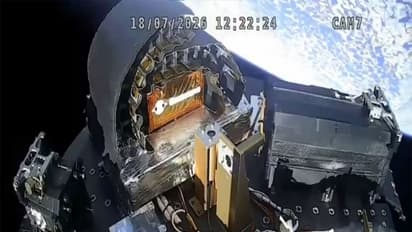
Skyroot Aerospace's Vikram-1 Test Flight-1 has successfully reached orbit, marking the maiden flight of India's first privately developed orbital-class rocket. The rocket completed its final burn and injected its payloads into a nearly 450-km orbit, making India the third country in the world with private orbital launch capability.
The mission, named "Mission Aagaman", was executed from the Satish Dhawan Space Centre. The 24-metre carbon-composite rocket completed all planned flight stages, including stage separations and the firing of its Orbital Adjustment Module (OAM).
The Orbital Adjustment Module fired its 3D-printed liquid engine for the final push to orbit. The module is designed to start, stop and restart in space.
Flight Stage Breakdown
During the flight--Kalam-1200, the solid first stage carried the rocket through the thickest part of the atmosphere before separating cleanly. The payload fairing was then separated, exposing the satellites to space for the first time.
The second stage, Kalam-250, completed its burn and separated, followed by the ignition of Kalam-100, the smallest and highest-flying solid stage of Vikram-1. The solid-propulsion phase concluded with the separation of Stage 3, paving the way for the Orbital Adjustment Module to complete the mission.
Rocket Design and Unique Payloads
The Vikram-1 rocket, powered by three solid-fuel stages and a liquid orbital adjustment module, is designed to deploy payloads up to 350 kg into a 450-km Low Earth Orbit (LEO).
The maiden flight carried multiple payloads, including the "Diamond Lotus", a lab-grown diamond from Bengaluru-based Cosmos Diamonds. Among the payloads on Vikram-1 Test Flight-1 is something truly special--a handwritten postcard from PM Modi with the words, "Vande Mataram". It travels to space alongside handwritten messages from the Skyroot team, investors, policymakers, and well-wishers across the globe, making Mission Aagaman a celebration carried by many hands and shared by millions. (ANI)
(Except for the headline, this story has not been edited by Asianetnews Editorial staff and is published from a syndicated feed.)Stay updated with the Breaking News Today and Latest News from across India and around the world. Get real-time updates, in-depth analysis, and comprehensive coverage of India News, World News, Indian Defence News, Kerala News, and Karnataka News. From politics to current affairs, follow every major story as it unfolds. IMD cities weather forecastsRain Cyclone Asianet News Official App