'Parliament supreme': VP Jagdeep Dhankhar defends remarks on judiciary's role (WATCH)
Synopsis
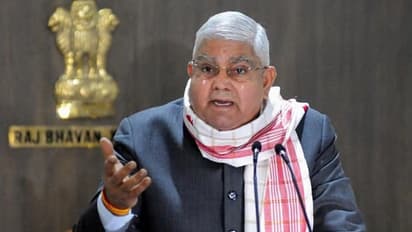
Vice President Jagdeep Dhankhar has once again stoked the ongoing institutional tussle, asserting that Parliament is supreme and accusing the judiciary—particularly the Supreme Court—of overstepping its constitutional boundaries.
Vice President Jagdeep Dhankhar has reignited the ongoing friction between the legislature and judiciary, asserting that Parliament holds supremacy in a democracy and warning against what he termed "judicial encroachment" by the Supreme Court.
Responding to criticism of his recent remarks questioning a top court order, Dhankhar defended his position, stating, “Every word spoken by a constitutional functionary is guided by the supreme national interest.”
He said "The Constitution is encapsulated, its essence, its worth, its nectar, in the Preamble of the Constitution. And what does it say? "We, the People of India." The supreme power is with them. No one is above the people of India. And we, the People of India, under the Constitution, have chosen to reflect their aspirations, their desires, their will through their public representatives. And they hold the representatives accountable, severely accountable, on occasions through elections. A Prime Minister who imposed ‘Emergency’ was held accountable in 1977. And therefore, let there be no doubt about it: the Constitution is for the people, and its repository of safeguarding is that of the elected representatives. They are the ultimate masters as to what the Constitution's content will be."
His comments reflect growing concerns among sections of the political establishment about judicial overreach, particularly in matters involving the basic structure doctrine and the review of parliamentary legislation.
Earlier, Jagdeep Dhankhar had sharply criticised the Supreme Court's April 8 verdict in the State of Tamil Nadu vs Governor case, which mandated a timeline for the President of India to act on state bills reserved by Governors.
Calling the judgement an overreach into executive functions, Dhankhar questioned the constitutional propriety of the court setting deadlines for the President’s assent. He further warned of growing judicial activism and called for greater accountability from the judiciary.
In a striking analogy, Dhankhar described Article 142 of the Constitution as a “nuclear missile against democratic forces available to the judiciary 24x7,” underscoring his concerns over its sweeping powers. The Supreme Court ruling, widely seen as a win for federalism, has reignited a deeper institutional debate on separation of powers and the role of constitutional functionaries.
Stay updated with the Breaking News Today and Latest News from across India and around the world. Get real-time updates, in-depth analysis, and comprehensive coverage of India News, World News, Indian Defence News, Kerala News, and Karnataka News. From politics to current affairs, follow every major story as it unfolds. IMD cities weather forecastsRain Cyclone Asianet News Official App