Pahalgam attack handshake? Pakistan PM Sharif, Army Chief Munir visit ISI headquarters
Synopsis
This visit coincided with increased global scrutiny of Pakistan's role in cross-border terrorism.
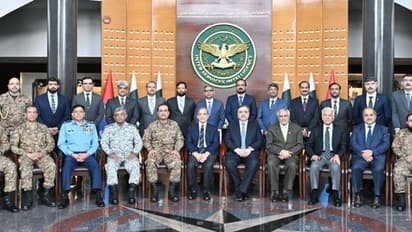
Days after the gruesome terror attack in Jammu and Kashmir’s Pahalgam that claimed 26 civilian lives, Pakistan Prime Minister Shehbaz Sharif and Army Chief General Asim Munir on Tuesday made a conspicuous visit to the headquarters of Pakistan’s Inter-Services Intelligence (ISI) in Aabpara, Islamabad—raising serious questions about the intent behind the meeting.
The high-profile visit came at a time when global condemnation is mounting over the April 22 terror strike, and scrutiny on Pakistan's role in fostering cross-border terrorism is intensifying. With the United Nations Security Council declining to issue any statement following Pakistan’s attempt to seek international sympathy, the Sharif-Munir meeting with ISI has triggered speculation about whether it was a covert nod to the intelligence agency for its alleged role in facilitating the Pahalgam attack.
ISI behind Pahalgam attack?
ISI, long accused of providing logistical and operational support to terror outfits targeting India, has been under global scrutiny, particularly after past attacks like Pulwama and Uri. Infact, former Pakistan Army personnel Adil Raja had earlier claimed on X that General Munir 'ordered the ISI to 'execute' the Pahalgam attack. Raja acknowledged the backlash he might face, adding, “I know this information will label us as Indian agents, but it is a fact.”
The visit comes amid India’s hard-hitting diplomatic and strategic response to the Pahalgam killings—including suspension of the Indus Waters Treaty, closure of the Attari land border, and a downgrade in diplomatic relations with Islamabad.
UNSC refuses to accept “false flag" narrative
Pakistan went to the United Nations Security council requesting a closed-door consultation, where Islamabad had to face some tough questions. According to sources privy to the meeting, council members refused to accept Pakistan’s “false flag” narrative and instead questioned whether terror group Lashkar-e-Taiba (LeT) was likely to be involved in the attack.
“There was broad condemnation of the terrorist attack and recognition of the need for accountability. Some members specifically brought up the targeting of tourists on the basis of their religious faith,” sources were quoted as saying.
India plans mock drills
Meanwhile, India will conduct a series of mock drills across 259 locations on May 7. Coming just days after a dastardly terror attack in Pahalgam and in the wake of Pakistan’s recent missile tests under “Exercise INDUS,” the mock drills are a clear indication to reinforce internal readiness for worst-case scenarios, including airstrikes or full-scale warfare.
Indian Prime Minister Narendra Modi had vowed to take strong action against the perpetrators of the Pahalgam attack. A high-level security review meeting with National Security Advisor Ajit Doval and Home Secretary Govind Mohan was convened by PM Modi on Tuesday, focusing India's options to respond to the dastardly attacks.
The meeting was a part of a series of consultations PM Modi has held with top defense and security officials. Defence Secretary Rajesh Kumar Singh briefed the Prime Minister on the evolving situation on Monday. Air Chief Marshal A P Singh, Chief of Air Staff, also met with Modi on Sunday to discuss the security scenario after the Pahalgam attack.
Stay updated with the Breaking News Today and Latest News from across India and around the world. Get real-time updates, in-depth analysis, and comprehensive coverage of India News, World News, Indian Defence News, Kerala News, and Karnataka News. From politics to current affairs, follow every major story as it unfolds. IMD cities weather forecastsRain Cyclone Asianet News Official App