No Cylinders, No Panic: The Kitchens That Cooked Through a Crisis
Synopsis
The conflict between the United States, Israel, and Iran has disrupted global energy routes through the Strait of Hormuz, the narrow waterway that carries nearly one‑fifth of the world’s oil and gas trade. India depends on it for over 90 percent of its LPG imports.
A war thousands of kilometres away has quietly walked into your kitchen in Bengaluru. No bombs, no blackouts — just an empty gas cylinder. The conflict between the United States, Israel, and Iran has disrupted global energy routes through the Strait of Hormuz, the narrow waterway that carries nearly one‑fifth of the world’s oil and gas trade. India depends on it for over 90 percent of its LPG imports. With the Strait effectively closed since March 1, those shipments have slowed to a trickle — and the flame under Bengaluru’s stoves has flickered dangerously low.
Karnataka Hit Hard
Karnataka’s hospitality sector bore the brunt almost overnight. On March 9, 2026, the State government capped commercial LPG supply at 7,000 cylinders a day, reserving just 1,000 for hotels, restaurants, and dhabas. Bengaluru alone has nearly 25,000 eating establishments.
The result: menus shrank, breakfast counters shut, and canteens rationed meals. The Bruhat Bengaluru Hoteliers’ Association estimated losses of ₹150 crore in just three weeks. Small eateries already strained by a ₹115 increase in cylinder prices were forced to downsize or close temporarily.
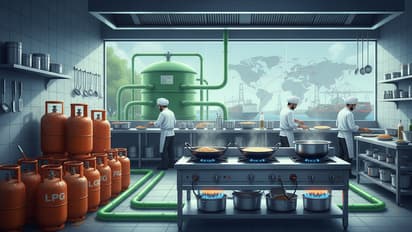
Amid this city‑wide scramble for LPG, a few kitchens kept their burners glowing — not with imported fuel, but with energy generated from their own waste.
Konarak’s Waste‑to‑Flame Model
Konarak Hotels, a four‑decade‑old landmark in Bengaluru’s vegetarian dining scene, never turned off its stoves. Instead, its Residency Road and Kanteerava Stadium, Kasturba Road kitchens ran entirely on compressed biogas (CBG) — produced in‑house.
Partnering with Carbon Age, a clean‑energy start‑up, Konarak installed a compact biogas plant that digests food and vegetable waste into methane‑rich gas 4 years back. The gas passes through scrubbers for purification before being compressed into cylinders.
“It burns just like LPG,” says Managing Director K .Ramamurthy. “We didn’t have to change the burners at all. It’s cheaper, cleaner, and always available.”
The nutrient‑rich slurry left after digestion is sent to nearby farms as organic manure, completing a perfect circular loop. When LPG trucks stopped arriving, Konarak’s kitchens didn’t notice.
Empire’s Koramangala Connection
A few kilometres away, the iconic Empire Restaurant in Koramangala runs largely on community‑generated biogas produced by the Kasa Rasa biogas plant, jointly managed by Saahas, Carbon Masters, and the Bengaluru Solid Waste Management Limited (BSWML).
Feeding on 8.5 tonnes of segregated wet waste daily from about 5,000 homes, the plant converts it into purified methane, which is stored and piped directly to nearby hotels.
“We’ve been getting almost 80 percent of our fuel from biogas for years,” says CEO Shakir Haq. “When LPG hit the crisis point, we didn’t have to reduce operations at all.”
The Koramangala network is now being called the “Empire Model” for decentralised, community‑scale waste‑to‑energy systems — efficient, odour‑free, and city‑compatible.
Adamya Chetana: India’s Largest Biofuel Kitchen
If biogas keeps hotels running, it also fuels compassion at scale. Bengaluru’s Adamya Chetana Foundation, founded by late Union Minister Ananth Kumar and run by Tejaswini Ananth Kumar, operates one of India’s largest community kitchens — serving nearly 200,000 mid‑day meals daily across government schools under the Akshara Dasoha programme.
In 2016, long before “energy crisis” became a headline, Adamya Chetana began reimagining its Basavanagudi kitchen with help from the Indian Institute of Science (IISc), Bangalore Bio Innovation Centre, and Bangalore City Corporation. Their joint project installed an advanced bio‑methanation and solar hybrid system, capable of processing about 1.5 tonnes of food and vegetable waste each day.
The digested slurry generates methane, which is purified, stored in balloons, and piped directly to industrial burners for cooking rice, sambhar, and vegetables. Alongside its solar‑steam system for water boiling, the foundation has built a kitchen that is 100 percent free of LPG and diesel.
As The Hindu reported, Tejaswini Kumar urged other institutions to adopt “no‑LPG kitchens.” “We cannot depend on imported fuel every time a global crisis breaks out,” she explained. “Waste and sunlight are free — that’s where our energy security lies.”
According to the foundation’s engineers, the biogas plant produces around 130–140 cubic metres of gas daily, enough to replace 150 commercial LPG cylinders a month. The shift saves ₹90,000–₹1 lakh monthly in fuel costs and prevents over 30 tonnes of carbon emissions each year.
The project also uses the leftover digestate as compost for urban terrace gardens maintained by volunteers. Over 2 million meals have now been cooked using biogas, proving that large‑scale community kitchens can run sustainably — even during total LPG cut‑offs.
Its success has drawn the attention of several state governments and NGOs working on mid‑day meal schemes. “For bulk‑cooking operations like hostels, hospitals, or temple kitchens, this is the future,” Tejaswini Kumar told Deccan Herald. “Once installed, the energy is free — every crisis only reminds us why this model matters.”
The Oterra’s Electric Resilience
While some institutions turned to biogas, others went electric. In Electronic City, The Oterra Hotel powers its kitchens almost entirely by induction and renewable electricity. LPG is reserved for pizza ovens and a few specialised sections — requiring just a couple of cylinders a day.
“Our kitchen electrification began in 2016 as a green‑energy initiative,” says General Manager Srinivas Adiga. “When LPG supplies dipped, our chefs didn’t even notice. It’s cleaner and consistent — no dependency on tankers.”
Bengaluru’s Untapped Potential
Experts estimate that Bengaluru’s 3,000 tonnes of daily wet waste could generate 200 tonnes of biogas, enough to meet nearly 20 percent of the city’s total hotel and canteen fuel demand.
“The capacity is literally under our feet,” says Som Narayan, co‑founder of Carbon Masters. “If each zone had decentralised biomethanation units, Bengaluru could become energy‑self‑reliant for its hospitality sector.”
A medium biogas system for a medium‑sized hotel now recovers its cost within three to five years, aided by savings on LPG, waste transport, and fertiliser use.
A Wake‑Up Call for Energy Independence
India consumes around 31 million tonnes of LPG annually, but domestic output meets less than half. Every drone strike or shipping blockade in West Asia translates into a restaurant closure in Mysuru or Mangalore. The message is clear: importing energy may light today’s stove, but only local innovation can keep it burning tomorrow.
From Konarak’s waste‑fed burners to Empire’s community biogas, from Adamya Chetana’s LPG‑free mega‑kitchen to Oterra’s electric stoves, Bengaluru is showing an energy model that matches India’s ambition for self‑reliance.
When the next global crisis hits, the winners will be those who looked beyond the cylinder — and turned yesterday’s leftovers into tomorrow’s flame.
Stay updated with the Breaking News Today and Latest News from across India and around the world. Get real-time updates, in-depth analysis, and comprehensive coverage of India News, World News, Indian Defence News, Kerala News, and Karnataka News. From politics to current affairs, follow every major story as it unfolds. IMD cities weather forecastsRain Cyclone Asianet News Official App