New employment law an 'overdue repair,' not demolition: BJP to Sonia
Synopsis
BJP's Amit Malviya has rejected Sonia Gandhi's criticism of the VB-G RAM-G law, calling it an 'overdue repair' and not a 'demolition.' He argued her claims were based on misrepresentations and that the new law strengthens employment guarantees.
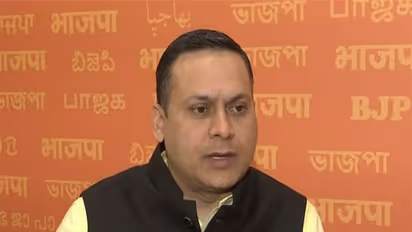
Bharatiya Janata Party (BJP) national IT cell in-charge Amit Malviya on Monday rejected Congress Parliamentary Party chairperson Sonia Gandhi's criticism of the VB-G RAM-G law, asserting that the legislation is not a "demolition" but an "overdue repair" on employment guarantees.
Responding on social media platform X, Malviya said Sonia Gandhi's recent article in an English daily reflected political speculation rather than a factual or legal assessment. He claimed her arguments were based on misrepresentations and selective interpretation, suggesting that she had not examined the provisions of the new Act. "Sonia Gandhi's recent article on MGNREGA reads less like a serious engagement with law or data and more like a flight of political fancy. It is evident that she has not read the VB-G RAM G Act, because her arguments rest on mischaracterisations, selective memory, and outright falsehoods," Malviya wrote on 'X'.
BJP counters Congress' claims on employment law
Malviya disputed Gandhi's claim that the demand-driven nature of employment has been undermined under the new law, stating that the legal right to employment remains intact. According to him, the only change is in the budgeting mechanism, which has shifted from an open-ended approach to a norm-based framework similar to those used in other government schemes.
He further said that the employment guarantee has been strengthened, with the maximum number of workdays increased from 100 to 125. He added that during FY 2024-25, planned allocations closely matched actual demand, indicating effective fiscal planning. "Sonia Gandhi next claims that demand-based employment is being dismantled, thereby destroying the employment guarantee itself. The facts say otherwise. The legal right to employment remains untouched. What has changed is the budgeting framework--from an open-ended, reactive model to a norm-based system, which is how virtually all government schemes function," he said.
"Far from weakening the guarantee, employment has been strengthened from 100 days to 125 days. In FY 2024-25, planned allocations closely tracked actual demand, demonstrating that disciplined planning works," the BJP leader said.
On impact on the poorest
Addressing concerns that changes to the MGNREGA framework would negatively impact the poorest sections, Malviya termed such claims misleading. He pointed to a sharp decline in rural poverty and a significant rise in MSME credit since 2014, arguing that these trends have expanded self-employment and non-farm livelihood opportunities. The claim that the poorest will be abandoned if the old framework changes is equally misleading. Rural poverty has fallen sharply--from 25.7% to 4.86%. MSME credit has tripled since 2014, enabling self-employment and non-farm livelihoods. Public policy cannot be frozen in the conditions of 2005 when India has demonstrably moved forward," he said.
On funding patterns
On funding patterns, Malviya rejected the opposition's assertion that the Centre is shifting the financial burden to states by moving from a 90:10 to a 60:40 funding ratio. He said MGNREGA was never fully funded at a 90% central share in practice, noting that states already bore substantial costs, including material expenses, administrative overheads, and unemployment allowances. He added that the new model formalises these arrangements, making states active partners rather than passive implementers. "Another repeated allegation is that the Centre is shifting the financial burden to states, moving from a supposed 90:10 model to 60:40. This, too, is false. MGNREGA was never funded at 90% by the Centre in practice. States already bore 25% of material costs, major administrative expenses, and 100% of unemployment allowance--often without predictability or transparency. The new model simply formalises and rationalises funding, making states equal partners rather than passive implementers of top-down mandates," he said.
'Overdue repair, not demolition'
Malviya described the VB-G RAM-G Bill as a long-overdue reform aimed at modernising social protection mechanisms. He said the legislation seeks to replace symbolic guarantees with a more effective, responsive framework suited to India's evolving economic conditions. "The bottom line is clear. This is not demolition--it is overdue repair The real choice is not between compassion and reform, but between paper guarantees that under-deliver and a modern framework that actually works. VB-G RAM G is not a retreat from social protection; it is its renewal and expansion for a changing India," Malviya wrote on 'X'. (ANI)
Sonia Gandhi's 'Bulldozed Demolition' charge
Congress Parliamentary Party Chairperson Sonia Gandhi, in a recent op-ed in a leading English daily, launched a sharp attack on the Central government, accusing it of dismantling the rights-based legislative framework through its proposed changes to the Mahatma Gandhi National Rural Employment Guarantee Act (MGNREGA) and other key laws.
In the article titled 'The Bulldozed Demolition of MGNREGA', Sonia Gandhi argued that the weakening of the rural employment scheme represents a collective moral failure, with long-term financial and human consequences for crores of working people across the country. She wrote that MGNREGA was not merely a welfare initiative but a rights-based programme that provided livelihood security and dignity to rural households. According to her, the erosion of the scheme is "collective moral failure". (ANI)
(Except for the headline, this story has not been edited by Asianet Newsable English staff and is published from a syndicated feed.)Stay updated with the Breaking News Today and Latest News from across India and around the world. Get real-time updates, in-depth analysis, and comprehensive coverage of India News, World News, Indian Defence News, Kerala News, and Karnataka News. From politics to current affairs, follow every major story as it unfolds. IMD cities weather forecastsRain Cyclone Asianet News Official App