$63 Billion Trade Shock: Jayant Krishna Explains How Modi Can Fix India’s Russia Imbalance
Synopsis
India–Russia ties face a critical test as Jayant Krishna warns of a ballooning trade deficit, sanctions pressure, oil uncertainty and the urgent need for market access, co-production and stable payments.
As Russian President Vladimir Putin arrived in New Delhi to a red-carpet welcome, 21-gun salute, and a warm hug from Prime Minister Narendra Modi, the spotlight has once again returned to a relationship often described as “time-tested” and “rock solid.”
From defence deals and joint manufacturing to cheap oil and geopolitical balancing amid US tariffs, the India–Russia partnership remains strategically indispensable. But beneath the warmth lies hard economic math—an increasingly unsustainable trade deficit, limited market access for Indian goods, and long-standing regulatory bottlenecks.
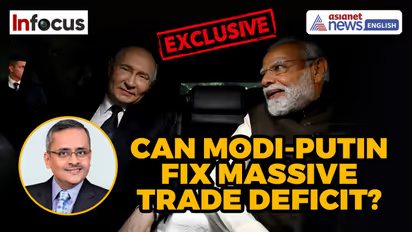
To decode the realities beneath the rhetoric, Asianet Newsable’s Heena Sharma spoke exclusively with Jayant Krishna, Senior Fellow at the Center for Strategic and International Studies.
Krishna explains what India urgently needs from Russia, how sanctions have reshaped trade mechanisms, whether oil imports can survive pressure from Washington—and why India must reimagine economic engagement beyond defence.
A Ballooning Trade Deficit: “We’ve had a miserable performance”
Despite strong political ties, India’s exports to Russia remain shockingly low. Krishna minces no words.
"If you look at both these countries and their GDP rank by purchasing power parity, right— we are already the third-largest economy by PPP. Otherwise, we are the fourth largest. And Russia is the fourth-largest by purchasing power parity as well. So these are two large economies, and Russia’s geographical expanse is huge. But the fact is that on the export front— the export of Indian products to Russia— we’ve had a miserable performance for several years. It’s not a new development at all.”
He points out how dramatically the gap has widened:
"The trade deficit in favour of Russia and against India, which used to be about $3.4 billion in 2020, has galloped to as much as $63 billion in the full year for which we have data— 2024. I think this is something we need to look at more closely. We all know India imports lots of products from Russia— beyond military equipment and so on.”
India imports Russian crude, fertilizers, edible oils and defence hardware in large volumes—but has no meaningful export category going the other way.
And tariff barriers are not to blame.
“Whereas if you look at what India exports to Russia, there’s not a single product category that has a critical mass. It’s a very, very small basket. And from what I understand, most of the open issues are not tariff issues. Unlike the US— where India faces 50% tariffs on most products except the exempted ones— with Russia, tariff barriers are not very significant. But non-tariff barriers, in terms of allowing Indian products to be exported to Russia, their standards, stipulations and many other regulations— these need to be ironed out," Krishna said.
What India Can Export: Textiles, Farm Goods, Marine Products, Pharma
Krishna lays out four sectors where India can immediately push for access—if Moscow lowers regulatory hurdles.
1. Textiles & Garments
“The categories that are very important, to my mind, are textiles and garments. If India is exporting them to the rest of the world, why not to Russia as well?”
2. Agricultural Products
With a population of nearly 14 crore, Russia is a major food market.
"Another category is farm products— India has emerged as a significant exporter of agricultural goods. And Russia’s population is about 14 crore. There are many mouths to be fed. That’s one area where we need greater market access.”
3. Shrimps and Marine Products
“Shrimps and other marine products— in the fisheries category— are another area where India can start exporting, because Russia is a huge shrimp-consuming country.”
4. Pharmaceuticals
Even the US exempted Indian pharma from its steep tariffs.
"Pharmaceuticals too— even the US kept pharmaceuticals outside its 50% tariff barrier because it is critical for the US to import pharmaceuticals from India. There is no reason why India shouldn’t export pharmaceuticals to Russia as well.”
But India will have to fight off stiff competition.
“China, over the years, has flooded the Russian market with a lot of its products. India will have to… I mean, it's not just a market access issue. We need to be competitive as well, vis-à-vis Chinese products that are already available in Russia in abundance. I think that’s fair because the export market is entirely competition-driven, and I’m sure India will find its own space— its own areas of advantage— where exports to Russia should be feasible,” Krishna stated.
The Sanctions Shadow: “We have to operate within the framework”
When asked if regulatory restrictions are new or post-Ukraine war, Krishna is clear:
“The single biggest contributor has been the sanctions imposed by the US and some other European countries when Russia invaded Ukraine in 2022. So we have to operate within the framework of those sanctions and examine whether they hurt us when it comes to exporting Indian products to Russia.”
These sanctions complicate payments, logistics, market entry and compliance for Indian exporters. He adds that some Russian category restrictions also limit what India can sell.
"Russia also has some category restrictions from what I understand. Certain product categories can’t be exported, or they have to go through a lot of due diligence— standards have to be met, and so on. These kinds of barriers need to be looked at. If India can export many of these products to the rest of the world, why not to Russia as well?” Krishna highlighted.
FDI Puzzle: “Russia has not looked at India as a major destination”
India invests far more in Russia than the reverse. Why? He cites the legacy of earlier disputes (like telecom licensing), but insists the environment today is much improved.
“For some reason, Russian businesses have not looked at India as a major source… as a major country where FDI can come in. One possible reason could be the episode where a Russian company’s 2G licence was cancelled in India after it had already made investments.”
“They may have some bitterness, but that’s a very old story now. Russia has to look at the fact that India’s ease of doing business has improved. Our rank, which used to be 120th, had jumped to 63. In the last couple of years the ranking hasn’t been updated, but I’m sure it would have jumped further. This is very important,” Krishna added.
However, he also warns India must ensure:
“Another thing India needs to look at— not just with Russia but also vis-à-vis the US, the European Union and others— is that we must ensure regulatory certainty. You can’t have a certain set of policies and regulations in place when someone decides to make an investment and then change it mid-course. I think that hurts the sentiments of overseas investors quite a lot. And once these things are addressed, I think there are many areas where Russian businesses could invest in India. I see this as… well, the problem is that our ties, historically, have largely been focused on defence,” Krishna said.
Defence Co-Production: “Not just importing, but co-manufacturing”
Beyond buying arms, India wants Russian systems built on Indian soil. Krishna lists major opportunities:
"India has never really explored or shown the hunger to attract Russian investments— something I’m sure will start happening now. Even for some of the defence products— like the S-400 upgrades, which are the S-500— not just importing them, but co-producing and co-manufacturing them with Russia in India, that’s very important.”
“Even the Sukhoi fifth-generation aircraft could be manufactured in India. Small and modular nuclear reactors, nuclear submarines— there are many areas India could explore. Rather than just importing from Russia, why not attract FDI here and co-manufacture these systems in the country itself, under the Make in India initiative or even otherwise? I think that's really important.”
Oil Imports Under Pressure: “It’s anybody’s guess”
Washington’s sanctions on two major Russian oil suppliers created uncertainty for Indian refiners.
“I think initially the public-sector oil companies in India went slow on importing,” Krishna said.
Yet November saw a surprising uptick.
“But if you look at the November data, we actually imported more crude oil from Russia than we did the previous month,” he added.
But a decline remains likely unless Modi and Putin find diplomatic workarounds.
Krishna stresses the economic logic:
"It makes a lot of business sense for India to import oil from Russia, given the rates we get. It helps India not only in terms of balance-of-payment matters but also in making cheaper oil available to Indian individuals as well as businesses.”
Rupee–Ruble Payments & BRICS Talk: “A contentious issue”
With 90% of bilateral trade currently settled in rupee–ruble terms, the mechanism still faces friction due to Western sanctions. Many multinational banks of Indian origin refused Russian payments because of potential sanctions.
“This is a contentious issue. If you look at BRICS, there have been discussions at the BRICS forum on de-dollarization and so on. So I think it’s not that easy. Yes, there are issues about the stability of the Russian currency and so on. Indian businesses would prefer that all these transactions shift to dollars and that we do dollar-denominated trade between the two countries. But it remains to be seen how these discussions go, and in the near future I don’t see any major changes in the way currencies operate in trade between these two countries,” Krishna noted.
And Krishna is blunt about the most stable option:
“But a more stable arrangement, to my mind, would be to do it in dollars.”
Stay updated with the Breaking News Today and Latest News from across India and around the world. Get real-time updates, in-depth analysis, and comprehensive coverage of India News, World News, Indian Defence News, Kerala News, and Karnataka News. From politics to current affairs, follow every major story as it unfolds. IMD cities weather forecastsRain Cyclone Asianet News Official App