Meta's Big Shift In India: Why Facebook Owner Will Now Report Child Safety Cases To I4C
Synopsis
Meta’s decision to report child safety matters directly to India’s I4C follows scrutiny over alleged child sexual abuse material promoted through Instagram advertisements. A BBC Eye investigation triggered government action, while MeitY ordered the ads removed and sought an explanation.
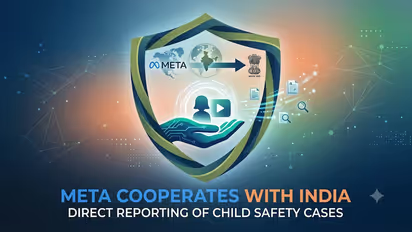
Meta, the parent company of Facebook and Instagram, has agreed to report child safety-related matters directly to India’s cybercrime portal, managed by the Indian Cyber Crime Coordination Centre (I4C), in a significant shift in how such cases are reported to Indian law enforcement. The move comes as the Centre steps up pressure on social media platforms to strengthen safeguards for children and take greater responsibility for harmful and illegal content online, including child sexual abuse material (CSAM), deepfakes and other forms of online abuse.
Meta said protecting children on its platforms remains a priority and that it is committed to working with the Indian government to hold those responsible for such crimes accountable. “To collectively strengthen our efforts to combat this harm, Meta will now report child safety matters directly to the cybercrime portal managed by I4C,” a Meta spokesperson said.
Meta, which is headquartered in the United States, is the first major technology intermediary to commit to creating a direct reporting pipeline to Indian law enforcement.
What has Meta agreed to do?
Until now, Meta has primarily reported child safety cases to the US-based National Center for Missing and Exploited Children (NCMEC).
The new arrangement will allow child safety-related matters to be reported directly through the cybercrime portal operated by I4C in India.
Government sources said earlier on Tuesday that Meta had agreed to report child safety-related matters to appropriate law enforcement agencies.
The Centre has described children's online safety as a “fundamental principle” for every social media platform operating in India and said it is “non-negotiable”.
The government has also warned that platforms that fail to take proactive measures to protect children could face action.
Why is the I4C reporting system important?
The Indian Cyber Crime Coordination Centre was established by the Ministry of Home Affairs to coordinate efforts against cybercrime in India.
It operates the National Cyber Crime Reporting Portal, or cybercrime.gov.in, which has a special focus on crimes against women and children.
I4C has also developed the Sahyog portal, which is used to route content takedown requests to social media platforms.
The Centre has previously directed intermediaries to appoint nodal officers for reporting child sexual abuse material and use artificial intelligence tools to identify and remove such content.
Direct reporting by Meta to the I4C system could therefore reduce the additional steps involved in getting child safety cases before Indian authorities.
Government increases pressure on social media platforms
The development comes amid increased government scrutiny of social media companies over illegal and harmful online content.
The Centre has been pushing platforms to identify and remove such material more proactively, while demanding stronger safeguards and greater accountability.
Government sources said India is continuing discussions with other online platforms and expects them to take proactive steps to identify and remove harmful content.
The government has also warned platforms that failure to comply with Indian law will not be tolerated.
The pressure has increased following concerns over child sexual abuse material and deepfakes appearing or being promoted through online platforms.
Meta faced scrutiny over Instagram CSEAM ads
Meta's agreement follows a series of actions by Indian authorities concerning alleged child sexual exploitative and abuse material (CSEAM) on Instagram.
In July, the Ministry of Electronics and Information Technology (MeitY) issued a notice to Meta over CSEAM allegedly appearing in paid advertisements on Instagram.
The ministry ordered Instagram to disable advertisements and content promoting or facilitating access to such material.
It also demanded a detailed explanation from Meta.
Several rounds of discussions with Meta's senior executives followed. During those discussions, the IT Ministry made it clear that such material was a violation and could not be protected under safe-harbour provisions.
What did the BBC Eye investigation allege?
The government action followed a BBC Eye investigation published in early July. The investigation alleged that Instagram had carried paid advertisements promoting CSAM. Some of the advertisements allegedly directed users to Telegram channels containing sexually explicit material involving children.
The investigation also alleged that Meta's recommendation systems were amplifying videos containing such material.
Following the report, MeitY ordered Instagram to disable the advertisements and asked Meta to provide a detailed explanation within seven days.
The allegations triggered further scrutiny from Indian authorities over how online platforms detect, report and remove illegal content involving children.
NCPCR also summoned Meta India executives
Earlier this month, the National Commission for Protection of Child Rights (NCPCR) summoned Meta India's Managing Director and Head of Meta India over its inquiry into the alleged CSEAM advertisements.
The child rights body took suo motu cognisance of the BBC Eye report and sought an explanation from the company.
The case has therefore involved several Indian authorities, reflecting the growing focus on how social media platforms respond when illegal content involving children is reported or detected.
NHRC seeks probe into Meta's reporting obligations
The National Human Rights Commission (NHRC) also became involved.
It directed the Delhi Police to investigate whether Meta had complied with mandatory reporting requirements under the Protection of Children from Sexual Offences (POCSO) Act.
In early August, the commission issued a follow-up notice seeking action-taken reports from MeitY, police authorities and Meta.
The issue of reporting is particularly important because authorities need information about suspected child sexual abuse material to investigate the people creating, distributing or facilitating access to it.
What does this mean for Meta and India?
Meta's direct reporting commitment marks a notable change in its engagement with Indian law enforcement.
The company had previously relied primarily on reporting child safety cases to NCMEC in the US. That system has faced criticism in India because it can introduce additional steps between a platform detecting potentially illegal content and domestic authorities receiving the information.
The new commitment is intended to create a more direct channel with Indian authorities through the I4C cybercrime portal.
However, government sources have stressed that the move is only a first step.
The Centre wants social media platforms to do more than report cases after harmful material is identified. It is also pressing them to proactively detect, prevent and remove such content.
(With inputs from agencies)
Stay updated with the Breaking News Today and Latest News from across India and around the world. Get real-time updates, in-depth analysis, and comprehensive coverage of India News, World News, Indian Defence News, Kerala News, and Karnataka News. From politics to current affairs, follow every major story as it unfolds. IMD cities weather forecastsRain Cyclone Asianet News Official App