Ladakh to get Autonomous Hill Development Councils in all 7 districts
Synopsis
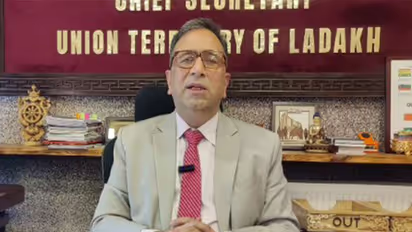
Ladakh UT Administration will constitute an Autonomous Hill Development Council in each of its seven districts, a move described by Chief Secretary Ashish Kundra as a major step towards democratic decentralisation and grassroots governance.
Ladakh's Chief Secretary Ashish Kundra has announced that the Union Territory Administration will constitute an Autonomous Hill Development Council in each of the seven districts on Monday. Adressing a press conference in Leh, he described it as a major step towards democratic decentralisation and grassroots governance.
Section 3(1) of the Ladakh Autonomous Hill Development Council (LAHDC) Act already provides for a Council for every district, to be constituted from a date the government notifies in the gazette. Only amendments to the Act were required, and a delimitation of constituencies remains, according to a release.
Ladakh moved from two districts to seven in April, when Sham, Nubra, Changthang, Zanskar and Drass were notified. Elected representation until now has stayed with the two existing Councils in Leh and Kargil.
With this announcement, each of the seven Councils will carry the full powers set out in the LAHDC Act. The new districts get the same authority that Leh has held since 1995 and Kargil since 2003, not a reduced version of it, the release noted.
Powers and Responsibilities of New Councils
Land Ownership and Allotment
Hill Councils have authority over land ownership and land allotment within the district. Sham, Nubra, Changthang, Zanskar and Drass will exercise that authority within their own boundaries.
Employment and Recruitment
Councils regulate recruitment and promotion for district cadre posts. Employment decisions in the new districts will rest with an elected body inside the district.
Financial Autonomy
Councils hold a dedicated Council Fund and can levy taxes and fees. Each new district will have a revenue base of its own.
Localised Development Plans
Councils formulate their own development plans. Each district will set its own priorities rather than receive them from Leh or Kargil.
Control over Local Services
Councils are responsible for health, education and tourism at the district level, along with local infrastructure and social welfare schemes.
Future Governance Framework
A Union Territory-level body is proposed above the seven Councils under a customised Article 371 framework, with legislative, executive, financial and administrative powers. The Chief Secretary said the model has no parallel elsewhere in the country and will draw on the best features of other arrangements, the release said.
The structure and powers of the Union Territory-level body will be settled through consultation between Ladakh's representatives and the Government of India. Some rebalancing of powers between the Councils and the UT body may follow.
The Councils are the first firm element of the new structure to be confirmed.
Coexistence with Panchayati Raj
As per the release, Panchayati Raj institutions will continue alongside the Hill Councils. Ladakh will have elected representation at the village, district and Union Territory levels. (ANI)
(Except for the headline, this story has not been edited by Asianetnews Editorial staff and is published from a syndicated feed.)Stay updated with the Breaking News Today and Latest News from across India and around the world. Get real-time updates, in-depth analysis, and comprehensive coverage of India News, World News, Indian Defence News, Kerala News, and Karnataka News. From politics to current affairs, follow every major story as it unfolds. IMD cities weather forecastsRain Cyclone Asianet News Official App