Karachi Agreement at 75: Still Fuelling Gilgit-Baltistan Protests
Synopsis
The Karachi Agreement, signed secretly in 1949, gave Pakistan control over Gilgit-Baltistan and other occupied parts of Jammu and Kashmir. No representative from Gilgit-Baltistan was included in the talks. Today, many residents say that unfair decision still affects their lives. They are demanding cheaper electricity, lower taxes and true self-rule
New Delhi: Seventy-five years after the Karachi Agreement — through which the political leadership of so-called "Azad Kashmir" handed Pakistan sweeping control over Pakistan-Occupied Jammu and Kashmir (PoJK), including Gilgit-Baltistan — the streets of this illegally occupied region are telling a simple truth: what was done without the people cannot indefinitely be imposed upon them. The current wave of protests is not an aberration; it is the long-deferred bill for a fraud committed in 1949.
A secret deal over a disputed land
The Karachi Agreement was signed on 28 April 1949 between the Government of Pakistan, the so-called "Azad Jammu and Kashmir" (AJK) regime represented by its president Sardar Muhammad Ibrahim Khan, and the All Jammu and Kashmir Muslim Conference under Chaudhry Ghulam Abbas — behind closed doors and away from public scrutiny. Kept as a secret document until it was revealed by the AJK High Court in the early 1990s, the agreement ceded to Pakistan control over defence, foreign affairs, communications, and, crucially, "all affairs of Gilgit and Ladakh" through the political agent in Gilgit.
No representative from Gilgit-Baltistan was present — a fact acknowledged by Pakistan's own courts decades later, with the AJK High Court specifically noting that there was no constitutional or legal provision empowering AJK representatives to act on behalf of the people of the region. That alone renders the arrangement politically immoral and legally untenable by any contemporary understanding of self-determination.
This was not a sovereign bargain; it was an intentional carve-up of territory that was not the signatories' to divide.
New Delhi has consistently rejected these moves, reiterating that the entire state of Jammu and Kashmir — including Gilgit-Baltistan — is an integral part of India, and that Pakistan's presence there is the result of forcible and illegal occupation. In other words, Karachi was an agreement among usurpers about how to manage what they had illegally seized.
Gilgit-Baltistan: a region without a constitution
Gilgit-Baltistan, an integral part of PoJK illegally occupied by Pakistan, came to be described by its own people as Khita-e-Be Aaeen — "a region without a constitution." Its administrative status was deliberately kept vague: not a province of Pakistan, not a genuinely autonomous unit, and certainly not empowered to decide its own future.
Successive Pakistani governments exploited this ambiguity to retain de facto control while evading responsibilities for rights, representation and development, while simultaneously engineering demographic changes and committing human rights violations.
Over the decades, Islamabad experimented with a series of ad hoc arrangements. Zulfikar Ali Bhutto established the Northern Areas Council in 1970, and subsequent administrations introduced the Gilgit-Baltistan (Empowerment and Self-Governance) Order 2009 — which created an elected legislative assembly and gave the region de facto province-like status — and then the Gilgit-Baltistan Order 2018, which replaced the 2009 framework.
Yet each iteration retained decisive authority with the federal executive, the prime minister, and the bureaucracy. India rightly protested that these moves were attempts to camouflage and perpetuate illegal occupation rather than to genuinely empower the region's people. For residents of Gilgit-Baltistan, the pattern was unmistakable: cosmetic councils, real power elsewhere.
Appointees instead of citizens
From the 1950s onward, governance in PoJK and in Gilgit-Baltistan was dominated by appointees — political agents, federal advisers, and military figures — rather than by genuinely elected local representatives.
Political activities were repeatedly curtailed; under Ayub Khan's martial law (1958–1969), even in PoJK, parties were constrained and local institutions were subordinated to the priorities of Pakistan's security establishment. In Gilgit-Baltistan, the situation was more extreme: no provincial status, no real assembly, and no meaningful role in decisions that shaped their land and resources.
What little "participation" existed was tightly managed. Electoral exercises were either absent, heavily circumscribed, or held under frameworks where Islamabad retained the power to dismiss governments or override legislation at will. These were not missteps but deliberate design features of a system geared to strategic control — over rivers, mountains, and eventually the China-Pakistan Economic Corridor — rather than to democratic inclusion.
Federal-heavy structures, local-light rights
The constitutional architecture that grew out of the Karachi Agreement entrenched a federal-heavy, region-light arrangement across PoJK. In AJK, an Islamabad-dominated council and constitutional provisions allowed the Pakistani government to dismiss elected authorities and keep critical portfolios beyond local reach.
In Gilgit-Baltistan, a chain of presidential orders and special regulations ensured that land, natural resources, taxation and security remained under federal or military control, leaving locals with only token representation.
This was exploitation by design. Pakistan extracted strategic depth and economic value from the region while denying its people full citizenship, constitutional protection and enforceable rights. Even Pakistani scholarship now acknowledges that Gilgit-Baltistan remains in constitutional limbo and that the deliberate ambiguity of its status directly undermines human security there.
Protests as a verdict on Karachi
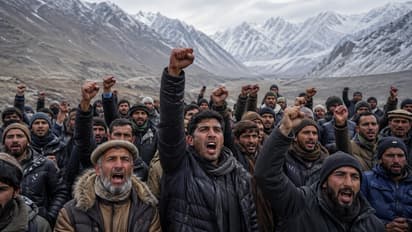
That is why the protests in Gilgit-Baltistan are not confined to the price of wheat or the burden of unfair taxes — though both are real triggers. Demonstrators braving sub-zero temperatures have demanded the restoration of wheat subsidies at 2022 levels, the suspension of the Finance Act 2022, the withdrawal of punitive levies, cancellation of exploitative mining leases awarded to non-locals, free electricity from local dams including the Diamer-Bhasha Dam, and — crucially — the replacement of the existing assembly with a genuinely empowered constituent body.
Hashtags like "#GBWantAutonomy" capture a political aspiration long suppressed by Islamabad's security-centric governance.
Each slogan on the streets is, in effect, a charge sheet against the Karachi Agreement and the illegitimate occupation it sought to entrench. The people are asking why a secret deal among Pakistani and PoJK elites in 1949 should still determine who owns their land, who writes their laws, and who speaks for them at the United Nations. Pakistan has no convincing answer beyond the tired rhetoric of "national interest" and "sensitive borders."
Seventy-five years on, tinkering with orders and councils cannot cure an original sin. A document signed without Gilgit-Baltistan's participation, over territory that Pakistan occupies illegally, cannot be the foundation of legitimate governance.
For India, the position remains clear: PoJK, including Gilgit-Baltistan, is part of the Union of India, and Pakistan must vacate these areas it has held by force since 1947.
For the people under occupation, the immediate demand is equally clear: clarity of constitutional status, genuine autonomy, and elected institutions that answer to them — not to a desk in Islamabad or Rawalpindi.
The protests in Gilgit-Baltistan are the latest reminder that the Karachi Agreement did not settle anything; it merely postponed the reckoning. Seventy-five years later, that reckoning has arrived.
Stay updated with the Breaking News Today and Latest News from across India and around the world. Get real-time updates, in-depth analysis, and comprehensive coverage of India News, World News, Indian Defence News, Kerala News, and Karnataka News. From politics to current affairs, follow every major story as it unfolds. IMD cities weather forecastsRain Cyclone Asianet News Official App