JP Nadda stresses 'Jan Bhagidari' for TB Mukt Bharat Abhiyaan goal
Synopsis
Union Health Minister JP Nadda chaired a TB Mukt Bharat Abhiyaan review meet in Delhi, emphasizing that TB elimination requires a people's movement through 'Jan Bhagidari', cooperation, and involvement of public representatives at all levels.
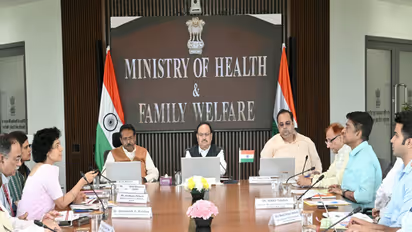
Union Health Minister Jagat Prakash Nadda on Wednesday chaired a review meeting of the TB Mukt Bharat Abhiyaan and the 100-day tuberculosis campaign with the Government of the National Capital Territory (NCT) of Delhi, emphasising that the elimination of tuberculosis can only be achieved through cooperation, public participation and coordinated implementation at all levels.
Jan Bhagidari Key to Bridge Gaps
According to a press release, addressing the meeting, Nadda said that while significant efforts have been made under the TB Mukt Bharat Abhiyaan, the remaining gap between efforts and outcomes can only be bridged through Jan Bhagidari (people's participation). He said tuberculosis elimination cannot be achieved by the health system in isolation and called for a people's movement with active participation from communities, public representatives and civil society.
Engaging Public Representatives
The Union Health Minister stressed that Members of Parliament, Members of Legislative Assemblies and Municipal Councillors should be regularly apprised by health officials about the TB burden in their respective constituencies, the challenges being faced, the solutions being implemented and the specific role they can play in accelerating case detection, ensuring treatment adherence and mobilising community support. He noted that public representatives are an important bridge between the government and the people, and their active involvement can significantly strengthen grassroots implementation of the campaign.
Directives for Cooperative Implementation
Reiterating Prime Minister Narendra Modi's vision articulated during the recent PRAGATI meeting, Nadda underlined that implementation should be based on cooperation rather than working in isolation. He directed that every ward should have a designated senior government officer to monitor the progress of the campaign. He also called for greater participation of MY Bharat volunteers to strengthen grassroots mobilisation and community outreach.
AI and Technology in TB Detection
Highlighting the role of technology in strengthening TB detection, the Union Minister said support would be provided for more handheld X-ray machines integrated with Artificial Intelligence (AI) to facilitate early diagnosis and improve case detection.
Strengthening Coordination and Communication
Nadda further emphasised the need for close coordination among the Union Ministry, the Delhi Government, district administration, healthcare institutions and frontline workers to ensure effective implementation of the campaign. He also stressed that all communication related to the campaign should be conveyed in simple, easily understandable language to ensure wider public outreach and participation. The Union Health Minister directed that regular joint review meetings involving hospitals, state health authorities and the Ministry of Health and Family Welfare be convened to review progress, address implementation challenges and facilitate the timely exchange of best practices. He said sustained coordination, collective ownership and Jan Bhagidari would be critical to achieving the national goal of a TB-Mukt Bharat.
Delhi's Progress and Path Forward
Presenting the programme review, Additional Secretary and Mission Director, National Health Mission, Aradhana Patnaik, said AI-driven vulnerability mapping using more than 30 region-specific indicators has identified 1.58 lakh high-risk villages and wards across the country. In Delhi, the exercise has narrowed the focus to 38 wards across 11 districts that together account for over 80 per cent of the city's high-risk burden, enabling a precision-targeted approach. Patnaik said Delhi has screened 28.83 lakh people, conducted 21.67 lakh chest X-rays and 3.65 lakh molecular (NAAT) tests, and notified 1.75 lakh TB patients under the campaign. She acknowledged the contribution of ASHA workers, Community Health Officers, laboratory technicians and field teams in carrying out ward-level screening and testing. She suggested that Delhi work towards providing upfront NAAT testing for all presumptive and drug-resistant TB cases alongside X-ray screening, ensure 100 per cent assessment of TB patients for differentiated care, further scale up TB Preventive Treatment for household contacts and other eligible vulnerable groups, and expand the engagement of Ni-kshay Mitras and MY Bharat volunteers to provide psychosocial support that often determines treatment adherence. Patnaik also encouraged Delhi to strengthen coordination with Resident Welfare Associations, ward committees and elected representatives, while affirming that the Union Health Ministry would continue to support the Delhi Government in achieving the objectives of the TB Mukt Bharat Abhiyaan.
High-Level Meeting Participants
The review meeting was attended by Union Minister of State Harsh Malhotra, Delhi Health Minister Pankaj Kumar Singh, MCD Mayor Parvesh Wahi, Union Health Secretary Punya Salila Srivastava, Special Secretary (Urban Development) Manoj Kumar Dwivedi, directors of AIIMS New Delhi, Safdarjung Hospital, Ram Manohar Lohia Hospital, Lady Hardinge Medical College and Army Hospital, representatives of NDMC, and senior officials from the Delhi Government and the Union Health Ministry. (ANI)
Stay updated with the Breaking News Today and Latest News from across India and around the world. Get real-time updates, in-depth analysis, and comprehensive coverage of India News, World News, Indian Defence News, Kerala News, and Karnataka News. From politics to current affairs, follow every major story as it unfolds. IMD cities weather forecastsRain Cyclone Asianet News Official App