INS Gharial Docks in Colombo with Bailey Bridges for Cyclone Relief
Synopsis
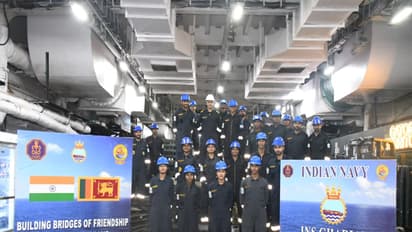
INS Gharial delivered 10 Bailey Bridges to Colombo to aid Sri Lanka's recovery from Cyclone Ditwah. This mission, part of India's humanitarian efforts, will restore crucial road connectivity for relief operations and affected communities.
The Indian Naval Ship Gharial has docked in Colombo with a vital shipment of 10 Bailey Bridges, aimed at bolstering Sri Lanka's reconstruction efforts following the devastation caused by Cyclone Ditwah. The delivery, which took place on Wednesday, marks a key milestone in ongoing humanitarian efforts to restore infrastructure and support affected communities in the aftermath of the cyclone.
Cyclone Ditwah caused severe damage to roads and vital transport networks, disrupting civilian mobility and hampering relief operations. The modular Bailey Bridges are set to play a transformative role in swiftly re-establishing road connectivity, ensuring that emergency services and humanitarian aid can reach the most impacted regions without delay.
India's Swift Humanitarian Response
This mission is integral to the humanitarian assistance and disaster relief (HADR) framework, which has become increasingly significant in the wake of natural disasters that threaten regional stability. It is also aligned with India's commitment made under the USD 450 million Special Economic Package announced by External Affairs Minister S Jaishankar, further demonstrating the depth of India's support for its neighbours during challenging times.
The deployment of the Indian Navy's resources exemplifies India's proactive stance as a first responder in the Indian Ocean Region, solidifying its role as a reliable partner in times of crisis.
The operation is an extension of the ongoing regional cooperation framework, Operation Sagar Bandhu, which aims to foster resilience and collaboration among countries in the region.
As the situation develops, the Indian Navy's efforts reiterate a message of hope and resilience, reinforcing the bond between India and Sri Lanka as they work together to overcome the challenges posed by natural disasters.
The swift delivery and implementation of these Bailey Bridges will not only expedite the rehabilitation process but also underscore the importance of regional cooperation in addressing humanitarian needs.
In the coming weeks, as reconstruction activities gain momentum, the collaborative spirit demonstrated by the Indian Navy and Sri Lankan authorities will serve as a reminder of the strong ties that unite the two nations, showcasing the power of solidarity in the face of adversity
Previous Engineering and Reconstruction Efforts
Cyclone Ditwah, which struck Sri Lanka late last year, triggered widespread flooding, landslides, and large-scale infrastructure damage, overwhelming local disaster-response mechanisms.
Earlier this January, the Indian Army's Engineer Task Force successfully constructed the third Bailey Bridge, measuring 120 feet, at KM 15 on the B-492 Highway in Sri Lanka. The bridge, located in the Central Province, reconnects the Kandy and Nuwara Eliya districts, restoring a critical lifeline that had remained disrupted for over a month following the devastation caused by Cyclone Ditwah.
The achievement followed the earlier successful launch of two Bailey bridges in the Jaffna and Kandy regions. Collectively, these engineering efforts have restored road connectivity, improved access to essential services, and provided much-needed relief to communities affected by the cyclone.
Under Operation Sagar Bandhu
Operation Sagar Bandhu, launched in November 2025, enabled India to provide urgent Humanitarian Assistance and Disaster Relief (HADR), including restoration of roads, bridges, and essential services.
By swiftly reestablishing connectivity along the B-492, the Indian Army has not only facilitated daily life for affected communities but also strengthened bilateral ties and goodwill between India and Sri Lanka.
Reinforcing the 'Neighbourhood First' Policy
This effort reaffirms India's steadfast commitment to Sri Lanka and the Neighbourhood First policy.
Under its 'Neighbourhood First' policy, Government is committed to developing friendly and mutually beneficial relations with all its neighbours.
India is an active development partner and is involved in several projects in the following countries - Afghanistan, Bangladesh, Bhutan, Maldives, Myanmar, Nepal, Pakistan, Sri Lanka.
India's policy of 'Neighbourhood First' focuses on creating mutually beneficial, people-oriented, regional frameworks for stability and prosperity. India's engagement with these countries is based on a consultative, non-reciprocal and outcome-oriented approach, which focuses on delivering benefits like greater connectivity, improved infrastructure, stronger development cooperation in various sectors area, security and broader people-to-people contacts. (ANI)
(Except for the headline, this story has not been edited by Asianet Newsable English staff and is published from a syndicated feed.)Stay updated with the Breaking News Today and Latest News from across India and around the world. Get real-time updates, in-depth analysis, and comprehensive coverage of India News, World News, Indian Defence News, Kerala News, and Karnataka News. From politics to current affairs, follow every major story as it unfolds. IMD cities weather forecastsRain Cyclone Asianet News Official App