India's Reform Express driven by science, tech & innovation: Singh
Synopsis
Union Minister Dr Jitendra Singh highlights how science, technology, and innovation are driving India's reforms. He says future growth will stem from sectors like Space, oceans, and biotech, citing key missions like Gaganyaan and Deep Ocean Mission.
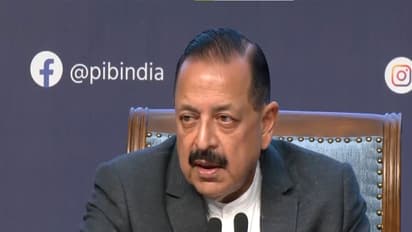
Union Minister Dr Jitendra Singh on Friday said that India's Reform Express is being driven by science, technology, and innovation, with technology acting as the central force behind governance, administration, and economic transformation.
Addressing a press conference, the Minister said that the country's future growth over the next two decades will be driven by innovation in sectors such as Space, oceans, biotechnology, clean energy, and advanced manufacturing.
The press conference was held in Delhi, bringing together the leadership of India's premier science ministries to highlight landmark initiatives and outcomes achieved during 2025. The briefing followed a comprehensive review of reforms and mission-mode programmes that underline the Government of India's sustained focus on science-led development since 2014.
The press conference was attended by senior scientific leadership, including Prof. A. K. Sood, Principal Scientific Adviser to the Government of India; Prof. Abhay Karandikar, Secretary, Department of Science & Technology; Dr. Rajesh S. Gokhale, Secretary, Department of Biotechnology; Dr. N. Kalaiselvi, Director General, CSIR; and M. Ravichandran, Secretary, Ministry of Earth Sciences.
Technology-Enabled Reforms
Highlighting the reform journey, Dr. Jitendra Singh said that every major reform undertaken by the Government today, across departments and ministries, is technology-enabled. He noted that this transformation has been possible due to the consistent prioritisation of science, technology, and innovation in national policymaking.
Referring to successive Independence Day addresses of the Prime Minister since 2014, the Minister said that each address has carried a strong scientific theme, reflecting the government's long-term intent and global vision.
Flagship Missions: Space and Oceans
The Minister underscored flagship missions such as Deep Ocean Mission and Gaganyaan, stating that India is preparing simultaneously for human spaceflight and deep-sea exploration. He said that while an Indian astronaut will venture into outer space, India will also send a human-occupied submersible to depths of up to 6,000 metres, marking a historic dual achievement in 2027.
Boosting Research and Innovation
A major highlight of the year, the Minister said, is the Research Development and Innovation (RDI) Fund of Rs 1 lakh crore, under which the government is directly supporting private sector R&D, an unprecedented step globally.
Complementing this, the Anusandhan National Research Foundation (ANRF) has been established to democratise research funding, expand participation beyond elite institutions and mobilise nearly 50-60% of its resources from non-government sources including philanthropy and industry.
Dr. Jitendra Singh also highlighted initiatives such as the National Quantum Mission, NIDHI, PRERNA / PURSE, and the VAIBHAV programme, aimed at strengthening startups, research infrastructure and global scientific collaboration, including structured engagement with the Indian scientific diaspora.
CSIR's 'Swadeshi' Innovations
Detailing CSIR's contributions, the Minister cited globally relevant innovations including steel-slag-based durable roads, indigenous paracetamol production, India's first indigenous antibiotic nafithromycin, sustainable food innovations such as millet-based products, and the HANSA-NG two-seater trainer aircraft developed under a PPP model.
He described these efforts as examples of "foreign markets accepting Swadeshi innovation".
Public outreach initiatives like One Day as a Scientist were also highlighted for fostering scientific temper among students.
Advances in Earth Sciences
On the Earth Sciences front, the Minister said India has made significant advances in weather forecasting through IMD's Nowcasting capability, enabling accurate three-hour predictions. He also highlighted the desalination plant in Lakshadweep as a global model for sustainable freshwater generation using ocean resources, alongside progress in ocean energy, marine observation systems, and climate resilience.
Future Outlook: A Top Global Economy
Concluding, Dr. Jitendra Singh said that India has moved from being an importer to an exporter of high-end technologies, including vaccines and medical devices, with India's bioeconomy emerging as a major growth driver. "The best is yet to come," he said, adding that science-led reforms will accelerate India's journey towards becoming a top global economy well before 2047. (ANI)
(Except for the headline, this story has not been edited by Asianet Newsable English staff and is published from a syndicated feed.)Stay updated with the Breaking News Today and Latest News from across India and around the world. Get real-time updates, in-depth analysis, and comprehensive coverage of India News, World News, Indian Defence News, Kerala News, and Karnataka News. From politics to current affairs, follow every major story as it unfolds. IMD cities weather forecastsRain Cyclone Asianet News Official App