Indian Army Taps Solar Power for Persistent Surveillance With Rs 168-Crore MAPSS Order
Synopsis
The Indian Army has placed a procurement order worth Rs 168 crore for the indigenous Medium Altitude Persistent Surveillance System (MAPSS) with Bengaluru-based NewSpace Research & Technologies, an iDEX-recognised startup.
The Indian Army has placed a procurement order worth Rs 168 crore for the indigenous Medium Altitude Persistent Surveillance System (MAPSS) with Bengaluru-based NewSpace Research & Technologies, an iDEX-recognised startup.
The contract is expected to provide a significant boost to the government’s flagship initiatives such as Make in India and Aatmanirbhar Bharat in the defence sector.
Highlighting the development, the Defence Innovation Organisation’s Innovations for Defence Excellence (iDEX) said in a post on X, “Major boost towards #MakeinIndia & #Aatmanirbharta in Defence. NewSpace Research & Technologies, an #iDEX startup, has secured a procurement order from the Indian Army for the indigenous #MAPSS (Medium Altitude Persistent Surveillance System) UAV, developed under #iDEX.”
What is MAPSS?
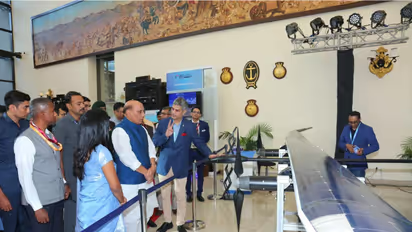
MAPSS is a solar-powered unmanned aerial vehicle designed for persistent surveillance missions. Unlike battery-powered or tethered drones that require frequent recharging or constant ground support, MAPSS harvests energy through onboard solar panels, enabling it to remain airborne for extended durations.
Built for persistence, the system allows continuous intelligence, surveillance and reconnaissance (ISR) operations with minimal logistical support. Its long-endurance capability enables round-the-clock monitoring without repeated landings or refuelling.
Derived from NewSpace Research & Technologies’ solar-powered High Altitude Pseudo Satellite (HAPS) programme, MAPSS prototypes have demonstrated impressive performance. The system has achieved endurance records, including flights exceeding 27 hours at altitudes above 26,000 feet, and another surpassing 24 hours under challenging operational conditions.
In addition to ISR, MAPSS is designed to deliver electronic intelligence (ELINT) and communications relay capabilities.
In 2024, the Indian Navy also signed a contract with NewSpace Research & Technologies to design and develop an indigenous High Altitude Pseudo Satellite (HAPS). The initiative aims to strengthen the Navy’s surveillance capabilities while reducing reliance on foreign technology.
HAPS are long-endurance unmanned aerial vehicles operating at altitudes significantly higher than conventional drones, offering satellite-like coverage for extended periods.
The Navy’s HAPS platform, also solar-powered, is expected to remain airborne for months -- far surpassing the endurance of traditional drones. This capability enables persistent monitoring of vast maritime regions, critical for safeguarding India’s extensive coastline and strategic interests in the Indo-Pacific region.
Stay updated with the Breaking News Today and Latest News from across India and around the world. Get real-time updates, in-depth analysis, and comprehensive coverage of India News, World News, Indian Defence News, Kerala News, and Karnataka News. From politics to current affairs, follow every major story as it unfolds. IMD cities weather forecastsRain Cyclone Asianet News Official App