Indian Army’s IBG Era Begins: Six Major Generals Lead New Warfighting Formations from July 1
Synopsis
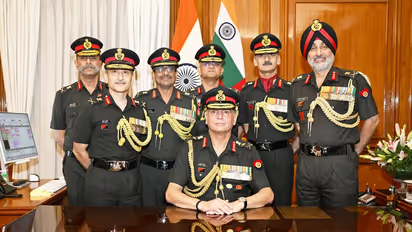
In one of the most significant structural reforms undertaken by the Indian Army in recent decades, six Major Generals have assumed command of five newly raised Integrated Battle Groups (IBGs) and one dedicated Fire Support Group (FSG) on July 1.
New Delhi: In one of the most significant structural reforms undertaken by the Indian Army in recent decades, six Major Generals have assumed command of five newly raised Integrated Battle Groups (IBGs) and one dedicated Fire Support Group (FSG) on July 1. The IBGs have been designed to deliver faster, leaner and more decisive military responses.
The move represents the first large-scale implementation of the Army’s long-discussed IBG concept, aimed at replacing cumbersome mobilisation procedures with integrated, mission-ready combat formations capable of responding to emerging threats at short notice.
A Trial Run, Not a Full Rollout
The entire exercise has been conceived as a pilot project, with 17 Mountain Strike Corps designated as the test-bed where the IBG and FSG model will be put through its paces under real operational conditions. The Army’s intent is to use this trial to validate the concept before committing to a wider transformation. The structure is expected to be extended to other Corps across the force.
What Makes an IBG Different?
The IBG concept has been on the Army’s drawing board for years, and this rollout is its first serious test in the field. Unlike a conventional division, which has to pull together infantry, armour, artillery and support units from scattered formations before it can fight, an IBG is built to be self-contained from day one.
Each one fuses infantry, mechanised forces, armour, artillery, engineers, air defence, signals and logistics into a single combined-arms package under one commander, so it can move and fight as a cohesive whole rather than being assembled piecemeal once a crisis breaks out.
A New Layer of Command: The Chief Operations Officer
A key institutional change accompanying the IBGs is the creation of the Chief Operations Officer (COO) appointment, to be held by a Brigadier in each formation. According to people familiar with the reorganisation, the COO is meant to act as the operational nerve centre of the formation – pulling together planning, intelligence, logistics, firepower and battlefield execution into one coordinated effort.
With the COO handling this day-to-day operational synchronisation, the Major General in command is freed up to focus on broader strategic and operational judgement calls, including during fast-moving situations in both peacetime and conflict.
Why the Army Wants a Shorter Chain of Command?
The underlying motivation is speed. In the existing setup, an operational decision often has to travel through several layers of headquarters before it translates into action on the ground. The IBG structure pushes more authority down to field commanders, cutting out intermediate steps so that tactical developments can be answered faster and combat power can be mobilised in a fraction of the time it currently takes.
The Fire Support Group’s Role
Standing apart from the five IBGs but raised alongside them, the new Fire Support Group has also been placed under a Major General. It brings long-range artillery, rocket systems, precision-strike capabilities and surveillance assets together under one roof, designed to deliver concentrated, on-demand firepower to combat formations as operations unfold, rather than leaving them to draw on dispersed fire assets.
Part of a Larger Transformation Drive
The IBG and FSG rollout sits within a broader modernisation effort that gathered momentum after the 2020 military standoff with China in eastern Ladakh. That episode pushed the Army to move faster on building agile formations, deepening jointness with the other services, integrating drones and loitering munitions into its operations, expanding network-centric warfare capabilities, and decentralising command.
Stay updated with the Breaking News Today and Latest News from across India and around the world. Get real-time updates, in-depth analysis, and comprehensive coverage of India News, World News, Indian Defence News, Kerala News, and Karnataka News. From politics to current affairs, follow every major story as it unfolds. IMD cities weather forecastsRain Cyclone Asianet News Official App