Rajnath Singh To Visit Vietnam, South Korea To Boost Defence Ties And Indo-Pacific Strategy
Synopsis
Defence Minister Rajnath Singh will visit Vietnam and South Korea from May 18 to strengthen defence cooperation. In Vietnam, talks on the BrahMos supersonic missile deal are at an advanced stage, valued at ₹5,800 crore. Vietnam could become the third BrahMos buyer. In South Korea, India will promote the new KIND-X defence innovation platform.
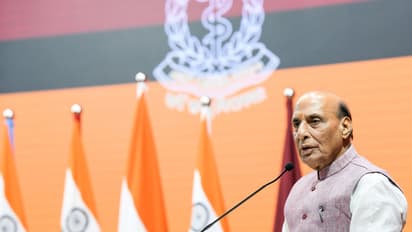
New Delhi: Defence Minister Rajnath Singh will be visiting to Vietnam and South Korea from May 18 in a push to deepen New Delhi’s strategic footprint across the Indo-Pacific.
The visit comes at a moment of quickening momentum on two fronts – a near-finalised supersonic cruise-missile deal with Hanoi, and the launch of a new bilateral defence innovation platform with Seoul.
Vietnam: BrahMos deal at advanced stage
The centrepiece of his Hanoi leg is the prospective sale of the BrahMos supersonic cruise missile system, jointly developed by India and Russia, which has been in active negotiation for several years. Talks have gathered speed following the Vietnamese president, To Lam’s, visit to New Delhi just days before the minister’s departure. Sources said that the negotiations are “at advanced negotiation stages,” with the prospective contract valued at approximately ₹5,800 crore.
If the deal concluded, Vietnam would become the third country to procure BrahMos, after the Philippines and Indonesia.
The Philippines signed a $375 million agreement in 2022, while Indonesia moved to finalize a deal worth at least $340 million earlier this year.
The BrahMos system, capable of travelling at nearly three times the speed of sound and striking targets up to 300 kilometres away in its standard export configuration, is one of India’s most sought-after defence exports.
For Vietnam – which has long-running territorial disputes with China in the South China Sea – the acquisition would represent a significant upgrade to its coastal-defence capabilities. Beyond missiles, India has offered technical cooperation covering the maintenance, repair, and modernization of Vietnamese military platforms, including Sukhoi Su-30 fighter aircraft and Kilo-class submarines – hardware originally acquired from Russia that India is well-positioned to service.
The offer fits within New Delhi’s broader strategy of converting defence sales into longer-term strategic partnerships.
South Korea: innovation accelerator and expanded co-production
In Seoul, the agenda shifts toward defence industrial collaboration and emerging technologies. The two governments used their summit on April 20, 2026, attended by the prime minister, Narendra Modi, and the South Korean president, Lee Jae Myung, to announce the Korea-India Defence Accelerator, known as KIND-X.
KIND-X is designed to connect defence companies, start-ups, incubators, investors, and universities from both countries, with the aim of co-developing technologies in areas such as unmanned systems, artificial intelligence, and advanced materials.
The initiative draws on the template established by the K9 Vajra self-propelled howitzer, which India and South Korea already co-manufacture under a technology-transfer arrangement, and seeks to replicate that model across a broader range of futuristic military systems.
South Korea has emerged as one of the world’s more aggressive arms exporters in recent years, with its defence industry securing deals worth tens of billions of dollars with Poland, Australia, and several other countries. For India, which is trying to build a robust domestic defence-manufacturing base under its “Atmanirbhar Bharat” (self-reliant India) policy, Seoul’s experience in scaling industrial production is a practical asset.
Stay updated with the Breaking News Today and Latest News from across India and around the world. Get real-time updates, in-depth analysis, and comprehensive coverage of India News, World News, Indian Defence News, Kerala News, and Karnataka News. From politics to current affairs, follow every major story as it unfolds. IMD cities weather forecastsRain Cyclone Asianet News Official App