India's 80th I-Day: Murmu's address, 'Vande Mataram' makes history
Synopsis
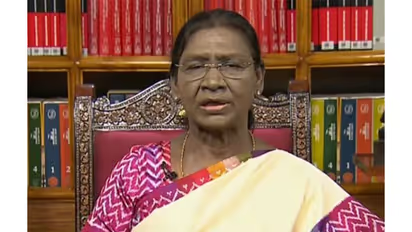
President Droupadi Murmu, in her 80th Independence Day eve address, laid out a roadmap for a developed India by 2047. The address made history with the first official playing of the full 'Vande Mataram' after its recent legal recognition.
As India stood on the threshold of its 80th Independence Day, President Droupadi Murmu on Friday delivered a message that brought together the memories of the freedom struggle, the aspirations of young India and the roadmap for a developed nation by 2047. From students facing examination challenges to soldiers guarding the nation's borders, the President's address reflected the spirit of a country moving forward with confidence and collective responsibility.
For the first time ever, the full version of "Vande Mataram" was played before and at the conclusion of the President Independence Day eve address, following its recent recognition of legal status at par with the national anthem "Jana Gana Mana". The rendition was followed by the national anthem, marking a historic moment in the official celebrations.
She began her address by extending greetings to the citizens. "On the eve of Independence Day, I would like to congratulate everyone. In a few hours, the auspicious commencement of the 80th year of the country's independence will take place," she said.
Honouring the Freedom Struggle
Addressing the nation, President Murmu highlighted the historic role of the national song in India's freedom movement. "During our freedom struggle, people with diverse ideologies were united by one common goal -- India's Independence. During the Swadeshi Movement, the song Vande Mataram became a song of the masses," she said.
Recalling the contributions of freedom fighters and social reformers, President Murmu said, "Countless Indians plunged themselves into our freedom struggle under the leadership of the Father of the Nation, Mahatma Gandhi. Babasaheb Dr Bhimrao Ambedkar embodied the highest ideals of social reform and patriotism." She paid homage to all those whose ideals guided India towards freedom and progress.
President Murmu's remarks came days after she gave assent to the Prevention of Insults to National Honour (Amendment) Bill, 2026, granting "Vande Mataram" the same legal protection as the national anthem. Under the amended law, deliberate disruption or prevention of the singing of the national song will attract penalties, including imprisonment, a fine, or both.
Focus on Youth and Examination Reforms
Placing students at the heart of India's development journey, President Murmu called for collective responsibility to protect their future amid concerns around public examinations and student aspirations. "Public examinations become gateways to the opportunities for our students," President Murmu said, stressing that the government was taking "comprehensive steps" to reform examination systems, curb unfair practices and make them "more transparent, more secure, and more trustworthy for the youth."
The President's remarks came against the backdrop of the recent student-led protests that demanded reforms following irregularities and paper leaks in competitive examinations. Protests were held at Jantar Mantar against the NEET-UG examination leak that led to the resignation of Dharmendra Pradhan as Union Education Minister. Students are also agitating in Jharkhand over "irregularities" in recruitment tests.
The President said the objectives of government reforms are to completely curb the use of unfair means in public examinations and make the examination system more secure and trustworthy for the youth. "Our students are the architects of India's future. Just as the government and society must remain united to ensure national security, everyone must contribute through joint and concerted efforts to safeguard the present and future of our students. Public examinations become gateways to opportunities for our students," she said.
"The Government is undertaking comprehensive steps to reform these examinations. The objectives of these reforms are to completely curb the use of unfair means in public examinations, make the examination system more transparent, more secure, and more trustworthy for the youth," she added.
Empowering Young Entrepreneurs
The President said that a wide range of new avenues are opening up for the youth through the Government's initiatives and emerging economic activities. She said India's demographic dividend was its greatest strength, with young people increasingly moving beyond the pursuit of jobs to entrepreneurship and job creation. The country's expanding start-up ecosystem, she said, reflected the talent and dedication of its youth. Major global enterprises were impressed by the talent of Indian youth and entrusted them with leadership roles, she added.
"Our younger generations strengthen my faith in India's bright and prosperous future," she said. "Many of our youth are embracing the culture of job creation as they pursue the path of self-employment. The participation of young entrepreneurs has led to the creation of a strong start-up ecosystem in our country. Major global enterprises are impressed by the talent and dedication of Indian youth and entrust them with leadership roles. Such young achievers have enhanced the reputation of India's youth power across the world," she said.
The Spirit of Independence and Nation-Building
In her address, President Murmu said the Tricolour remained the "symbol of our freedom" and reflected the pride of every Indian. Recalling August 15, 1947, she said freedom transformed every citizen into "an architect of the destiny of Independent India" and emphasised that the true meaning of independence lay in ensuring opportunities for every individual to realise their dreams.
Highlighting the role of citizens in nation-building, the President praised students, teachers, scientists, engineers, doctors, farmers, workers, entrepreneurs, artists, social workers and security personnel for contributing towards India's progress. She especially lauded the dedication of soldiers of the Armed Forces, Armed Police Forces and police personnel, saying their commitment strengthened the nation.
Remembering Partition and Unification
On the eve of Independence Day, President Murmu also remembered the victims of Partition during Vibhajan Vibheeshika Smriti Divas, observed on August 14. She paid tribute to the lakhs of Indians who lost their lives in communal violence and those forced to endure displacement and refugeehood. "Lakhs of people had to become refugees due to communal violence and endure the horrors of partition. Yet, they did not give up their identity," she said.
Recalling the challenge of integrating more than 550 princely states after independence, President Murmu paid homage to Sardar Vallabhbhai Patel, describing him as the "sculptor of the unity of modern India" for bringing together the diverse regions into the democratic framework of the country.
Roadmap to Viksit Bharat 2047
The President reiterated India's resolve to become a developed nation by 2047, the centenary year of independence. Guided by the principle of Antyodaya, she said the aim was to ensure that development reached every citizen. "Development and well-being of every Indian is the real objective of building Viksit Bharat," she said, urging citizens to work towards transforming independent India into a developed India.
She highlighted the achievements of the last decade, including poverty reduction, financial inclusion and welfare expansion. Referring to schemes such as Pradhan Mantri Jan Dhan Yojana, Ayushman Bharat and Kisan Samman Nidhi, she said millions of citizens had gained access to banking, healthcare and agricultural support.
Furthermore, President Murmu said India's growth story was being shaped by a balance between modernisation and cultural heritage. She noted that the country's ancient traditions, knowledge systems and values continued to provide strength while India advanced in science, technology and infrastructure. She highlighted India's digital transformation, saying the country had developed the world's largest digital infrastructure, with digital payments becoming common even among small rural shops and street vendors. "More than half of the world's real-time digital transactions take place in India," she said, describing the digital revolution as a partnership between citizens and the government.
Economic Progress and Sustainable Development
From highways and railways to waterways and airways, the President said India had witnessed an unprecedented expansion of infrastructure, creating employment opportunities, encouraging entrepreneurship and boosting investor confidence. Amid global conflicts and instability, President Murmu said India's economy continued to move forward as the fastest-growing major economy. She said initiatives like Atmanirbhar Bharat Abhiyan had strengthened economic progress and national security.
She also underlined India's commitment to environmental protection, saying the country had achieved several Sustainable Development Goals ahead of schedule and witnessed rapid growth in renewable energy.
India on the Global Stage
Calling peace, cooperation, dialogue and Vasudhaiva Kutumbakam the pillars of India's foreign policy, President Murmu said India was playing a leading role among countries of the Global South and advocating a rules-based international order with greater representation for nations at global platforms.
Celebrating Nari Shakti
President Murmu highlighted the growing participation of women across sectors - from agriculture and entrepreneurship to defence and leadership roles. She praised the achievements of women in education and sports, noting their contribution to India's success at international events. She specifically highlighted India's performance at the recently concluded Commonwealth Games in Glasgow, where women athletes won 8 of India's total tally of 13 gold medals, showcasing the rising strength of Nari Shakti in sports.
She said more than 10 crore women were members of Self Help Groups and that the target of creating 3 crore Lakhpati Didis had been achieved. President Murmu also referred to the Nari Shakti Vandan Adhiniyam, enacted in 2023, saying the move towards 33 per cent representation for women in legislatures would strengthen women's leadership in Indian democracy.
India's Youth: The Nation's Most Valuable Asset
With 65 per cent of India's population below the age of 35, President Murmu described youth as the country's "most valuable asset." She praised young innovators, entrepreneurs and start-up founders for creating solutions to challenges at the grassroots level. She highlighted India's expanding space ambitions, noting that a recent successful rocket launch was achieved by a young team with an average age of just 28 years.
Encouraging students and young people, she said that emerging economic opportunities were opening new pathways for success and called for greater focus on their physical and mental well-being.
Upholding National Security and Military Valour
Remembering India's military valour, President Murmu referred to Kargil Vijay Diwas and the completion of one year of Operation Sindoor, praising the Armed Forces for their precision and courage in countering terrorism. "That historic operation against terrorism demonstrated the capability of the Indian Armed Forces to act with precision," she said, adding that it sent a strong message to terrorists and their supporters.
President Murmu added the operation sent "a clear and firm message to terrorists and those who support them, that no matter where they hide, they will have to face the consequences of their actions." The President also described the suspension of the Indus Waters Treaty with the country that harbours terrorism as a decisive step in the national interest, especially for farmers. She also highlighted the government's efforts to eliminate Naxalism, saying areas once affected by violence were now witnessing development, sports and cultural activities.
The President paid tribute to India's soldiers and spoke about the importance of recognising bravery through gallantry awards. She said the courage and sacrifice of the Armed Forces remained a source of inspiration for the nation.
Highlighting India's rich heritage, she noted that 12 forts associated with the Maratha military tradition were included in the UNESCO World Heritage List, while Sarnath, the site of Bhagwan Buddha's first sermon, also received global recognition.
Concluding her address, President Murmu quoted Telugu writer Gurajada Apparao's message that a nation was not merely its land but its people. "Love your country, Foster goodness. A nation is not just its land; a nation is all its people," she said, calling upon citizens to dedicate themselves to the national mission of building a healthier, happier and prosperous India. With a message rooted in freedom, sacrifice, inclusion and progress, President Murmu's address reflected a vision of an India where every citizen becomes a partner in the journey towards Viksit Bharat.
(Except for the headline, this story has not been edited by Asianet Newsable English staff and is published from a syndicated feed.)Stay updated with the Breaking News Today and Latest News from across India and around the world. Get real-time updates, in-depth analysis, and comprehensive coverage of India News, World News, Indian Defence News, Kerala News, and Karnataka News. From politics to current affairs, follow every major story as it unfolds. IMD cities weather forecastsRain Cyclone Asianet News Official App