India’s BRICS Moment; Between Multipolarity and Fragmentation
Synopsis
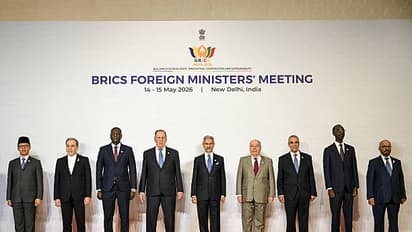
As India hosts the 2026 BRICS Foreign Ministers’ Meeting, it has found itself having to navigate through a grouping that has evolved more in the past two years than it did since its inception.
As India hosts the 2026 BRICS Foreign Ministers’ Meeting, it has found itself having to navigate through a grouping that has evolved more in the past two years than it did since its inception. It is a group that has become simultaneously more influential and more internally divided than at any point in its history. It began as a loose coalition of emerging economies seeking greater representation in global governance and it has now evolved into a far more politically complex platform which is also marred by geopolitical rivalries, international sanctions regimes, regional conflicts, and competing visions of the international order.
The challenge for India is to ensure that the true ethos of the grouping is salvaged and it still works as a platform for the global south instead of it slowly becoming an organisation that is ideologically polarised or just turns into a bandwagon the furthers foreign policy goals for China.
The timing of the summit could hardly be more significant. Intensifying hostilities in West Asia, growing uncertainty in energy markets, renewed debates over de-dollarisation, and increasing US-China competition have all come together to test the coherence of the expanded BRICS framework. The inclusion of new members such as Iran, the United Arab Emirates, Saudi Arabia, Egypt, Ethiopia, and Indonesia has undoubtedly added to not just the bloc’s geopolitical reach but also added to the dynamics within the groups. This expansion has imported regional rivalries directly into the organisation, as well as larger dynamics of bilateral relations between countries especially vis-à-vis China, which has made consensus-building significantly more difficult.
This reality is already detectable in discourse surrounding the ongoing conflict in West Asia. Iran is expected to push for harder language condemning actions of the US and Israel, while Gulf states are likely to prefer regulated diplomatic expressions that avoid further escalation. China and Russia would probably support more overtly anti-Western rhetoric, but India is unlikely to endorse such positioning.
India’s approach will instead be centred on familiar principles of dialogue, de-escalation, humanitarian concerns, respect for international law, and the protection of energy and maritime security. This calibrated position reflects India’s larger foreign policy doctrine of strategic multi-alignment. India has close strategic relations with the United States and Europe through technology transfers, Indo-Pacific cooperation, and investment flows, while simultaneously deepening engagement with Russia, Iran, the Gulf, and the broader Global South.
A second fault line emerges around the future direction that BRICS might adopt. China and Russia have progressively projected the grouping as a counterbalance to Western-led institutions and norms. India, however, has constantly resisted framing BRICS as an anti-Western coalition. New Delhi’s discomfort originates not only from its expanding ties with Washington and Europe, but also from unease regarding Chinese dominance within BRICS structures.
India’s concern on proposals surrounding a common BRICS currency or aggressive de-dollarisation is reflective of a broader strategic calculation. While India supports reducing susceptibilities within the global financial system and increasing trade in local currencies, it remains cautious of initiatives that could cause financial instability, expose members to sanctions risks, or inadvertently increase dependence on Chinese financial institutions.
Subsequently, India is likely to push for pragmatic rather than ideological economic cooperation. This includes strengthening the New Development Bank, promoting resilient supply chains, encouraging digital public infrastructure partnerships, and enhancing South-South development financing. Such targets align with India’s broader effort to position itself as a credible developmental leader of the Global South rather than merely a geopolitical balancing power.
Importantly, India’s presidency theme is focused on resilience, innovation, cooperation, and sustainability. It is indicative of an attempt to steer BRICS toward institution-building rather than bloc confrontation. India is keen to foreground issues such as climate resilience, technology governance, digital connectivity, energy security, and reforms in multilateral institutions including the United Nations Security Council, IMF, and World Bank. However, such underneath developmental themes lie a deeper strategic concern, which is the fragmentation within BRICS itself.
The grouping today contains countries with differing political systems, competing regional ambitions, and differing economic priorities. China and India remain strategic competitors notwithstanding the periodic diplomatic stabilization. Tensions remain unresolved between Iran and Gulf states which have only increased due to the ongoing conflict. Brazil and South Africa will prioritize economic development over geopolitical confrontation. Russia on the other hand, increasingly views BRICS through the lens of its confrontation with the West. These contradictions raise an important question about the coherence of platform.
India’s answer appears to be rooted in pragmatism. Rather than pursuing ideological consolidation, it is attempting to preserve BRICS as an extensive umbrella platform capable of accommodating diverse interests while avoiding overt polarization. In this sense, India’s presidency is less about transforming BRICS and more about stabilizing it during a period of geopolitical turbulence.
Whether that balancing act is sustained will depend not only on India’s diplomacy, but also on the future trajectory of the grouping. For now, however, India’s BRICS presidency highlights a central characteristic of contemporary Indian foreign policy which is the support for multipolarity without embracing polarization.
(Author is an Asst Professor at Amity Institute of Defence and Strategic Studies, and has a PhD in Latin American Studies from the Centre for Americas, Jawaharlal Nehru University)
Disclaimer: The opinions expressed are solely those of the author and do not reflect the views or stance of the organization. The organization assumes no responsibility for the content shared.
Stay updated with the Breaking News Today and Latest News from across India and around the world. Get real-time updates, in-depth analysis, and comprehensive coverage of India News, World News, Indian Defence News, Kerala News, and Karnataka News. From politics to current affairs, follow every major story as it unfolds. IMD cities weather forecastsRain Cyclone Asianet News Official App