IIT Guwahati Develops Innovative Four-in-One Yarn Winding Machine
Synopsis
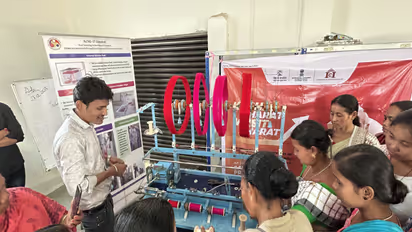
The Rural Technology Action Group at IIT Guwahati has developed a versatile four-in-one yarn winding machine designed to increase handloom productivity, reduce labor-intensive steps, and protect weavers from health issues caused by awkward postures.
IIT Guwahati Develops Innovative Yarn Winding Solution
The Rural Technology Action Group (RuTAG) at the Indian Institute of Technology (IIT) Guwahati has developed a four-in-one yarn winding machine to simplify the tiring steps of handloom weaving. Yarn winding is an essential preparatory step in handloom weaving. It involves transferring yarn from hanks, cones or other packages onto bobbins and pirns, so that it can be used smoothly in weaving. Proper winding ensures smooth yarn handling, which in turn leads to the production of quality fabric. Most traditional weaving households still carry out this task by hand, often using a manually operated charkha. So, for the handloom weavers, the machine has been tested at several weaving locations in Assam and Meghalaya.
The process is slow and labour-intensive, and depending on the working conditions, traditional methods may process only about 1-2 kg of yarn a day. The repetitive nature of the task can also lead to awkward postures, repeated movements and long working hours, which raise concerns about weavers’ health. To address these challenges, RuTAG IIT Guwahati has combined the four winding functions together in one single unit.
Features and Functions of the New Machine
The four winding operations of the machine are Hank-to-bobbin winding - Wind yarn from a hank onto a bobbin, Bobbin-to-pirn winding - Wind yarn from a bobbin onto a pirn for weaving, Doubling – Combine two or more yarn ends onto a single package, preparing them for twisting where required, Cone-to-bobbin winding - Wind yarn from a large cone onto smaller bobbins suitable for the next operation.
Commenting on the significance of the work, Prof. Sashindra K Kakoty, Coordinator, RuTAG IIT Guwahati, said, "Earlier we developed two winding machines, namely, Hank to Bobbin machine and Pirn winding machine. Then we realized that these winding operations are not necessarily be simultaneous, so, a single machine can serve both purposes. Also, we realized that doubling operations can also be incorporated in the same machine." He added, "Nowadays, yarns in the market are available in cone or reel form also; therefore, we decided to keep a provision for cone (or reel) to bobbin winding operation in the same machine. It is indeed necessary to increase productivity in the weaving sector, ensuring more profit. The weaver community can reap the benefits by using such a machine. Use of these machines reduces health risks like body pain etc. as awkward postures are not required to operate the machine. When this machine is targeted for handloom users, it can very well be used by power loom users to reduce the pre-processing time."
Impact on Traditional Weaving
The team received feedback on the convenience and efficiency of the winding machine from the weavers who took part in the trials. By simplifying yarn preparation and reducing the drudgery of manual winding, this technological intervention aims to improve the efficiency of this preparatory step while keeping traditional weaving practices intact. For a sector that supports rural livelihoods and traditional skills across the region, the machine offers a practical technological upgrade that fits the way weavers already work. Through this initiative, RuTAG IIT Guwahati seeks to promote appropriate technological interventions that respond to the real, everyday needs of traditional weavers and support the growth of the handloom sector. The commercialisation of the machine is in process at present. Nevertheless, interested weavers can contact RuTAG IITG for procurement and demonstration of the machine. The work is especially relevant for handloom and textile stakeholders, rural technology and livelihood programmes, and efforts to improve working conditions in traditional crafts.
Stay updated with the Breaking News Today and Latest News from across India and around the world. Get real-time updates, in-depth analysis, and comprehensive coverage of India News, World News, Indian Defence News, Kerala News, and Karnataka News. From politics to current affairs, follow every major story as it unfolds. IMD cities weather forecastsRain Cyclone Asianet News Official App