13 Years in Coma Ends: Harish Rana, India's First Person To Be Allowed Passive Euthanasia, Dies in AIIMS
Synopsis
Harish Rana, India’s first passive euthanasia case, dies after 13 years in coma. His case marks a legal milestone, reigniting debate on dignity, end-of-life care, and rights.
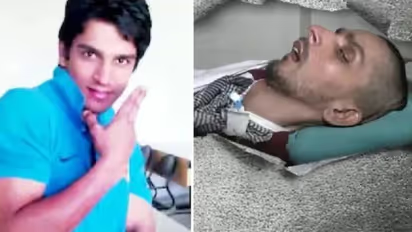
In a deeply emotional and legally significant moment for India, Harish Rana — the country’s first individual to be granted passive euthanasia — passed away on Tuesday at All India Institute of Medical Sciences, bringing an end to a 13-year-long battle between life, law, and dignity. He was 31.
A Life Suspended Since 2013
Harish’s story began with a tragic accident in 2013. Then a BTech student at Panjab University, he fell from a fourth-floor balcony, suffering severe head injuries that left him in a permanent coma.
For over a decade, his life was sustained through artificial nutrition and intermittent oxygen support. His condition never improved — doctors repeatedly confirmed there was no possibility of recovery.
Despite the odds, his family stayed by his side.
As the Supreme Court of India later observed, “His family never left his side.”
Landmark Judgment That Changed Everything
On March 11, in what is now being seen as a watershed moment in India’s legal and ethical landscape, the Supreme Court allowed passive euthanasia for Harish Rana — the first such case in the country.
The bench of Justices J B Pardiwala and K V Viswanathan ruled on the long-debated and emotionally charged issue, reinforcing the right to die with dignity under Article 21.
The court noted that Harish survived only through clinically administered nutrition via ‘percutaneous endoscopic gastrostomy’ tubes, and that medical boards had unanimously concluded that continuing treatment merely prolonged biological existence without any chance of recovery.
Crucially, the court stated: “When primary and secondary boards have certified withdrawal of life support, there is no need for judicial intervention.”
It also urged the Union government to consider framing comprehensive legislation on passive euthanasia.
A Family’s Painful but Selfless Decision
For Harish’s parents, Ashok and Nirmala Rana, the decision was never about relief — but about dignity.
After the judgment, the family had said that withdrawing life support would not bring them any personal benefit. Instead, they hoped the decision would help others in similar situations.
His father had said passive euthanasia would “restore Harish's dignity after years of irreversible suffering.”
Those words now carry even more weight.
Final Days at AIIMS
On March 14, Harish was moved from his home in Ghaziabad to the palliative care unit at AIIMS Delhi — specifically at the Dr BR Ambedkar Institute Rotary Cancer Hospital.
A specialised team led by Dr Seema Mishra, professor and head of anaesthesia and palliative medicine, was tasked with carrying out the process with utmost sensitivity.
Doctors from neurosurgery, onco-anaesthesia, psychiatry, and palliative care worked together to ensure a “tailored plan” — as directed by the court — so that dignity was maintained throughout.
His artificial nutritional support was gradually withdrawn over the following days.
He passed away peacefully on Tuesday.
Understanding Passive Euthanasia
Passive euthanasia involves allowing a patient to die by withholding or withdrawing life-sustaining treatment.
India’s legal position on the matter has evolved over time:
- In 2018, the Supreme Court recognised passive euthanasia and the right to die with dignity as a fundamental right.
- It allowed the use of “Advance Medical Directives.”
- In 2023, the guidelines were simplified, requiring approval from primary and secondary medical boards instead of lengthy legal procedures.
Harish Rana’s case marks the first real-world implementation of these principles.
Stay updated with the Breaking News Today and Latest News from across India and around the world. Get real-time updates, in-depth analysis, and comprehensive coverage of India News, World News, Indian Defence News, Kerala News, and Karnataka News. From politics to current affairs, follow every major story as it unfolds. IMD cities weather forecastsRain Cyclone Asianet News Official App