Gujarat's air ambulance service nears 100 missions since 2022 launch
Synopsis
Gujarat's 24x7 air ambulance service is nearing its 100-mission milestone since its 2022 launch. It has completed 98 flights, including 48 for patient transport and 50 for vital organ transport, providing rapid medical aid at subsidised rates.
In a significant initiative to strengthen emergency healthcare and ensure faster access to specialised medical treatment, the Gujarat Government’s dedicated 24×7 air ambulance service has completed 98 flight missions since its launch in 2022 and is approaching the milestone of 100 missions, according to a statement.
Under the leadership of Prime Minister Narendra Modi, the healthcare sector has been accorded priority to improve access to medical services for citizens across the country. The air ambulance initiative was undertaken under the leadership of Chief Minister Bhupendra Patel to provide rapid emergency medical transportation to patients.
Service Operations and Infrastructure
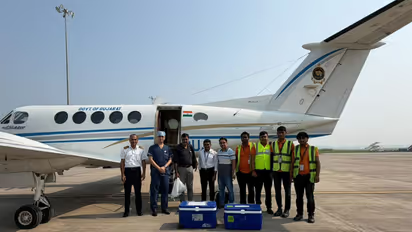
Of the 98 missions, 48 were undertaken for patient transportation, while 50 were dedicated to transporting vital human organs for transplantation. “The air ambulance service, operated by the Government of Gujarat through the Civil Aviation Department and Gujarat State Aviation Infrastructure Company Limited (GUJSAIL), provides air medical transportation at subsidised rates and is available to citizens across India. The initiative has emerged as an important component of the State’s emergency medical response infrastructure,” said Deputy Chief Minister Harsh Sanghavi, who also holds the Civil Aviation portfolio. The service operates a dedicated VT-GUJ, Beechcraft King Air B200 aircraft, which is available round the clock for air ambulance missions. Depending on the patient’s medical condition, the urgency of the case, the distance and the destination, the aircraft can be equipped with the required doctors, medical personnel, equipment and other support facilities, the release said.
Coordinated Emergency Response
The air ambulance service involves a coordinated chain of medical and aviation operations. 108 Emergency Services plays an important role in identifying cases requiring air ambulance support and initiating the process. Once a requirement is identified, it is referred to the GUJSAIL Flight Operations Department, which serves as the operational control point for the flight.
The Flight Operations Department coordinates aviation requirements and facilitates the patient’s transfer following arrival at the airport. The process involves coordination among medical personnel, aircraft crew, airport authorities, ground transportation teams and the receiving hospital, the release said.
Hospitals can also directly request the air ambulance service when a patient requires an urgent transfer to another medical facility. The objective is to ensure seamless medical transportation—from the hospital or point of origin to the airport, through the flight and onward to the receiving medical facility—so that critically ill patients can access appropriate medical care with minimum delay.
Operational Flexibility and Reach
An important feature of the Government’s air ambulance service is its operational flexibility. The aircraft can operate from a wide range of airports and suitable airstrips, including uncontrolled airstrips, subject to applicable operational, weather and safety requirements. This capability can be particularly valuable when a patient requiring specialised treatment is located far from a major metropolitan airport. The ability to operate from smaller airstrips can help bring air medical transportation closer to the patient’s location and reduce the distance travelled by road, the release said.
The air ambulance service complements the existing road ambulance network rather than replacing it. While road transportation remains appropriate in many situations, air transportation offers an additional and potentially faster option when distance, urgency or geographical conditions make it advantageous.
Patient and Organ Transportation Missions
Since 2022, the service has undertaken 48 patient transportation missions, enabling critically ill patients requiring urgent or specialised medical treatment to be transferred between locations in significantly less time than may otherwise be required by road, the release noted.
The service can support patients requiring specialised hospital care, advanced surgical intervention, critical care or other forms of specialised medical treatment. By reducing the time needed to reach an appropriate healthcare facility, the air ambulance can play a crucial role in emergency medical situations. Another significant component of the service is the transportation of vital human organs. Of the 98 missions completed since 2022, 50 were dedicated to organ transportation. Organ transplantation is highly time-sensitive, as transplant teams have a limited window within which an available organ must be transported and transplanted. By providing dedicated aviation support, the Government of Gujarat assists hospitals and transplant teams in transporting vital organs rapidly between locations.
Subsidised Rates and Accessibility
The Government of Gujarat provides the air ambulance service at subsidised rates. The subsidised charge is Rs 50,000 for a Gujarati patient, while the charge for a non-Gujarati patient is Rs 65,000. In cases where the service is booked by a hospital, the applicable charge is Rs 55,000, the release said. The service is available to citizens across India, making it a public-service initiative that extends beyond the State’s geographical boundaries.
A Collaborative Effort
The effectiveness of the air ambulance service depends on coordination among several departments, agencies and professionals. The Civil Aviation Department, GUJSAIL, Flight Operations personnel, pilots, medical professionals, 108 Emergency Services, hospitals, airport authorities and ground support teams all contribute to the successful completion of missions. (ANI)
(Except for the headline, this story has not been edited by Asianetnews Editorial staff and is published from a syndicated feed.)Stay updated with the Breaking News Today and Latest News from across India and around the world. Get real-time updates, in-depth analysis, and comprehensive coverage of India News, World News, Indian Defence News, Kerala News, and Karnataka News. From politics to current affairs, follow every major story as it unfolds. IMD cities weather forecastsRain Cyclone Asianet News Official App