Gujarat farmers embrace cow-based natural farming to cut costs, boost soil
Synopsis
With support from the ATMA Project, farmers in Gujarat's Dahod district are shifting to cow-based natural farming. This method reduces costs, improves soil health, and provides a sustainable income, with financial aid and training available.
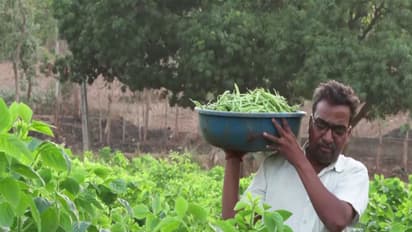
Farmers across Gujarat are increasingly adopting cow-based natural farming to reduce cultivation costs and improve soil health, supported by the Agricultural Technology Management Agency (ATMA) Project. In Dahod district, farmers such as Narendrabhai Hatila have been practising indigenous cow-based natural farming after receiving training under the ATMA Project. They use natural formulations like Jeevamrut and Ghan Jeevamrut, prepared from indigenous cow dung and urine, instead of chemical fertilisers. The practice has helped reduce input costs while improving soil fertility and promoting sustainable agriculture.
A Farmer's Perspective
Speaking to ANI, farmer Narendrabhai Hatila said natural farming requires minimal expenditure and is centred around indigenous cows. He said one indigenous cow can support natural farming on up to 30 acres of land. According to him, the practice not only restores soil fertility affected by excessive chemical fertiliser use but also benefits human health and the environment while significantly reducing farming expenses.
ATMA Project: Driving the Change
The Agriculture Department, through the ATMA Project, is promoting natural farming by providing farmers with training, technical guidance, model farms and financial assistance.
Taluka Project Manager of the ATMA Project, Chetan Kumar Rathod, said Narendrabhai has been associated with the project for the past seven years and has consistently practised natural farming. He said the farmer received district-level training and support through model farms. Rathod added that Narendrabhai's five-layer model farm includes horticultural crops, vegetables and fruit crops, and that he earns a good annual income through cow-based natural farming without using chemical fertilisers or pesticides.
Financial Assistance and Resource Centres
Technology Manager of the ATMA Project in Dahod, Ramsinh Chauhan, said farmers practising indigenous cow-based natural farming in Dhanpur Taluka receive financial assistance of ₹10,800 annually under the ATMA Project. He added that Bio-Resource Centres (BRCs) have also been established to ensure the local availability of natural formulations such as Jeevamrut, Ghan Jeevamrut, Agni Astra and Brahmastra. Under the Mission Cluster Scheme, financial assistance of ₹1 lakh is provided for establishing a BRC unit, while ₹60,000 is available under the Non-Mission category.
With lower input costs, improved soil health and better farm returns, cow-based natural farming is emerging as a sustainable and cost-effective model for enhancing farmers' incomes in Gujarat.
Stay updated with the Breaking News Today and Latest News from across India and around the world. Get real-time updates, in-depth analysis, and comprehensive coverage of India News, World News, Indian Defence News, Kerala News, and Karnataka News. From politics to current affairs, follow every major story as it unfolds. IMD cities weather forecastsRain Cyclone Asianet News Official App