Gujarat CM inaugurates 10th World Circular Economy Forum in Gandhinagar
Synopsis
Gujarat CM Bhupendra Patel inaugurated the 10th World Circular Economy Forum 2026 in Gandhinagar, a first for South Asia. The global event, with 2000+ delegates from 66 nations, focuses on circular business models and sustainable economic growth.
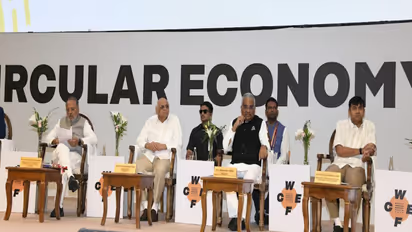
Gujarat Chief Minister Bhupendra Patel inaugurated the 10th edition of the prestigious World Circular Economy Forum (WCEF) 2026 at Mahatma Mandir, Gandhinagar, being held for the first time in South Asia. Union Minister for Environment Bhupender Yadav graced the occasion. Forests and Environment Minister Arjun Modhwadia and Minister of State Pravin Mali were also present.
According to the Gujarat Chief Minister's Office (CMO), more than 2,000 stakeholders, scientists, and entrepreneurs from 66 countries are participating in this global forum. The four-day forum, being held until September 18, 2026, will focus on reducing global emissions, promoting circular business models and accelerating sustainable economic growth. The forum will also strengthen the exchange of environment-friendly policies and technologies among South Asian countries.
On this occasion, CM Patel and Union Minister Bhupender Yadav formally inaugurated and visited the special ‘Circularity Expo’. The expo features more than 125 stalls showcasing green innovations, waste-to-wealth models and recycling technologies.
CM Patel Highlights Gujarat's Leadership and Traditions
CM Patel stated that a global exchange of ideas is beginning from the land of Gujarat one that will not only shape the future direction of the economy but also secure a better future for generations to come. CM said that the World Circular Economy Forum–2026 (WCEF) is being held in India for the first time. The participation of representatives from 66 countries, along with more than 200 international experts and 55 international speakers, highlights the global importance of the forum. He said this reflects India’s growing global leadership under the visionary leadership of Prime Minister Narendra Modi.
He said that under the guidance of the Prime Minister, Gujarat has taken several initiatives to balance development and the environment in areas such as industrial growth, renewable energy, waste and water management, and resource efficiency. WCEF–2026 will allow Gujarat to showcase its best practices globally and learn from successful practices around the world.
Somnath Temple: A Model of Circular Economy
Presenting the renowned pilgrimage site Somnath Temple as an excellent example of the circular economy, CM said that the Trust is undertaking several unique initiatives under the guidance of Prime Minister Shri Narendra Modi. Flowers, bilipatra, milk, water, panchamrut, clothes and other samagri (essentials)offered by devotees are not simply treated as waste and discarded. The sacred liquid generated during the abhishek is scientifically purified and made available to devotees as ‘Som-Ganga Jal’. Flowers, bilipatra, and organic waste generated at the temple and through the Trust’s activities are scientifically converted into manure. Plastic waste is used to make paver blocks, with local women from Sakhi Mandals trained and involved in the process.
CM further said that the circular economy has been part of India’s ancient traditions. Reuse and recycling have always been naturally integrated into our way of life. He added that the ‘Waste to Wealth’ approach and waste management models are also helping boost the rural economy. He added that in the changing global scenario, achieving Atmanirbharta in the energy sector is essential, and the circular economy can play an important role in strengthening it.
CM further stated that Prime Minister Narendra Modi firmly believes that development and the environment are not contradictory. We need growth along with greenery, industry along with ecology, and prosperity along with sustainability. He said this is the true spirit of WCEF–2026. CM expressed hope that the exchange of ideas on various topics during the four-day forum will inspire new thinking and provide a new direction for the welfare of the world. He expressed confidence that this forum will strengthen the spirit of ‘Vasudhaiva Kutumbakam’.
Union Minister Yadav Emphasises India's Sustainable Ethos
Welcoming all the delegates, Union Minister for Environment Bhupender Yadav said that the New Delhi Declaration of BRICS has reaffirmed the importance of the circular economy for economic resilience and sustainable development. He said that the circular economy is not limited to waste disposal or recycling, but is a comprehensive approach to making the entire life cycle of resources—including design, production, consumption, reuse, repair and remanufacturing—more efficient and sustainable.
The Union Minister further said that under the leadership of Prime Minister Narendra Modi, India has taken significant steps towards resource-efficient, sustainable and inclusive development by treating environmental protection and economic development as complementary, rather than contradictory. He said that the circular economy is not a new concept for India but has been an integral part of the country’s centuries-old lifestyle, culture and traditional values. Indian culture has long emphasised repairing, reusing and, wherever possible, remanufacturing products instead of simply discarding them after use.
The Union Minister said that what is now called the ‘circular economy’ in policymaking has long been a natural way of life in India, with the principle of “repair before replacing and reuse before it becomes waste.” He added that to integrate this traditional approach with modern systems, the Government of India has established a strong framework through legal reforms and digital systems. Under the Environment Protection Act, mechanisms such as Extended Producer Responsibility (EPR) have been introduced for waste management in sectors including plastic, e-waste, batteries, scrap metal, and construction and demolition waste.
Yadav added that the circular economy is not limited to any one country or sector; it is a global issue connected to the sustainable future of humanity. He said the real challenge is not to stop development, but to make it more resource-efficient, environment-friendly and sustainable. He added that the success of a circular economy should not be measured only by how much waste is recycled, but by how much waste is avoided, how many resources are reused, and how much is conserved for future generations.
Gujarat's Economic Potential in Circular Economy: Arjun Modhwadia
Forest and Environment Minister Arjun Modhwadia stated that India is emerging as a major opportunity in the field of circular economy. By 2050, India’s circular economy is expected to surpass USD 2 trillion in market value and generate nearly 1 crore jobs. He said that the circular economy is therefore not only important for protecting the environment and ecosystem but is also emerging as a major opportunity for economic growth and prosperity. He said that strengthening public participation and putting the principles of circularity into action to build a sustainable and resilient future is our shared responsibility.
Gujarat is the birthplace and karmabhoomi of Mahatma Gandhi. Recalling Mahatma Gandhi’s words, “The Earth provides enough to satisfy every man’s needs, but not every man’s greed,” he said that this message remains equally relevant even today. The Minister said that this vision has been embraced not only in Gujarat and India but across the world.
Prime Minister Shri Narendra Modi, during his tenure as Chief Minister of Gujarat, laid the foundation for the circular economy in the state. According to the release, Modhwadia said that 25 years of his public leadership in this field are being completed. Under the leadership of Chief Minister Bhupendra Patel, Gujarat is poised to emerge as a global hub for the circular economy. The state’s strong industrial ecosystem, world-class infrastructure, renewable energy potential, maritime connectivity and investor-friendly governance are its key strengths.
He further said that Gujarat has developed the country’s largest hazardous waste resource recovery system and a strong circular economy ecosystem. The state has 1,242 recycling facilities and 19 core processing units. Last year, around 63% of Gujarat’s waste was recycled. The state also has 41 e-waste recyclers and 12 refurbishers. The system is supported by registered producers and manufacturers, with regular audits of these facilities, the Minister added.
Global Collaboration and Perspectives
On this occasion, Marieke Spijkerboer, Deputy Director General of the Department of Economic Affairs and Climate Policy of the Netherlands, highlighted the importance of the circular economy. She said that sustainability policies have become increasingly important amid challenges such as climate change, heatwaves, geopolitical tensions, global trade risks and supply chain uncertainties. Rising consumption and production have also led to challenges such as waste, pollution and resource scarcity. In this situation, making the economy circular is the need of the hour. The Netherlands has been working towards a circular economy through its national programme since 2016 and aims to become fully circular by 2050. By 2035, it plans to reduce material consumption by 15%, increase the use of bio-based resources and secondary materials to at least 55%, and recycle at least 82% of its waste. Highlighting the importance of global collaboration, she said that more than 20 Dutch companies and organisations are participating in Gujarat and collaborating with the World Circular Economy Forum. She added that the World Circular Economy Forum–2026 should not leave us merely inspired by the discussions, but should inspire us to take action and drive meaningful transformation.
Ambassador of Finland Mikko Kivikoski highlighted the importance of the World Circular Economy Forum (WCEF) 2026. He said that this is the 10th edition of the global conference and is being held in India for the first time. He added that the forum is important for bringing the needs and solutions of the Global South and emerging economies to the centre of the circular economy. He added that the key message of the forum is that circularity should not be limited to recycling. Attention must be given from the very beginning to product design, material selection and retaining the value of resources. He said that the best waste is waste that is never generated in the first place. He stated that in March, Prime Minister Narendra Modi and President Alexander Stubb of Finland signed an MoU on environmental cooperation between the two countries, focusing on the circular economy, sustainable development and climate action.
Aligning with 'Viksit Bharat @ 2047'
Secretary of the Ministry of Environment, Forest and Climate Change, Government of India, Tanmay Kumar, in his welcome address, said that India is giving greater importance to the circular economy as a new dimension of development under ‘Viksit Bharat @ 2047’. He said the forum will strengthen efforts towards sustainable production and responsible consumption by promoting global collaboration, innovation and capacity building. He emphasised that the judicious use of natural resources is essential to realise the Prime Minister’s vision of ‘Mission LiFE’.
He stressed the need to move from the traditional linear model to a circular economy through the convergence of policy, technology and public participation, leading to sustainable and resource-efficient development.
The WCEF–2026 global forum is being organised jointly by the Union Ministry of Environment, Forest and Climate Change (MoEF&CC), Central Pollution Control Board (CPCB), Government of Gujarat, Gujarat Pollution Control Board (GPCB), Finnish Innovation Fund ‘Sitra’, and the Government of Finland.
A special short film highlighting the Government of India’s initiatives on the circular economy and Mission LiFE (Lifestyle for Environment), along with India’s global message, was screened during the event. Dignitaries also released important publications on the circular economy.
Gujarat Chief Secretary MK Das, Principal Secretary of the Forest and Environment Department Dr. Vinod Rao, GPCB Chairman RB Barad, senior officials from the Central and State Pollution Control Boards, and a large number of delegates from India and abroad were present at the inaugural ceremony. (ANI)
(Except for the headline, this story has not been edited by Asianetnews Editorial staff and is published from a syndicated feed.)Stay updated with the Breaking News Today and Latest News from across India and around the world. Get real-time updates, in-depth analysis, and comprehensive coverage of India News, World News, Indian Defence News, Kerala News, and Karnataka News. From politics to current affairs, follow every major story as it unfolds. IMD cities weather forecastsRain Cyclone Asianet News Official App