First BIMSTEC Health Ministers' Meeting Adopts Key Regional Statement
Synopsis
The First BIMSTEC Health Ministers' Meeting in Colombo adopted a joint statement to enhance regional health security, with India offering support in traditional medicine, digital health infrastructure, and bilateral medical aid.
Strengthening Regional Health Cooperation
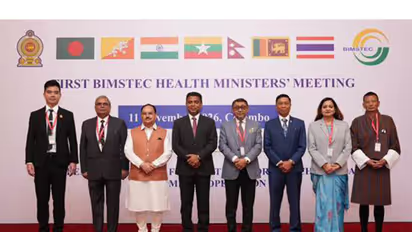
In a major step towards strengthening regional health cooperation, the First BIMSTEC Health Ministers’ Meeting held in Colombo, Sri Lanka, today unanimously adopted a Joint Ministerial Statement, reaffirming the collective commitment of member countries to advancing accessible, affordable and quality healthcare, strengthening regional health security and building resilient public health systems across the Bay of Bengal region. According to a press release, Union Minister of Health and Family Welfare and Minister of Chemicals and Fertilisers, Jagat Prakash Nadda, represented India at the historic meeting, highlighting the country's growing role in advancing regional health cooperation through knowledge-sharing, digital innovation, capacity building and collaborative action on common public health challenges.
The meeting also adopted the Revised BIMSTEC Plan of Action on Public Health (2026–2030), providing a structured roadmap for cooperation in disease surveillance, pandemic preparedness, digital health, traditional medicine, One Health and healthcare workforce development. India's engagement at the meeting was further marked by significant bilateral initiatives with Sri Lanka, including the exchange of a Memorandum of Understanding (MoU) for the supply of 100 additional fully-equipped ambulances and the announcement of support for 50 Medical Kiosks/Health ATMs to strengthen primary healthcare services. Nadda also held bilateral discussions with Nepal's Health Minister and interacted with the Indian diaspora in Colombo, reaffirming India's commitment to strengthening its longstanding partnerships in the region.
Landmark Cooperation and Priorities
Addressing the inaugural meeting, Nadda described the occasion as a landmark in regional cooperation, following the decision taken at the Sixth BIMSTEC Summit in Bangkok in April 2025 to establish a dedicated mechanism for cooperation among Health Ministers of member countries. He emphasised that BIMSTEC countries share both a collective responsibility and a significant opportunity to strengthen healthcare systems, improve access to quality health services and enhance preparedness against emerging health challenges.
The unanimously adopted Joint Ministerial Statement underscores the commitment of member countries to Universal Health Coverage and Sustainable Development Goal 3, while identifying key priorities for coordinated regional action. The Statement provides a forward-looking framework for strengthening disease surveillance, emergency preparedness, early warning systems, antimicrobial resistance management, digital healthcare, traditional medicine, climate-related health responses and capacity building. It also envisages exploring a BIMSTEC Digital Health Framework to promote telemedicine, interoperable electronic health records and the use of Artificial Intelligence in diagnostics and disease modelling.
Regional Initiatives and Centres of Excellence
The meeting welcomed regional initiatives, including the proposed BIMSTEC Regional Centre of Excellence for Public Health in Sri Lanka, the establishment of the BIMSTEC Centre of Excellence on Tropical Medicine in Thailand, and India's initiative to establish a Centre of Excellence in Traditional Medicine. The Joint Ministerial Statement also welcomed Bangladesh's proposal for a Regional Zoonotic Disease Observatory and Early Warning System and underscored the importance of strengthening coordinated preparedness against cross-border health threats.
India's Healthcare Roadmap
Highlighting India's progress towards Universal Health Coverage under the leadership of Prime Minister Narendra Modi, Nadda outlined the country's comprehensive approach to healthcare, combining expanded primary healthcare services, financial protection, modern public health infrastructure and digital innovation. He informed the gathering that India has established over 1.85 lakh Ayushman Arogya Mandirs, bringing comprehensive primary healthcare services closer to communities and improving access to preventive, promotive and essential healthcare. The Minister also highlighted Ayushman Bharat Pradhan Mantri Jan Arogya Yojana (AB PM-JAY), one of the world's largest publicly funded health assurance schemes, providing annual cashless hospitalisation coverage of up to ₹5 lakh per eligible family and covering over 60 crore people.
Referring to the Pradhan Mantri Ayushman Bharat Health Infrastructure Mission (PM-ABHIM), he underscored India's investments in strengthening public health infrastructure, disease surveillance, diagnostic capabilities and preparedness for future health emergencies. Nadda also highlighted the transformative role of technology in expanding healthcare access, noting that India's National Telemedicine Service, eSanjeevani, has crossed 50 crore teleconsultations. He outlined India's experience under the Ayushman Bharat Digital Mission (ABDM) in building an interoperable digital health ecosystem to improve healthcare accessibility, efficiency and continuity of care.
Traditional Medicine and One Health
Reaffirming India's commitment to regional cooperation, Nadda offered to share the country's experience, technical expertise and best practices with BIMSTEC Member States, particularly in primary healthcare, digital health systems and public health infrastructure. In a significant initiative to deepen regional cooperation in traditional medicine, Nadda announced India's commitment to hosting the BIMSTEC Centre of Excellence in Traditional Medicine at the Institute of Teaching and Research in Ayurveda (ITRA), Jamnagar, Gujarat. The Centre is envisaged as a regional platform for collaborative research, academic exchanges, institutional partnerships, capacity building and the sharing of traditional medicine knowledge and best practices. It will also promote evidence-informed approaches, quality and safety standards, and the responsible preservation of traditional knowledge.
Underscoring the importance of collective preparedness, Nadda called for greater regional cooperation under the One Health approach. He highlighted that the approach aligns with Prime Minister Narendra Modi's vision of “One Earth, One Family, One Future”, rooted in India's ancient philosophy of Vasudhaiva Kutumbakam, representing India's long-held integrated approach to global health, sustainability and collaborative governance. The Minister emphasised that One Health is a shared responsibility and early detection, timely information-sharing and coordinated action are essential to preventing disease outbreaks and safeguarding public health.
Bilateral Engagements in Colombo
On the sidelines of the BIMSTEC meeting, JP Nadda held a high-level bilateral meeting with Sri Lanka's Minister of Health and Mass Media, Dr. Nalinda Jayatissa, to review ongoing health initiatives and explore opportunities for further strengthening cooperation between the two countries. In a significant outcome of the meeting, the two Ministers witnessed the exchange of an MoU for the supply of 100 additional fully-equipped ambulances to Sri Lanka's 1990 Suwa Seriya Emergency Ambulance Service. The initiative will be supported through Indian grant assistance of SLR 1,725.73 million (approximately USD 5.28 million) and is expected to further strengthen emergency medical response capabilities, improve operational efficiency and facilitate timely access to emergency healthcare services across Sri Lanka.
Further strengthening bilateral healthcare cooperation, Nadda announced India's support for the procurement of 50 Medical Kiosks/Health ATMs to enhance primary healthcare delivery in Sri Lanka. The initiative, involving Indian grant assistance of up to SLR 225 million, forms part of the USD 450 million comprehensive rehabilitation package announced by the Government of India following Cyclone Ditwah, which affected Sri Lanka during November–December 2025. The Medical Kiosks will be deployed at Sri Lanka's Arogya Primary Health Centres to provide point-of-care diagnostic services integrated with telemedicine facilities.
Nadda also held a bilateral meeting with Nepal's Minister for Health and Food Safety, Neesha Mehta, on the sidelines of the First BIMSTEC Health Ministers’ Meeting. The two Ministers held fruitful discussions on deepening bilateral and regional health cooperation, sharing expertise and best practices, and improving access to affordable, accessible and quality healthcare. The meeting reaffirmed the deep-rooted historical, cultural and people-to-people ties between India and Nepal, which continue to provide a strong foundation for cooperation in healthcare and development. Guided by Prime Minister Narendra Modi's Neighbourhood First policy, India reiterated its commitment to working closely with Nepal to strengthen healthcare partnerships, promote improved health outcomes and advance shared regional prosperity.
During his visit, Nadda also interacted with members of the Indian diaspora in Colombo, acknowledging their invaluable contribution to strengthening the longstanding friendship and people-to-people ties between India and Sri Lanka. The First BIMSTEC Health Ministers’ Meeting brought together Health Ministers and senior representatives from Bangladesh, Bhutan, India, Myanmar, Nepal, Sri Lanka and Thailand. The meeting was chaired by Sri Lanka's Minister of Health and Mass Media, Nalinda Jayatissa. The unanimously adopted Joint Ministerial Statement reaffirmed the decision to convene BIMSTEC Health Ministers’ Meetings and Senior Officials’ Meetings every two years, ensuring sustained engagement and follow-up on agreed regional priorities. Thailand's offer to host the Second BIMSTEC Health Ministers’ Meeting in 2028 was also welcomed.
Concluding his address, Nadda expressed appreciation to the Government of Sri Lanka for hosting the historic meeting and reaffirmed India's commitment to building a healthier, safer and more resilient BIMSTEC region. He emphasised that “No country should be left behind in its pursuit of better health outcomes.” The unanimous adoption of the Joint Ministerial Statement, the advancement of a common regional public health roadmap, India's commitment to hosting the Centre of Excellence in Traditional Medicine, and the significant bilateral healthcare initiatives with Sri Lanka and Nepal mark an important step towards strengthening regional health security and deepening India's healthcare partnerships.
(Except for the headline, this story has not been edited by Asianetnews Editorial staff and is published from a syndicated feed.)Stay updated with the Breaking News Today and Latest News from across India and around the world. Get real-time updates, in-depth analysis, and comprehensive coverage of India News, World News, Indian Defence News, Kerala News, and Karnataka News. From politics to current affairs, follow every major story as it unfolds. IMD cities weather forecastsRain Cyclone Asianet News Official App