Explained: How Rahul Gandhi Accessed Gen Naravane’s Unpublished Memoir
Synopsis
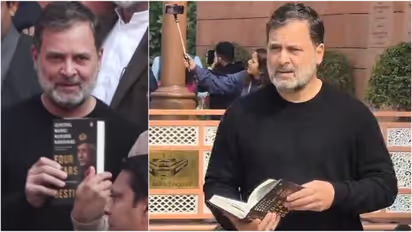
General M.M. Naravane’s unpublished memoir Four Stars of Destiny, reportedly detailing the 2020 India-China standoff, has triggered political tension after the Defence Ministry blocked its release citing national security concerns.
In early February 2026, Indian Parliament witnessed one of its most dramatic and unusual confrontations in recent years — not over a bill or budget, but over an unpublished military memoir. The book in question, Four Stars of Destiny, authored by former Chief of Army Staff General Manoj Mukund Naravane (Retd), has sparked political tension, legal questions and public debate about transparency, national security and the boundaries of parliamentary discourse.
General Naravane’s memoir was originally slated for publication by Penguin Random House India in early 2024, with advance listings and pre-orders appearing on major online retailers such as Amazon and Flipkart. However, the launch never materialised — and Four Stars of Destiny remains unpublished as of 2026. Reports indicate that the Defence Ministry has withheld formal clearance for the manuscript, a mandatory step for books by retired senior officers that contain sensitive defence or operational details.

What the Book Is About
While the full text has not been released, excerpts and reporting suggest Four Stars of Destiny contains General Naravane’s reflections on key episodes of India’s recent military history, including the tense 2020 standoff with Chinese troops in eastern Ladakh — a confrontation that brought Indian and Chinese forces to the brink of escalation along the Line of Actual Control (LAC). These passages reportedly touch on strategic decisions made at the highest levels during a period of heightened geopolitical stress, including discussions between military commanders and policymakers.
The controversy deepened when opposition leader Rahul Gandhi attempted to quote passages from the unpublished book during a Lok Sabha debate in early February. Gandhi insisted that his intention was to raise important defence and national security questions, claiming that Naravane’s perspective deserved to be heard in Parliament. However, the Speaker of the House, citing procedural rules, disallowed him from reading unpublished material during proceedings.
Procedural Rules and Parliamentary Uproar
Two key parliamentary rules — Rule 349(i) and Rule 353 — became focal points in the dispute:
Rule 349(i) restricts members from reading out books, newspapers or letters in the House unless directly relevant to business and properly authenticated.
Rule 353 prohibits defamatory or incriminatory allegations against individuals without prior notice, compelling members to provide advance written notice to both the Speaker and the person concerned.
Using these rules, the Speaker and defence ministers maintained that members could not quote from an unpublished manuscript that has not cleared security vetting or been made publicly available — a position that the Treasury benches argued was necessary to avoid spreading unverified assertions and compromising sensitive military matters.
Opposition leaders countered that refusing to even discuss parts of the memoir was tantamount to restricting democratic debate and hiding crucial insights into how the government handled the 2020 border crisis. The ensuing clash led to a heated back-and-forth, and at times to the adjournment of the Lok Sabha amid shouts from both sides.
Why the Memoir Is Still Unpublished
Under Indian defence protocol, retired military officers who have had access to classified information — particularly relating to defence operations, intelligence or international engagements — are required to seek prior clearance from the Ministry of Defence before publishing accounts that touch on those topics. This vetting process, designed to protect national security interests, involves reviews by relevant military directorates such as the Additional Directorate General of Strategic Communication.
According to an RTI reply cited by The Indian Express, Four Stars of Destiny stands out among books submitted to the Ministry in recent years: it is the only book still pending clearance, despite dozens of other military manuscripts having been approved and published since 2020.
General Naravane himself has publicly commented that his role was limited to writing the manuscript and handing it over to the publisher, and that obtaining the necessary permissions from the Defence Ministry was the responsibility of Penguin Random House. He noted that the book has been “under review” for more than a year, and that both publisher and ministry have been in ongoing contact about the process.
Political and Public Reactions
The book’s stalled publication has triggered divergent reactions across India’s political spectrum. Opposition leaders argue that the government’s reluctance to clear the memoir reflects a broader issue of accountability, suggesting that the insights of a former Army chief into matters such as the Galwan incident and other defence controversies should be part of public record.
Supporters of the government, on the other hand, maintain that national security considerations must take precedence, and that parliamentary rules are being applied correctly to prevent the dissemination of unverified or sensitive information. Some government figures have also leveraged the incident to highlight other historical defence publications that were cleared and published without issue, pointing out that clearance depends on content rather than the author’s rank.
Broader Implications
Beyond the immediate parliamentary clash, the Naravane memoir row brings into focus several broader themes:
• The balance between transparency and security in a vibrant democracy.
• The role of retired military officials in public discourse.
• The extent to which Parliament should be able to reference unpublished material in debates.
• The public’s appetite for insider accounts of major strategic events like the India-China border standoff.
Irrespective of whether Four Stars of Destiny eventually clears the necessary vetting and reaches bookshelves, it has already carved out a significant place in India’s political narrative — prompting questions about institutional process, freedom of expression, and the mechanisms that govern the dissemination of defence-related information in the public domain.
Stay updated with the Breaking News Today and Latest News from across India and around the world. Get real-time updates, in-depth analysis, and comprehensive coverage of India News, World News, Indian Defence News, Kerala News, and Karnataka News. From politics to current affairs, follow every major story as it unfolds. IMD cities weather forecastsRain Cyclone Asianet News Official App