Delhi Weather Update: AQI Stays ‘Poor’, Minimum Temperature Recorded At 19°C
Synopsis
According to the Air Quality Early Warning System, Delhi's air quality will likely remain poor until October 25.
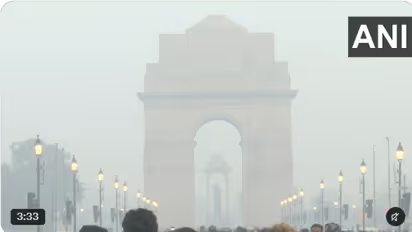
Delhi's air quality remained bad, with a low temperature of 19°C on Friday. The air quality index (AQI) was at 223 (8 a.m.). Of 57 air quality monitoring sites, 19 had moderate air quality, while the rest were in the bad category. An AQI between 201 and 300 is considered as poor by the Central Pollution Control Board.
The air quality result comes amid a yearly worsening in pollution levels as winter approaches and climatic conditions promote pollutant buildup. According to the Air Quality Early Warning System, Delhi's air quality will likely stay bad till October 25. The forecast over the next six days also suggests that the city is unlikely to experience a quick turnaround.
According to India Meteorological Department (IMD) statistics, Safdarjung, Delhi's base meteorological station, reported a low of 19 degrees Celsius, 1.8 degrees above the seasonal normal. The low temperature at the Ridge station was 19.2 degrees Celsius, 0.7 degrees above average.
Lodi Road reported a low temperature of 18.6°C, 2.6°C above average, while Ayanagar recorded 19.1°C, 1.9°C above normal. Palam had the lowest minimum temperature of the five stations, at 18.3°C, 0.5°C above average.
The highest temperature on Thursday was 32.5°C at Safdarjung, 32.4°C at Lodi Road, 31.7°C in Ayanagar, 31.5°C at the Ridge, and 29.9°C at Palam.
No rain fell at any of the five weather stations during the 24-hour period that ended at 8:30 a.m. on Friday.
Stubble burning data
According to the Decision Support System for Air Quality Management in Delhi, designed by the Indian Institute of Tropical Meteorology (IITM) in Pune, stubble burning contributed an estimated 7.4% of Delhi's PM2.5 on Thursday. Its contribution increased to 15.9% on Friday.
On Thursday, satellite monitoring revealed 114 paddy residue-burning incidents in six states: 36 in Punjab, 1 in Haryana, 3 in Uttar Pradesh, 56 in Rajasthan, 11 in Uttarakhand, and 7 in Madhya Pradesh. No fires were observed in Delhi.
Between September 15 and October 22, satellites identified 1,507 agricultural waste burning occurrences in six states and Delhi. Punjab hosted 510 events, followed by Madhya Pradesh (400), Rajasthan (308), Uttar Pradesh (193), Uttarakhand (83), Haryana (12), and Delhi (1).
Transport is the greatest contributor.
According to the Decision Support System, the transport sector contributed the most to Delhi's pollution, accounting for 17.32% of the estimated concentration, followed by other sources at 17.28%.
Stay updated with the Breaking News Today and Latest News from across India and around the world. Get real-time updates, in-depth analysis, and comprehensive coverage of India News, World News, Indian Defence News, Kerala News, and Karnataka News. From politics to current affairs, follow every major story as it unfolds. IMD cities weather forecastsRain Cyclone Asianet News Official App