Delhi's Navjeevan Vihar turns garbage into resource with zero waste model
Synopsis
Over 280 families in south Delhi's Navjeevan Vihar have adopted a "zero waste to landfill" model. The community-led initiative involves segregating wet and dry waste, converting kitchen waste into compost, and recycling dry materials.
Zero Waste to Landfill: A Delhi Colony's Success Story
What if the waste generated by a household never had to reach a landfill? In south Delhi's Navjeevan Vihar, more than 280 families are showing that with simple habits, community participation and smart waste management, garbage can be turned into a resource rather than a burden.
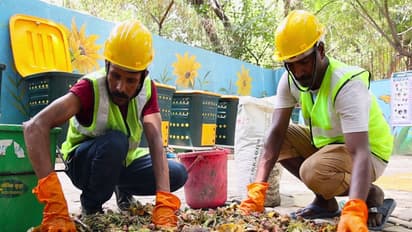
The colony has adopted a "zero waste to landfill" model in which residents segregate wet and dry waste at source. Kitchen waste, including vegetable and fruit peels, is converted into compost within the colony and used for gardening, while dry waste such as plastic is sent for recycling.
For the Banerjee family, waste segregation has become part of everyday life. Resident Gopa Banerjee says separating waste at source is essential for protecting the environment. "When wet and non-biodegradable waste are mixed, they can cause environmental harm. Segregated wet waste can turn into compost, while dry waste can be recycled."
Community and Technology Drive Success
The community-led initiative has been driven by Dr Ruby Makhija, Secretary of the Navjeevan Vihar Resident Welfare Association (RWA). Under the model, segregated waste from individual homes is collected and taken to dedicated processing and recycling facilities, ensuring that waste generated by the colony does not end up in a landfill.
Makhija says the objective is not to eliminate waste generation altogether, but to ensure that it does not become part of landfill waste mountains. "The real concept is zero waste to landfill. We must reduce the waste we generate, use it responsibly and ensure that nothing reaches the landfill unnecessarily."
The colony has also introduced a QR code-based waste collection system. Residents can alert the collection team through the system, allowing sanitation workers to receive the request and collect the waste promptly.
Youth Ensure Lasting Change
Young residents are playing an increasingly important role in sustaining the initiative. Over the past three years, several youngsters have joined the campaign, focusing not just on awareness but on encouraging lasting behavioural change.
Student Bhavuk, who is part of the initiative, says young people have a crucial role in driving sustainable practices. "Our aim is not just to create awareness, but to bring positive behavioural change. As Gen Z, we should not wait for change--we should become the change."
Navjeevan Vihar's experience demonstrates how household-level segregation, community participation and technology can combine to create an effective waste-management system. As India pushes towards cleaner cities and a more circular economy, the colony offers a simple lesson: when waste is segregated, processed and reused responsibly, what was once considered garbage can become a valuable resource.
(Except for the headline, this story has not been edited by Asianetnews Editorial staff and is published from a syndicated feed.)Stay updated with the Breaking News Today and Latest News from across India and around the world. Get real-time updates, in-depth analysis, and comprehensive coverage of India News, World News, Indian Defence News, Kerala News, and Karnataka News. From politics to current affairs, follow every major story as it unfolds. IMD cities weather forecastsRain Cyclone Asianet News Official App