Delhi Government Accelerates Yamuna Cleanup With 43 Sewerage Projects Worth Rs 8,941 Crore
Synopsis
Delhi has launched a major push to clean the Yamuna, with 43 sewerage and water purification projects worth ₹8,941.22 crore aimed at improving sewage treatment, expanding networks and strengthening water supply.
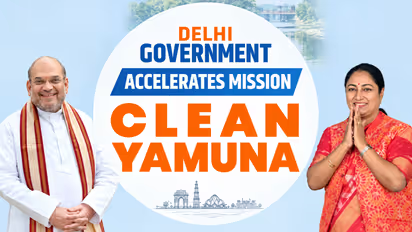
The government has taken major steps to strengthen Delhi's sewerage system and clean the Yamuna River. Union Home and Cooperation Minister Amit Shah inaugurated 43 sewerage and water purification projects and laid the foundation stone for several others in Shyam Nagar Phase 1. The total cost of these projects is estimated to exceed ₹8,941 crore.
On this occasion, Delhi Chief Minister Rekha Gupta stated that the government has expedited several important projects related to sewerage management and water purification. These include 29 decentralized sewage treatment plant (STP) projects, upgrading existing STPs, providing household sewer connections, and expanding the sewer network. The government is focused on developing a system to prevent sewage water from entering the Yamuna without proper treatment. The Chief Minister also reiterated her commitment to cleaning the Yamuna and maintaining its uninterrupted flow.
Complete details of 43 projects in Delhi: 10 inaugurated, 33 laid the foundation stone The total estimated cost of these 43 Delhi Jal Board projects is ₹8,941.22 crore. This includes the inauguration of 10 projects worth ₹2,827.11 crore and the foundation stone laying of 33 projects worth ₹6,114.11 crore. This plan is not limited to launching new projects, but also focuses on improving existing water and sewerage infrastructure.
The major parts of the projects are as follows:
New Sewage Treatment Plant at Okhla: A 124 MGD capacity STP will be built at a cost of around Rs 1,161 crore.
Upgrading existing STPs: Approximately ₹1,041 crore will be spent to upgrade eight sewage treatment plants, increasing their combined capacity from 78.2 MGD to 140.8 MGD.
29 decentralised STPs and pumping stations: These facilities will be developed in outer Delhi at a cost of around Rs 3,113.67 crore.
Expansion of Sewer Network: There is a plan to develop a 1,034 km long sewer network at a cost of about Rs 1,691 crore.
Water purification plant at Chandrawal: A 477 MLD capacity plant will be built at a cost of about Rs 298.3 crore.
29 new STPs will benefit 358 colonies and 113 villages
The proposed 29 decentralized sewage treatment plants and sewage pumping stations in outer Delhi are a key part of this plan. They aim to provide sewerage services to 358 unauthorized colonies and 113 villages. According to the government, this could benefit approximately 36.29 lakh people. The advantage of decentralized STPs is that where large sewage treatment plants are not feasible, sewage can be treated locally. This can help address deficiencies in the sewer network and manage wastewater. There are many colonies and areas in Delhi where, due to the lack of a sewerage network, wastewater reaches drains. Developing sewer connections and treatment systems in such areas is essential to reduce pollution in the Yamuna.
Chandrawal water plant can provide relief to 22 lakh people
Trunk Drain in Mundka: A 4.5 kilometre long drain will be constructed at a cost of approximately Rs 225 crore.
The plan includes not only sewerage but also drinking water infrastructure. A 477 MLD water treatment plant will be developed in Chandrawal. Its cost is estimated to be around ₹298.3 crore. The project aims to replace the old water treatment infrastructure and meet the needs of approximately 2.2 million people. This initiative is also important because with the growing population in Delhi, water demand and distribution systems are under pressure. Increasing water treatment capacity can help strengthen the supply system. However, the actual benefits will depend on the completion and operation of the project.
To clean the Yamuna, emphasis should be laid on preventing sewage from reaching the river.
The Yamuna pollution problem in Delhi has been a long-standing issue. Cleaning the ghats alone is not enough to stop the flow of sewage into the river. Collecting sewage, properly treating it, and addressing deficiencies in the sewer network are essential. Chief Minister Rekha Gupta has expressed her commitment to clean the Yamuna and maintain its uninterrupted flow through projects. The primary objective of the Delhi government's plan is to develop the sewerage infrastructure to prevent untreated sewage from entering the river through drains.
The impact of these projects will depend on how quickly sewer connections are provided, whether the STPs operate according to prescribed standards, and how the entire network is maintained. According to the Delhi government, all related work is expected to take approximately two to two and a half years to complete. The goal is to prevent untreated sewage from flowing into drains and, through them, into the Yamuna.
Stay updated with the Breaking News Today and Latest News from across India and around the world. Get real-time updates, in-depth analysis, and comprehensive coverage of India News, World News, Indian Defence News, Kerala News, and Karnataka News. From politics to current affairs, follow every major story as it unfolds. IMD cities weather forecastsRain Cyclone Asianet News Official App